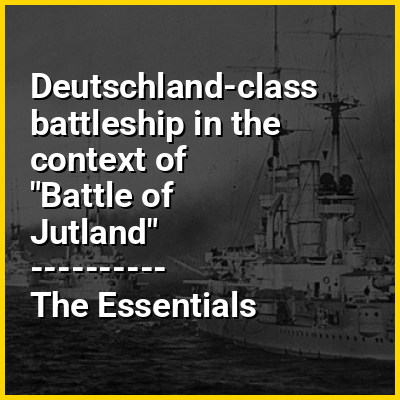
Deutschland-class battleship in the context of "Battle of Jutland"

Play Trivia Questions online!

or

Skip to study material about Deutschland-class battleship in the context of "Battle of Jutland"

Ad spacer

⭐ Core Definition: Deutschland-class battleship

The Deutschland class was a group of five pre-dreadnought battleships built for the German Kaiserliche Marine (Imperial Navy), the last vessels of that type to be built in Germany. The class comprised Deutschland, the lead ship, Hannover, Pommern, Schlesien, and Schleswig-Holstein. The ships closely resembled those of the preceding Braunschweig class, but with stronger armor and a rearranged secondary battery. Built between 1903 and 1908, they were completed after the launch of the revolutionary British all-big-gun battleship HMS Dreadnought in 1906. As a result, they were obsolescent before entering service. The ships nevertheless saw extensive service in the High Seas Fleet, Germany's primary naval formation, through the late 1900s and early 1910s, when they were used for training, which included overseas cruises.

Following the start of World War I in July 1914, the German fleet adopted a strategy of raids on the British coast, which the five Deutschland-class ships supported. These operations culminated in the Battle of Jutland on 31 May – 1 June 1916, where all five ships saw action, despite their marked inferiority to British dreadnoughts. Regardless, they intervened to protect the battered German battlecruisers from their British counterparts, allowing them to escape. In the confused night actions, Pommern was torpedoed and sunk by a British destroyer. After the battle, the four surviving ships were removed from front-line service and used for coastal defense through mid-1917. Thereafter, Hannover alone remained on patrol duty, while the rest were used as barracks or training ships. After Germany's defeat, the Treaty of Versailles permitted the postwar navy to retain several old battleships for coastal defense, including the four Deutschland-class ships.
↓ Menu

>>>PUT SHARE BUTTONS HERE<<<
In this Dossier

Deutschland-class battleship in the context of German battleship Schleswig-Holstein

SMS Schleswig-Holstein (pronounced [ˌʃleːsvɪç ˈhɔlʃtaɪn] ) was the last of the five pre-dreadnought Deutschland-class battleships built by the German Kaiserliche Marine. The ship, named for the province of Schleswig-Holstein, was laid down in the Germaniawerft dockyard in Kiel in August 1905 and commissioned into the fleet nearly three years later. The ships of her class were already outdated by the time they entered service, being inferior in size, armor, firepower and speed to the new generation of dreadnought battleships.

Schleswig-Holstein fought in both World Wars. During World War I, she saw front-line service in II Battle Squadron of the High Seas Fleet, culminating in the Battle of Jutland on 31 May – 1 June 1916. Schleswig-Holstein saw action during the engagement, and was hit by one large-caliber shell. After the battle, Schleswig-Holstein was relegated to guard duty in the mouth of the Elbe River before being decommissioned in late 1917. As one of the few battleships permitted for Germany by the terms of the Treaty of Versailles, Schleswig-Holstein was again pressed into fleet service in the 1920s. In 1935, the old battleship was converted into a training ship for naval cadets.

↑ Return to Menu

Deutschland-class battleship in the context of Squadron (naval)

A squadron, or naval squadron, is a significant group of warships which is nonetheless considered too small to be designated a fleet. A squadron is typically a part of a fleet. Between different navies there are no clear defining parameters to distinguish a squadron from a fleet (or from a flotilla), and the size and strength of a naval squadron varies greatly according to the country and time period. Groups of small warships, or small groups of major warships, might instead be designated flotillas by some navies according to their terminology. Since the size of a naval squadron varies greatly, the rank associated with command of a squadron also varies greatly.

Before 1864 the entire fleet of the Royal Navy was divided into three squadrons, the red, the white, and the blue. Each Royal Navy squadron alone was more powerful than most national navies. Today, a squadron might number three to ten vessels, which might be major warships, transport ships, submarines, or small craft in a larger task force or a fleet. A squadron may be composed of one type of ship of various types tasked with a specific mission such as coastal defense, blockade, or minesweeping. In the United States Navy, the term squadron has always been used for formations of destroyers and submarines.

↑ Return to Menu