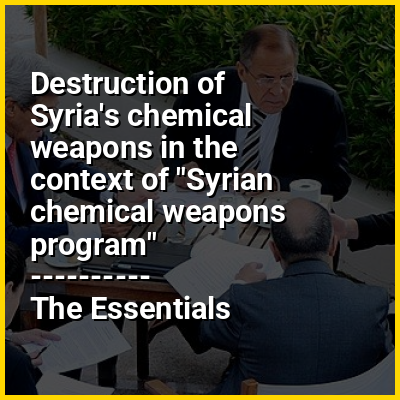
Syria's chemical weapons program began in the 1970s with weapons and training from Egypt and the Soviet Union, with production of chemical weapons in Syria beginning in the mid-1980s. Syria's chemical weapons program was the largest of any in the Middle East. For some time, Syria was believed to have the world's third-largest stockpile of chemical weapons, after the United States and Russia. Prior to September 2013 Syria had not publicly admitted to possessing chemical weapons, although Western intelligence services believed it to hold one of the world's largest stockpiles. In September 2013, French intelligence put the Syrian stockpile at 1,000 tonnes, including Yperite, VX and "several hundred tonnes of sarin". At the time, Syria was one of a handful of states which had not ratified the Chemical Weapons Convention. In September 2013, Syria joined the CWC (formally acceding on 14 October), and agreed to the destruction of its weapons, to be supervised by the Organisation for the Prohibition of Chemical Weapons (OPCW), as required by the convention. A joint OPCW-United Nations mission was established to oversee the destruction process. Syria joined OPCW after international condemnation of the August 2013 Ghouta chemical attack, for which Western states held the Syrian government responsible (whilst Syria and Russia held the Syrian rebels of the Syrian civil war responsible) and agreed to the prompt destruction of its chemical weapons.
The destruction of Syria's chemical weapons that the Assad government had declared was completed by August 2014, yet further disclosures, incomplete documentation, and allegations of withholding part of Syria's chemical weapons stockpile since mean that serious concerns regarding chemical weapons and related sites in Syria remain. On 5 April 2017, the government of Syria allegedly unleashed a chemical attack that killed 70 civilians. A suspected chemical attack on Douma on 9 April 2018 that killed at least 49 civilians has been blamed on the Syrian Government.