Despotate of Epirus in the context of "Empire of Trebizond"

Play Trivia Questions online!

or

Skip to study material about Despotate of Epirus in the context of "Empire of Trebizond"

Ad spacer

⭐ Core Definition: Despotate of Epirus

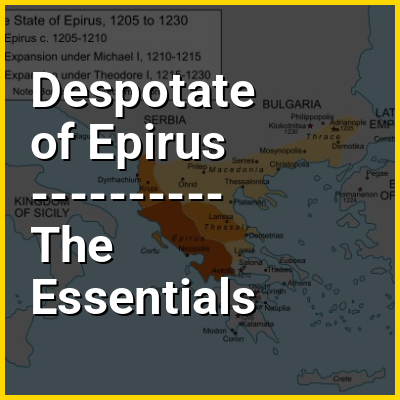
The Despotate of Epirus (Medieval Greek: Δεσποτᾶτον τῆς Ἠπείρου) was one of the Greek rump states of the Byzantine Empire established in the aftermath of the Fourth Crusade in 1204 by a branch of the Angelos dynasty. It claimed to be the legitimate successor of the Byzantine Empire during the subsequent struggle for Constantinople, along with the Empire of Nicaea and the Empire of Trebizond; its rulers briefly proclaiming themselves as Emperors in 1227–1242 (during which it is most often called the Empire of Thessalonica). The term "Despotate of Epirus" is, like "Byzantine Empire" itself, a modern historiographic convention and not a name in use at the time.

The Despotate was centred on the region of Epirus, encompassing also Albania and the western portion of Greek Macedonia and also included Thessaly and western Greece as far south as Nafpaktos. Through a policy of aggressive expansion under Theodore Komnenos Doukas the Despotate of Epirus also briefly came to incorporate central Macedonia, with the establishment of the Empire of Thessalonica in 1224, and Thrace as far east as Didymoteicho and Adrianople, and was on the verge of recapturing Constantinople and restoring the Byzantine Empire before the Battle of Klokotnitsa in 1230 where he was defeated by the Bulgarian Empire. After that, the Epirote state contracted to its core in Epirus and Thessaly, and was forced into vassalage to other regional powers. It nevertheless managed to retain its autonomy until being conquered by the restored Palaiologan Byzantine Empire in ca. 1337. In the 1410s, Carlo I Tocco, Count Palatine of Cephalonia and Zakynthos, managed to reunite the core of the Epirote state, but his successors gradually lost it to the advancing Ottoman Empire, with the last stronghold, Vonitsa, falling to the Ottomans in 1479.
↓ Menu

>>>PUT SHARE BUTTONS HERE<<<
In this Dossier

Despotate of Epirus in the context of Principality of Arbanon

Arbanon (Old Gheg: Arbënia, Old Tosk: Arbëria; Latin: Arbanum) was a medieval principality in present-day Albania, ruled by the native Progoni family, and the first Albanian state to emerge in recorded history. The principality was established in 1190 by the Albanian archon Progon in the region surrounding Kruja, to the east and northeast of Venetian territories. Progon was succeeded by his sons Gjin and then Demetrius, who managed to retain a considerable degree of autonomy from the Byzantine Empire. In 1204, Arbanon attained full, though temporary, political independence, taking advantage of the weakening of Constantinople following its pillage during the Fourth Crusade. However, Arbanon lost its large autonomy c. 1216, when the ruler of Epirus, Michael I Komnenos Doukas, started an invasion northward into Albania and Macedonia, taking Kruja and ending the independence of the principality. From this year, after the death of Demetrius, the last ruler of the Progoni family, Arbanon was successively controlled by the Despotate of Epirus, then by the Bulgarian Empire and, from 1235, by the Empire of Nicaea.

During this period, the area was ruled by the Greco-Albanian lord Gregorios Kamonas, the new spouse of Demetrius' Serbian former wife Komnena Nemanjić, and by Golem (Gulam), a local magnate who had married Kamonas' and Komnena's daughter. Arbanon was eventually annexed in the winter of 1256–57 by the Byzantine statesman George Akropolites. Golem subsequently disappeared from historical records. Akropolites' historical writings are the main primary source for late Arbanon and its history.

↑ Return to Menu

Despotate of Epirus in the context of Gjin Progoni

Gjin Progoni (Latin: Ginius) was an archon (or lord) of Kruja, located in present-day Albania, from c. 1198 until his death in 1208. He succeeded his father, Progon of Kruja, becoming the second ruler of the Principality of Arbanon. During his reign, he controlled the areas around Elbasan and the fortress of Krujë. He also maintained good ties with the Despotate of Epirus due to the Venetian threat in northern Epirus. Gjin was succeeded by his younger brother Dhimitër Progoni.

↑ Return to Menu

Despotate of Epirus in the context of Michael I Komnenos Doukas

Michael I Komnenos Doukas, Latinized as Comnenus Ducas (Greek: Μιχαήλ Κομνηνός Δούκας, romanizedMikhaēl Komnēnos Doukas), and in modern sources often recorded as Michael I Angelos, a name he never used, was the founder and first ruler of the Despotate of Epirus from c. 1205 until his assassination in 1214/15.

Born c. 1170, Michael was a descendant of Alexios I Komnenos and a cousin of emperors Isaac II Angelos and Alexios III Angelos. He began his public career in 1190, as a hostage to the Third Crusade, and went on to serve as governor of the province of Mylasa and Melanoudion in the 1190s and again in c. 1200/01. During the latter tenure he rebelled against Alexios III but was defeated and forced to flee to the Seljuk Turks. In the aftermath of the sack of Constantinople by the Fourth Crusade in 1204, he attached himself to Boniface of Montferrat. Soon, however, he abandoned the Crusader leader and went to Epirus, where he established himself as ruler, apparently through marriage with the daughter or widow of a local magnate.

↑ Return to Menu

Despotate of Epirus in the context of Empire of Nicaea

The Empire of Nicaea (Greek: Βασιλεία Ῥωμαίων), also known as the Nicene Empire, was the largest of the three Byzantine Greek rump states founded by the aristocracy of the Byzantine Empire that fled when Constantinople was occupied by Western European and Venetian armed forces during the Fourth Crusade, a military event known as the Sack of Constantinople. Like the other Byzantine rump states that formed due to the 1204 fracturing of the empire, such as the Empire of Trebizond and the Despotate of Epirus, it was a continuation of the eastern half of the Roman Empire that survived well into the Middle Ages. A fourth state, known in historiography as the Latin Empire, was established by an army of Crusaders and the Republic of Venice after the capture of Constantinople and the surrounding environs.

Founded by the Laskaris family, it lasted from 1204 to 1261, when the Nicenes restored the Byzantine Empire after they recaptured Constantinople. Thus, the Nicene Empire is seen as a direct continuation of the Byzantine Empire, as it fully assumed the traditional titles and government of the Byzantines in 1205.

↑ Return to Menu

Despotate of Epirus in the context of Gregory Kamonas

Gregorios Kamonas (fl.c. 1215 – ?) was a Greek-Albanian lord who ruled the Principality of Arbanon after c. 1215. Demetrios Chomatenos (1216–1236) mentioned him as having the title of sebastos, given to him by the emperor Alexios III Angelos after 1205, during his stay in the Despotate of Epirus at the court of his nephew Michael I Komnenos Doukas. He first married the daughter of Gjin Progoni, then married Serbian princess Komnena Nemanjić, the daughter of King Stefan Nemanjić and widow of Dimitri Progoni, thus inheriting the rule of Arbanon. He strengthened ties with Serbia and secured Arbanon through an Orthodox alliance. He had a daughter together with Komnena, who married Golem of Kruja, the next lord of Kruje.

↑ Return to Menu

Despotate of Epirus in the context of Battle of Achelous (1359)

The Battle of Achelous (Albanian: Beteja e Akelout) (also Battle of Acheloos) took place in 1358 or 1359 near the river Achelous in Aetolia, modern Greece, between the forces of the Despotate of Epirus under Nikephoros II Orsini and Albanian tribesmen under Karl Thopia. The Albanians defeated Orsini's troops and inflicted heavy casualties upon his forces, and Orsini himself was killed during the battle. Epirus was then divided amongst the Albanian clans, which resulted in the establishment of two despotates from regions previously part of the Despotate of Epirus: the Despotate of Arta and the Despotate of Angelokastron and Lepanto. Within Epirus, only the city of Ioannina remained under Greek governance and was not under the control of the Albanians.

↑ Return to Menu

Despotate of Epirus in the context of Byzantine–Ottoman wars

The Byzantine–Ottoman wars were a series of decisive conflicts between the Byzantine Greeks and Ottoman Turks and their allies that led to the final destruction of the Byzantine Empire and the rise of the Ottoman Empire. The Byzantines, already having been in a weak state even before the partitioning of their Empire following the 4th Crusade, failed to recover fully under the rule of the Palaiologos dynasty. Thus, the Byzantines faced increasingly disastrous defeats at the hands of the Ottomans. Ultimately, they lost Constantinople in 1453, formally ending the conflicts (however, several Byzantine Holdouts lasted until 1479).

Taking advantage of the situation, the Seljuk Sultanate of Rum began seizing territory in western Anatolia, until the Nicaean Empire was able to repulse the Seljuk Turks from the remaining territories still under Byzantine rule. Eventually Constantinople was re-taken from the Latin Empire in 1261 by the Nicaean Empire. The position of the Byzantine Empire in Europe remained uncertain due to the presence of the rivals in Epirus, Serbia and Bulgaria. This, combined with the declining power of the Sultanate of Rum (Byzantium's chief rival in Asia Minor) led to the removal of troops from Anatolia to maintain Byzantium's grip on Thrace.

↑ Return to Menu

Despotate of Epirus in the context of Gjirokastër

Gjirokastër (Albanian: [ɟiɾoˈkast:əɾ, -ra], Albanian definite form: Gjirokastra) is a city in southern Albania and the seat of Gjirokastër County and Gjirokastër Municipality. It is located in a valley between the Gjerë mountains and the Drino, at 300 metres above sea level. Its old town is a UNESCO World Heritage Site. The city is overlooked by Gjirokastër Fortress, where the Gjirokastër National Folk Festival is held every five years. It is the birthplace of former Albanian communist leader Enver Hoxha, and author Ismail Kadare.

The city appears in the historical record dating back in 1336 by its medieval Greek name, Αργυρόκαστρο, Argyrókastro, as part of the Byzantine Empire. It first developed in the hill where the Gjirokastër Fortress is located. In this period, Gjirokastër was contested between the Despotate of Epirus and the Albanian clan of Zenebishi under Gjon Zenebishi who made it his capital in 1417. It was taken by the Ottomans in 1418, a year after's Gjon's death and it became the seat of the Sanjak of Albania. Throughout the Ottoman era, Gjirokastër was officially known in Ottoman Turkish as Ergiri and also Ergiri Kasrı. During the Ottoman period conversions to Islam and an influx of Muslim converts from the surrounding countryside made Gjirokastër go from being an overwhelmingly Christian city in the 16th century into one with a large Muslim population by the early 19th century. Gjirokastër also became a major religious centre for Bektashi Sufism.

↑ Return to Menu

Despotate of Epirus in the context of Theodore Komnenos Doukas

Theodore Komnenos Doukas (Greek: Θεόδωρος Κομνηνὸς Δούκας, Theodōros Komnēnos Doukas; Latinized as Theodore Comnenus Ducas; died c. 1253) or Theodore Angelos Komnenos was the ruler of Epirus and Thessaly from 1215 to 1230 and of Thessalonica and most of Macedonia and western Thrace from 1224 to 1230. He was also the power behind the rule of his sons John and Demetrios over Thessalonica in 1237–1246.

Theodore was the scion of a distinguished Byzantine aristocratic family related to the imperial Komnenos, Doukas, and Angelos dynasties. Nevertheless, nothing is known about Theodore's life before the conquest of Constantinople and dissolution of the Byzantine Empire by the Fourth Crusade in 1204. Following the fall of Constantinople, he served Theodore I Laskaris, founder of the Empire of Nicaea, for a few years before being called to Epirus, where his half-brother Michael I Komnenos Doukas had founded an independent principality. When Michael died in 1215, Theodore sidelined his brother's underage and illegitimate son Michael II and assumed the governance of the Epirote state. Theodore continued his brother's policy of territorial expansion. Allied with Serbia, he expanded into Macedonia, threatening the Latin Kingdom of Thessalonica. The capture of the Latin Emperor Peter II of Courtenay in 1217 opened the way to the gradual envelopment of Thessalonica, culminating in the city's fall in 1224.

↑ Return to Menu