Dependencies of Norway in the context of "Procedural law"

Play Trivia Questions online!

or

Skip to study material about Dependencies of Norway in the context of "Procedural law"

Ad spacer

⭐ Core Definition: Dependencies of Norway

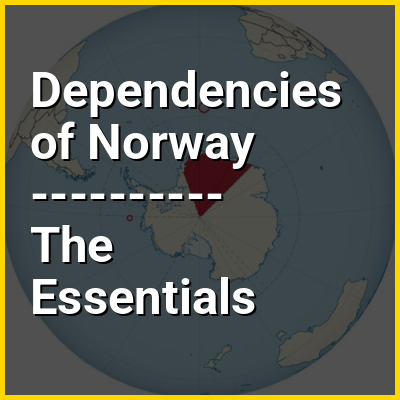
Norway has three dependent territories (Norwegian: biland), all uninhabited and located in the Southern Hemisphere. Bouvet Island (Bouvetøya) is a sub-Antarctic island in the South Atlantic Ocean. Queen Maud Land is the sector of Antarctica between the 20th meridian west and the 45th meridian east. Peter I Island is a volcanic island located 450 kilometres (280 mi) off the coast of Ellsworth Land of continental Antarctica. Despite being unincorporated areas, neither Svalbard nor Jan Mayen is formally considered a dependency. While the Svalbard Treaty regulates some aspects of that Arctic territory, it acknowledges that the islands are part of Norway. Similarly, Jan Mayen is recognized as an integral part of Norway.

Both Peter I Island and Queen Maud Land are south of 60°S and are thus part of the Antarctic Treaty System. While the treaty does not affect these claims, the only states that recognize Norwegian sovereignty also have Antarctic claims. Administration of the dependencies is handled by the Polar Affairs Department of the Ministry of Justice and Public Security in Oslo. Norwegian criminal law, private law and procedural law apply to the dependencies, as do other laws that explicitly state they are valid on the dependencies.
↓ Menu

>>>PUT SHARE BUTTONS HERE<<<
In this Dossier

Dependencies of Norway in the context of Norway

Norway, officially the Kingdom of Norway, is a Nordic country located on the Scandinavian Peninsula in Northern Europe. The remote Arctic island of Jan Mayen and the archipelago of Svalbard also form part of the Kingdom of Norway. Bouvet Island, located in the Subantarctic, is a dependency, and not a part of the Kingdom; Norway also claims the Antarctic territories of Peter I Island and Queen Maud Land. Norway has a population of 5.6 million. Its capital and largest city is Oslo. The country has a total area of 385,207 square kilometres (148,729 sq mi). The country shares a long eastern border with Sweden, and is bordered by Finland and Russia to the northeast. Norway has an extensive coastline facing the Skagerrak strait, the North Atlantic Ocean, and the Barents Sea. In 2024, Norway was ranked the seventh happiest country in the world.

The unified kingdom of Norway was established in 872 as a merger of petty kingdoms and has existed continuously for 1,152–1,153 years. From 1537 to 1814, Norway was part of Denmark–Norway, and, from 1814 to 1905, it was in a personal union with Sweden. Norway was neutral during the First World War, and in the Second World War until April 1940 when it was invaded and occupied by Nazi Germany until the end of the war.

↑ Return to Menu

Dependencies of Norway in the context of Peter I Island

Peter I Island (Norwegian: Peter I Øy) is an uninhabited volcanic island in the Bellingshausen Sea, 450 kilometres (240 nmi) from continental Antarctica. It is claimed as a dependency of Norway and, along with Bouvet Island and Queen Maud Land, composes one of the three Norwegian dependent territories in the Antarctic and Subantarctic. The island measures approximately 11 by 19 kilometres (7 by 12 mi), with an area of 156 km (60 sq mi); its highest point is the ultra-prominent, 1,640-metre-tall (5,380 ft) Lars Christensen Peak. Nearly all the island is covered by a glacier, and it is surrounded most of the year by pack ice, making it inaccessible during these times. There is little vertebrate animal life on the island, apart from some seabirds and seals.

The island was first sighted by Fabian Gottlieb von Bellingshausen on 21 January 1821 and was named after Peter I of Russia. Not until 2 February 1929 did anyone set foot on the island, when Nils Larsen and Ola Olstad's Second Norvegia Expedition, financed by Lars Christensen, was successful. They claimed it for Norway, which annexed it in 1931 and made it a dependency in 1933. The next landing occurred in 1948, and the island has been subject to some scientific research and a limited amount of tourism. The island became subject to the Antarctic Treaty in 1961. Since 1987, there has been an automated meteorological station on the island. Three amateur radio DX-peditions have visited the island, and there are sporadic landings by tourists.

↑ Return to Menu

Dependencies of Norway in the context of Queen Maud Land

Queen Maud Land (Norwegian: Dronning Maud Land) is a roughly 2.7-million-square-kilometre (1.0-million-square-mile) region of Antarctica claimed by Norway as a dependent territory. It borders the claimed British Antarctic Territory 20° west, specifically the Caird Coast, Coats Land on the West, and the Australian Antarctic Territory 45° east, specifically Enderby Land on the East. In addition, a small unclaimed area from 1939 was annexed in June 2015. Positioned in East Antarctica, it makes out about one-fifth of the continent, and is named after the Norwegian Queen Maud (1869–1938).

In 1930, the Norwegian Hjalmar Riiser-Larsen was the first person known to have set foot in the territory. On 14 January 1939, the territory was claimed by Norway. On 23 June 1961, Queen Maud Land became part of the Antarctic Treaty System, making it a demilitarised zone. It is one of two Antarctic claims made by Norway, the other being Peter I Island. They are administered by the Polar Affairs Department of the Norwegian Ministry of Justice and Public Security in Oslo.

↑ Return to Menu