Demand Note in the context of United States ten-dollar bill


Demand Note in the context of United States ten-dollar bill

⭐ Core Definition: Demand Note

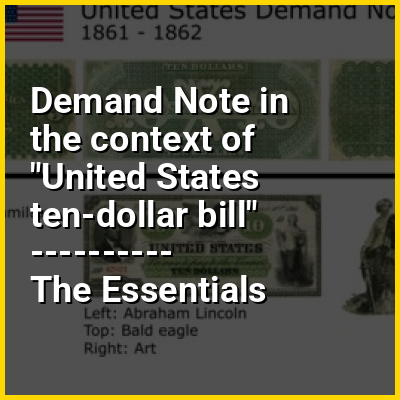
A Demand Note is a type of United States paper money that was issued from August 1861 to April 1862 during the American Civil War in denominations of 5, 10, and 20 US$. Demand Notes were the first issue of paper money by the United States that achieved wide circulation, albeit only for a short time. The U.S. government placed Demand Notes into circulation by using them to pay expenses incurred during the Civil War including the salaries of its workers and military personnel.

Because of the distinctive green ink on their reverse, and because state-chartered bank and Confederate notes of the day typically had blank reverses, the Demand Notes were nicknamed "greenbacks", a name later inherited by United States Notes and Federal Reserve Notes. The obverse of the Demand Notes contained familiar elements such as the images of a bald eagle, Abraham Lincoln, and Alexander Hamilton, though the portraits used on Demand Notes are different from the ones seen on U.S. currency today.
↓ Menu
HINT:

In this Dossier

Demand Note in the context of Banknotes of the United States dollar

From 1775 to 1779, the Continental Congress issued Continental currency banknotes. Then there was a period when the United States just used gold and silver, rather than paper currency. In 1812, the US began issuing Treasury Notes, although the motivation behind their issuance was funding federal expenditures rather than the provision of a circulating medium. In 1861, the US began issuing Demand Notes, which were the first paper money issued by the United States whose main purpose was to circulate. And since 1914, the US has issued Federal Reserve Notes.

Since 1971, Federal Reserves Notes have been the only banknotes of the United States dollar that have been issued. But at some points in the past, the United States had multiple different types of banknotes, such as United States Notes (1862–1971), Interest bearing notes (1863-1865), and Gold certificates (1865–1934).

View the full Wikipedia page for Banknotes of the United States dollar
↑ Return to Menu

Demand Note in the context of United States Note

A United States Note, also known as a Legal Tender Note, is a type of paper money that was issued from 1862 to 1971 in the United States. Having been current for 109 years, they were issued for longer than any other form of U.S. paper money other than the currently issued Federal Reserve Note. They were known popularly as "greenbacks", a name inherited from the earlier greenbacks, the Demand Notes, that they replaced in 1862. Often termed Legal Tender Notes, they were named United States Notes by the First Legal Tender Act, which authorized them as a form of fiat currency. During the early 1860s the so-called second obligation on the reverse of the notes stated:

By the 1930s, this obligation would eventually be shortened to:

View the full Wikipedia page for United States Note
↑ Return to Menu