Delmarva Peninsula in the context of "Maryland Eastern Shore"

Play Trivia Questions online!

or

Skip to study material about Delmarva Peninsula in the context of "Maryland Eastern Shore"


⭐ Core Definition: Delmarva Peninsula

38°30′N 75°40′W / 38.500°N 75.667°W / 38.500; -75.667

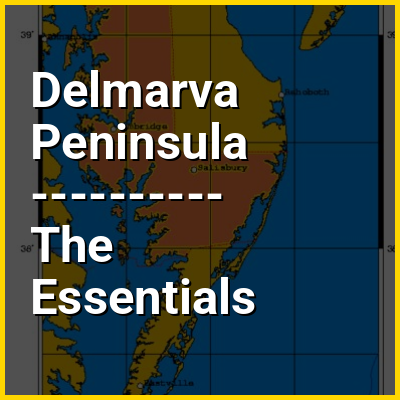
The Delmarva Peninsula, or simply Delmarva, is a peninsula on the East Coast of the United States, occupied by the majority of the state of Delaware and parts of the Eastern Shore of Maryland and Eastern Shore of Virginia.

↓ Menu

In this Dossier

Delmarva Peninsula in the context of Chesapeake Bay

The Chesapeake Bay (/ˈɛsəpk/ CHESS-ə-peek) is the largest estuary in the United States. The bay is located in the Mid-Atlantic region and is primarily separated from the Atlantic Ocean by the Delmarva Peninsula, including parts of the Eastern Shore of Maryland, the Eastern Shore of Virginia, and the state of Delaware. The mouth of the bay at its southern point is located between Cape Henry and Cape Charles. With its northern portion in Maryland and the southern part in Virginia, the Chesapeake Bay is a very important feature for the ecology and economy of those two states, as well as others surrounding within its watershed. More than 150 major rivers and streams flow into the bay's 64,299-square-mile (166,534 km) drainage basin, which covers parts of six states (New York, Pennsylvania, Delaware, Maryland, Virginia, and West Virginia) and all of Washington, D.C.

The bay is approximately 200 miles (320 km) long from its northern headwaters in the Susquehanna River to its outlet in the Atlantic Ocean. It is 2.8 miles (4.5 km) wide at its narrowest (between Kent County's Plum Point near Newtown in the east and the Harford County western shore near Romney Creek) and 30 miles (48 km) at its widest (just south of the mouth of the Potomac River, which divides Maryland from Virginia). Total shoreline including tributaries is 11,684 miles (18,804 km), circumnavigating a surface area of 4,479 square miles (11,601 km). Average depth is 21 feet (6.4 m), reaching a maximum of 174 feet (53 m). The bay is spanned twice, in Maryland by the Chesapeake Bay Bridge from Sandy Point (near Annapolis) to Kent Island and in Virginia by the Chesapeake Bay Bridge–Tunnel connecting Virginia Beach to Cape Charles.

↑ Return to Menu

Delmarva Peninsula in the context of Delaware

Delaware (/ˈdɛləwɛər/ DEL-ə-wair) is a state in the Mid-Atlantic and South Atlantic regions of the United States. It borders Maryland to its south and west, Pennsylvania to its north, New Jersey to its northeast, and the Atlantic Ocean to its east. The state's name derives from the adjacent Delaware Bay, which in turn was named after Thomas West, 3rd Baron De La Warr, an English nobleman and the Colony of Virginia's first colonial-era governor.

Delaware occupies the northeastern portion of the Delmarva Peninsula, and some islands and territory within the Delaware River. It is the second-smallest and sixth-least populous state, but also the sixth-most densely populated. Delaware's most populous city is Wilmington, and the state's capital is Dover, the second-most populous city in Delaware. The state is divided into three counties, the fewest number of counties of any of the 50 U.S. states; from north to south, the three counties are: New Castle County, Kent County, and Sussex County. The southern two counties, Kent and Sussex, have historically been predominantly agrarian economies. New Castle is more urbanized and is considered part of the Philadelphia metropolitan area. Delaware is considered part of the Southern United States by the U.S. Census Bureau, but the state's geography, culture, and history are a hybrid of the Mid-Atlantic, Northeastern, and Southern regions of the country.

↑ Return to Menu

Delmarva Peninsula in the context of Eastern Shore of Maryland

The Eastern Shore of Maryland is a part of the U.S. state of Maryland that lies mostly on the east side of the Chesapeake Bay. Nine counties are normally included in the region. The Eastern Shore is part of the larger Delmarva Peninsula that Maryland shares with Delaware and Virginia.

As of the 2020 census, its population was 456,815, with about 7% of Marylanders living in the region. The region is politically more conservative than the rest of the state, generally returning more votes for Republicans than Democrats in statewide and national elections.

↑ Return to Menu

Delmarva Peninsula in the context of Eastern Shore of Virginia

The Eastern Shore of Virginia is the easternmost region of the Commonwealth of Virginia in the United States. It consists of two counties (Accomack and Northampton) on the Atlantic coast. It is detached from the mainland of Virginia by the Chesapeake Bay. The 70-mile-long (110 km) region is part of the Delmarva Peninsula. Its population was 45,695 as of 2020.

↑ Return to Menu

Delmarva Peninsula in the context of Cape Charles (headland)

Cape Charles is a headland, or cape, in Northampton County, Virginia. Located at the southern tip of Northampton County, it forms the southern tip of the Delmarva Peninsula and the northern side of the entrance to the Chesapeake Bay. Cape Charles was named in honor of Charles I of England, the second son of King James I and his eventual successor to the thrones of England, Scotland, and Ireland.

Cape Henry, which forms the southern side of the entrance to the Chesapeake Bay, and Cape Charles are collectively known as the Virginia Capes.

↑ Return to Menu

Delmarva Peninsula in the context of Kent Island, Maryland

Kent Island is the largest island in the Chesapeake Bay and a historic place in Maryland, United States. To the east, a narrow channel known as the Kent Narrows barely separates the island from the Delmarva Peninsula, and on the other side, the island is separated from Sandy Point, an area near Annapolis, by roughly four miles (6.4 km) of water. At only four miles wide, the main waterway of the bay is at its narrowest at this point and is spanned here by the Chesapeake Bay Bridge. The Chester River runs to the north of the island and empties into the Chesapeake Bay at Kent Island's Love Point. To the south of the island lies Eastern Bay. The United States Census Bureau reports that the island has 31.62 square miles (81.90 km) of land area.

Kent Island is part of Queen Anne's County, Maryland, and Maryland's Eastern Shore region. The first English establishment on the island, Kent Fort, was founded in 1631, making Kent Island the oldest English settlement within the present day state of Maryland and the third oldest permanent English settlement in what became the United States—after Jamestown, Virginia (1607), and Plymouth, Massachusetts (1620). The census-designated places of Stevensville and Chester are located on the island, along with several other communities, including the fishing community of Kent Narrows, which is located partially on the island. Although all of Kent Island's communities are unincorporated, the census designated places of Stevensville and Chester on the island are both more populous than any of Queen Anne's County's incorporated towns.

↑ Return to Menu

Delmarva Peninsula in the context of Chesapeake Bay Bridge–Tunnel

The Chesapeake Bay Bridge–Tunnel (CBBT, officially the Lucius J. Kellam Jr. Bridge–Tunnel) is a 17.6-mile (28.3 km) bridge–tunnel that crosses the mouth of the Chesapeake Bay between Delmarva and Hampton Roads in the U.S. commonwealth of Virginia. It opened in 1964, replacing ferries that had operated since the 1930s. A major project to dualize its bridges was completed in 1999, and in 2017 a similar project was started to dualize one of its tunnels.

With 12 miles (19 km) of bridges and two one-mile-long (1.6 km) tunnels, the CBBT is one of only 14 bridge–tunnel systems in the world and one of three in both Hampton Roads and the United States. It carries US 13, which saves motorists roughly 95 miles (153 km) and 1+12 hours on trips between Hampton Roads and the Delaware Valley and points north compared with other routes through the Washington–Baltimore Metropolitan Area. As of January 2021, over 140 million vehicles have crossed the CBBT.

↑ Return to Menu

Delmarva Peninsula in the context of New Netherland

New Netherland (Dutch: Nieuw Nederland) was a colony of the Dutch Republic located on the East Coast of what is now the United States. The claimed territories extended from the Delmarva Peninsula to Cape Cod. Settlements were established in what became the states of New York, New Jersey, Delaware, and Connecticut, with small outposts in Pennsylvania and Rhode Island.

The colony was originally conceived by the Dutch West India Company in 1621 to capitalize on the North American fur trade. Settlement initially stalled because of policy mismanagement by the company and conflicts with Native Americans. The settlement of New Sweden by the Swedish South Company encroached on its southern flank, while its eastern border was redrawn to accommodate the English colonies of an expanding New England Confederation.

↑ Return to Menu

Delmarva Peninsula in the context of Tidewater (geographic term)

Tidewater is a region in the Atlantic Plains of the United States located east of the Atlantic Seaboard fall line (the natural border where the tidewater meets with the Piedmont region) and north of the Deep South. The term "tidewater" can be applied to any region where water levels are affected by the tide. Still, culturally and historically, the Tidewater region refers most commonly to the low-lying plains of southeastern Virginia (known as the coastal plain or Tidewater Virginia), eastern Maryland, the Eastern Shore, and the Chesapeake Bay. It can also encompass Delaware, the remainder of the Delmarva Peninsula, and Northeastern North Carolina.

The cultural Tidewater region got its name from the effects of changing ocean tides on local rivers, sounds, and shorelines. The area has a centuries-old cultural heritage that sets itself apart from the adjacent inland parts of the United States, especially concerning its distinctive dialects of English, which are gradually disappearing, along with its islands and its receding shoreline.

↑ Return to Menu