Degree of polymerization in the context of Arithmetic mean


Degree of polymerization in the context of Arithmetic mean

Degree of polymerization Study page number 1 of 1

Play TriviaQuestions Online!

or

Skip to study material about Degree of polymerization in the context of "Arithmetic mean"


⭐ Core Definition: Degree of polymerization

The degree of polymerization, or DP, is the number of monomeric units in a macromolecule or polymer or oligomer molecule.

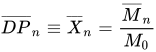
For a homopolymer, there is only one type of monomeric unit and the number-average degree of polymerization is given by ,where is the number-average molecular weight and is the molecular weight of the monomer unit. The overlines indicate arithmetic mean values. For most industrial purposes, degrees of polymerization in the thousands or tens of thousands are desired. This number does not reflect the variation in molecule size of the polymer that typically occurs, it only represents the mean number of monomeric units.
↓ Menu
HINT:

In this Dossier

Degree of polymerization in the context of Rag paper

Rag paper is a category of paper that is made from a pulp of discarded textiles, rope and other fibre products. Rag paper in its various forms was a widely-used paper for most of the past two millennia. Production spread along the Silk Road from its early 2nd-century origin in China to the Islamic world by the 8th century. It was introduced into Christian Europe by the 12th century, and western Europe came to dominate rag production up until the mid-19th century, when rag paper was displaced in favour of far more cost-efficient pulpwood acidic paper.

Rag paper is valued today as a specialty paper for its archival quality and tear resistance compared to wood pulp paper. Modern rag paper is often cotton paper, made from cotton linters, with a usual pH of 6.4 and degree of polymerization of 1481.2.

View the full Wikipedia page for Rag paper
↑ Return to Menu

Degree of polymerization in the context of Monostroma

Monostroma is a genus of marine green algae (seaweed) in the family Monostromataceae. As the name suggests, algae of this genus are monostromatic (single cell layered). Monostroma kuroshiense, an algae of this genus, is commercially cultivated in East Asia and South America for the edible product "hitoegusa-nori" or "hirohano-hitoegusa nori", popular sushi wraps. Monostroma oligosaccharides with degree of polymerization 6 prepared by agarase digestion from Monostroma nitidum polysaccharides have been shown to be an effective prophylactic agent during in vitro and in vivo tests against Japanese encephalitis viral infection. The sulfated oligosaccharides from Monostroma seem to be promising candidates for further development as antiviral agents. The genus Monostroma is the most widely cultivated genus among green seaweeds.

View the full Wikipedia page for Monostroma
↑ Return to Menu

Degree of polymerization in the context of Molar mass distribution

In polymer chemistry, the molar mass distribution (or molecular weight distribution) describes the relationship between the number of moles of each polymer species (Ni) and the molar mass (Mi) of that species. In linear polymers, the individual polymer chains rarely have exactly the same degree of polymerization and molar mass, and there is always a distribution around an average value. The molar mass distribution of a polymer may be modified by polymer fractionation.

View the full Wikipedia page for Molar mass distribution
↑ Return to Menu