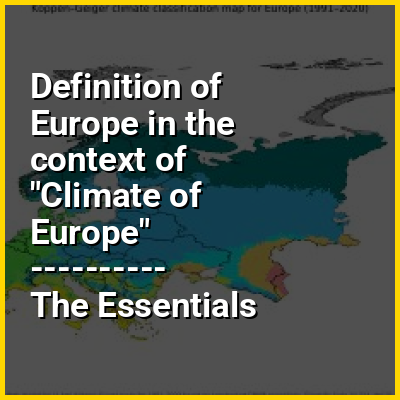
Europe is a continent located entirely in the Northern Hemisphere and mostly in the Eastern Hemisphere. It is bordered by the Arctic Ocean to the north, the Atlantic Ocean to the west, the Mediterranean Sea to the south, and Asia to the east. Europe shares the landmass of Eurasia with Asia, and of Afro-Eurasia with both Africa and Asia. Europe is commonly considered to be separated from Asia by the watershed of the Ural Mountains, the Ural River, the Caspian Sea, the Greater Caucasus, the Black Sea, and the Turkish straits.
Europe covers approx. 10,186,000 square kilometres (3,933,000 sq mi), or 2% of Earth's surface (6.8% of Earth's land area), making it the second-smallest continent (using the seven-continent model). Politically, Europe is divided into about fifty sovereign states, of which Russia is the largest and most populous, spanning 39% of the continent and comprising 15% of its population. Europe had a total population of about 745 million (about 10% of the world population) in 2021; the third-largest after Asia and Africa. The European climate is affected by warm Atlantic currents, such as the Gulf Stream, which produce a temperate climate, tempering winters and summers, on much of the continent. Further from the sea, seasonal differences are more noticeable producing more continental climates.