De Brouckère metro station in the context of Charles de Brouckère


De Brouckère metro station in the context of Charles de Brouckère

⭐ Core Definition: De Brouckère metro station

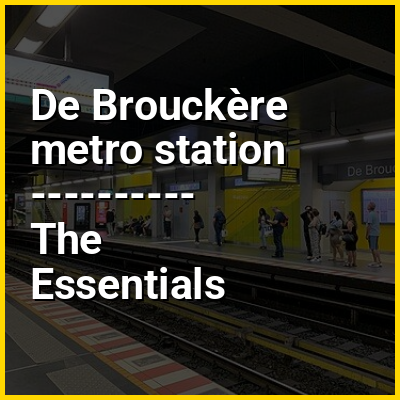
De Brouckère (French pronunciation: [də bʁukɛʁ]) is a rapid transit station located under the Place de Brouckère/De Brouckèreplein in central Brussels, Belgium. It consists of both a metro station (serving lines 1 and 5) and a premetro (underground tram) station (serving lines 4 and 10 on the North–South Axis between Brussels-North railway station and Albert premetro station). The station takes its name from that aboveground square, itself named after the former mayor of the City of Brussels, Charles de Brouckère.

The station opened on 17 December 1969 as a premetro station on the tram line between De Brouckère and Schuman. This station was upgraded to full metro status on 20 September 1976, serving former east–west line 1 (further split in 1982 into former lines 1A and 1B). Since 4 October 1976, the station has also accommodated North–South Axis premetro services at separate platforms. Then, following the reorganisation of the Brussels Metro on 4 April 2009, it is served by lines 1, 3, 4 and 5 Line 3 was disbanded in 2024 and replaced by the new line 10.
↓ Menu
HINT:

In this Dossier

De Brouckère metro station in the context of Brussels Metro

The Brussels Metro (French: Métro de Bruxelles [metʁo bʁysɛl]; Dutch: Brusselse metro [ˈbrʏsəlsə ˈmeːtroː]) is a rapid transit system serving a large part of the Brussels-Capital Region of Belgium. It consists of four conventional metro lines and three premetro lines. The metro-grade lines are M1, M2, M5, and M6 with some shared sections, covering a total of 39.9 kilometres (24.8 mi), with 59 metro-only stations. The premetro network consists of three tram lines (T4, T7, and T10) that partly travel over underground sections that were intended to be eventually converted into metro lines. Underground stations in the premetro network use the same design as metro stations. A few short underground tramway sections exist, so there is a total of 52.0 kilometres (32.3 mi) of underground metro and tram network. There are a total of 69 metro and premetro stations as of 2011.

The Brussels Metro was planned at the beginning of the 1960s to become a fully underground network. The original network, running between De Brouckère and Schuman, was inaugurated on 17 December 1969 as premetro tramways, which were later, in 1976, converted into the common section of the first two metro lines. These lines were then considered a single line with two branches, between De Brouckère and Tomberg and De Brouckère and Beaulieu. On 4 April 2009, with the completion of the "loop" of line 2 connecting Delacroix and Gare de l'Ouest/Weststation, the Brussels Metro was significantly reorganised.

View the full Wikipedia page for Brussels Metro
↑ Return to Menu

De Brouckère metro station in the context of Brussels Metro line 5

Line 5 is a rapid transit line on the Brussels Metro in Belgium operated by STIB/MIVB. It connects Herrmann-Debroux in the south-east of Brussels to Erasme/Erasmus in the south-west via the city centre. It has existed in its current form since 4 April 2009, when the section of former line 1A between Beekkant and Roi Baudouin/Koning Boudewijn was replaced by the section of former line 1B between Beekkant and Erasme. Starting from Herrmann-Debroux, the line crosses the municipalities of Auderghem, Etterbeek, City of Brussels, Molenbeek-Saint-Jean, Koekelberg and Anderlecht. It serves 28 metro stations and has a common section with line 1 between Gare de l'Ouest/Weststation and Merode, and with lines 2 and 6 between Gare de l'Ouest and Beekkant. At Arts-Loi/Kunst-Wet, the line also connects with lines 2 and 6. Railway connections are possible at Brussels-Central, Brussels-Schuman, Merode and Brussels-West.

The first section of this line was built in the late 1960s between Schuman and De Brouckère, but was served by trams. The first metro was brought into service on 20 September 1976, and the existing underground section was extended up to Tomberg on former line 1B, and up to Beaulieu on former line 1A. Line 1A was further expanded eastwards, to Demey in 1977 and to Herrmann-Debroux in 1985. The line was also expanded westwards, to Sainte-Catherine/Sint-Katelijne in 1977, to Beekkant in 1981, to Bockstael in 1982, to Heysel/Heizel in 1985 and to Roi Baudouin in 1998.

View the full Wikipedia page for Brussels Metro line 5
↑ Return to Menu

De Brouckère metro station in the context of Brussels Metro line 1

Line 1 is a rapid transit line on the Brussels Metro in Belgium operated by STIB/MIVB. It has existed in its current form since 4 April 2009, when former line 1B, which ran between Stockel/Stokkel and Erasme/Erasmus, was shortened to Gare de l'Ouest/Weststation. The section between Gare de l'Ouest and Erasme is now served by line 5. The line serves 21 metro stations, and has a common section with line 5 between Gare de l'Ouest and Merode, and with lines 2 and 6 between Gare de l'Ouest and Beekkant. At Arts-Loi/Kunst-Wet, the line also connects with lines 2 and 6. Railway connections are possible at Brussels-Central, Brussels-Schuman, Merode and Brussels-West. The line crosses the municipalities of Molenbeek-Saint-Jean, Koekelberg, City of Brussels, Etterbeek, Woluwe-Saint-Pierre and Woluwe-Saint-Lambert.

The first section of this line was built in the late 1960s between Schuman and De Brouckère, but was served by trams. The first metro was brought into service on 20 September 1976, and the existing underground section was extended up to Tomberg on former line 1B, and up to Beaulieu on former line 1A. Line 1B was later expanded westwards, to Sainte-Catherine/Sint-Katelijne in 1977, to Beekkant in 1981, to Saint-Guidon/Sint-Guido in 1982, to Veeweyde/Veeweide in 1985, to Bizet in 1992 and finally to Erasme in 2003. The line was also expanded eastwards, to Alma in 1982 and to Stockel in 1988.

View the full Wikipedia page for Brussels Metro line 1
↑ Return to Menu

De Brouckère metro station in the context of Place de Brouckère

The Place de Brouckère (French, pronounced [plas bʁu.kɛʁ]) or De Brouckèreplein (Dutch, pronounced [də ˈbrukɛr(ə)ˌplɛin]) is a major square in central Brussels, Belgium. It was created following the covering of the river Senne (1867–1871), replacing the Temple of the Augustinians, which was demolished in 1893. It is named in honour of Charles de Brouckère, a former mayor of the City of Brussels and professor at the Free University of Brussels, who played an important political role during the Belgian Revolution of 1830. The square measures approximately 50 by 350 metres (160 by 1,150 ft) and is nearly entirely paved.

The Place de Brouckère is located in the perspective of the Boulevard Émile Jacqmain/Émile Jacqmainlaan and the Boulevard Adolphe Max/Adolphe Maxlaan to the north, forming a "Y" crossroad, and the Boulevard Anspach/Anspachlaan to the south. The area around the square is characterised by the presence of theatres, a large cinema, hotels and restaurants, as well as some of the city's most important entertainment venues and shopping streets. It is served by the metro and premetro (underground tram) station De Brouckère on lines 1, 4, 5 and 10.

View the full Wikipedia page for Place de Brouckère
↑ Return to Menu