Dardani in the context of "Monunius II"

Play Trivia Questions online!

or

Skip to study material about Dardani in the context of "Monunius II"

Ad spacer

⭐ Core Definition: Dardani

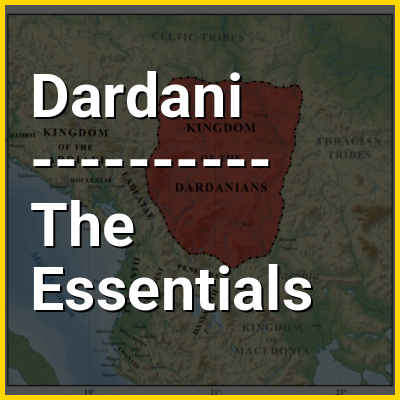
The Dardani (/ˈdɑːrdən/; Ancient Greek: Δαρδάνιοι, Δάρδανοι; Latin: Dardani) or Dardanians were a Paleo-Balkan people, who lived in a region that was named Dardania after their settlement there. They were among the oldest Balkan peoples, and their society was very complex. The Dardani were the most stable and conservative ethnic element among the peoples of the central Balkans, retaining an enduring presence in the region for several centuries.

Ancient tradition considered the Dardani as an Illyrian people. Strabo, in particular – also mentioning Galabri and Thunatae as Dardanian tribes – describes the Dardani as one of the three strongest Illyrian peoples, the other two being the Ardiaei and Autariatae. As Dardanians had followed their own peculiar geographical, social and political development in Dardania, some ancient sources also distinguish them from those Illyrians dwelling in the central and southern coast of the eastern Adriatic Sea and its hinterland, who had constituted their own socio-political formation, referred to as 'Illyrian kingdom' by ancient authors. The Dardani were also related to their Thracian neighbors. In Roman times, there appear Thracian names in the eastern strip of Dardania, and several Thracian and Dacian placenames also appear there, such as Dardapara and Quemedava, but Illyrian names dominated the rest. Nevertheless, ancient authors have not identified Dardanians with Thracians, and Strabo explicitly makes a clear distinction between them. The Dardanians, who are said by Nicholas Damascenus, Strabo, Appian and others to be Illyrians, were regarded by Dio Cassius as being Moesians, and Stephanus says that their towns of Naissus [Nish] and Skupi [Skopje] were Thracian. Various scholars regard Dardania as a mixed territory of Daco-Thracian-Illyrian elements.
↓ Menu

>>>PUT SHARE BUTTONS HERE<<<
In this Dossier

Dardani in the context of Kosovo

Kosovo, officially the Republic of Kosovo, is a landlocked country in Southeast Europe with partial diplomatic recognition. It is bordered by Albania to the southwest, Montenegro to the west, Serbia to the north and east, and North Macedonia to the southeast. It covers an area of 10,887 km (4,203 sq mi) and has a population of nearly 1.6 million, of whom the vast majority (approximately 92 per cent) are ethnic Albanians. Kosovo has a varied terrain, with high plains along with rolling hills and mountains, some of which have an altitude over 2,500 m (8,200 ft). Its climate is mainly continental with some Mediterranean and Alpine influences. Kosovo's capital and most populous city is Pristina; other major cities and urban areas include Prizren, Ferizaj, Gjilan, and Peja.

Kosovo formed the core territory of the Dardani, an Illyrian people, attested in classical sources from the 4th century BCE. The Dardani established the Kingdom of Dardania, with its political and cultural center likely located near present-day Lipjan (ancient Ulpiana). The kingdom was incorporated into the Roman Empire in the 1st century BCE; later, in the 3rd century CE, it was transformed into a separate Roman province. During the Byzantine period, the region was eventually organised as part of the Theme of Dardania and remained under imperial control, facing Slavic migrations in the 6th and 7th centuries CE. Control shifted between the Byzantines and the First Bulgarian Empire. In the 13th century, Kosovo became integral to the Serbian medieval state and the establishment of the Serbian Patriarchate. Ottoman expansion in the Balkans in the late 14th and 15th centuries led to the decline and fall of the Serbian Empire; the Battle of Kosovo of 1389, in which a Serbian-led coalition of various ethnicities fought against the Ottoman Empire, is considered one of the defining moments.

↑ Return to Menu

Dardani in the context of Macedonia (Roman province)

Macedonia (Latin: Macedonia; Ancient Greek: Μακεδονία) was a province of ancient Rome, encompassing the territory of the former Antigonid Kingdom of Macedonia, which had been conquered by the Roman Republic in 168 BC at the conclusion of the Third Macedonian War. The province was created in 146 BC, after the Roman general Quintus Caecilius Metellus defeated Andriscus of Macedon, the last self-styled King of Macedonia in the Fourth Macedonian War. The province incorporated the former Kingdom of Macedonia with the addition of Epirus, Thessaly, and parts of Illyria, Paeonia and Thrace.

During the Republican period, the province was of great military significance, as the main bulwark protecting the Aegean region from attacks from the north. The Via Egnatia, which crossed the province from west to east was of great strategic importance, providing the main overland link between Rome and its domains in the Eastern Mediterranean. In this period, campaigns against the Dardani and Scordisci to the north and the Thracians to the east were nearly constant. By the first century BC, the province notionally extended to the Danube.

↑ Return to Menu

Dardani in the context of History of Macedonia (ancient kingdom)

The kingdom of Macedonia was an ancient state in what is now the Macedonian region of northern Greece, founded in the mid-7th century BC during the period of Archaic Greece and lasting until the mid-2nd century BC. Led first by the Argead dynasty of kings, Macedonia became a vassal state of the Achaemenid Empire of ancient Persia during the reigns of Amyntas I of Macedon (r. 547 – 498 BC) and his son Alexander I of Macedon (r. 498 – 454 BC). The period of Achaemenid Macedonia came to an end in roughly 479 BC with the ultimate Greek victory against the second Persian invasion of Greece led by Xerxes I and the withdrawal of Persian forces from the European mainland.

During the age of Classical Greece, Perdiccas II of Macedon (r. 454 – 413 BC) became directly involved in the Peloponnesian War (431–404 BC) between Classical Athens and Sparta, shifting his alliance from one city-state to another while attempting to retain Macedonian control over the Chalcidice peninsula. His reign was also marked by conflict and temporary alliances with the Thracian ruler Sitalces of the Odrysian Kingdom. He eventually made peace with Athens, thus forming an alliance between the two that carried over into the reign of Archelaus I of Macedon (r. 413 – 399 BC). His reign brought peace, stability, and financial security to the Macedonian realm, yet his little-understood assassination (perhaps by a royal page) left the kingdom in peril and conflict. The turbulent reign of Amyntas III of Macedon (r. 393 – 370 BC) witnessed devastating invasions by both the Illyrian ruler Bardylis of the Dardani and the Chalcidian city-state of Olynthos, both of which were defeated with the aid of foreign powers, the city-states of Thessaly and Sparta, respectively. Alexander II (r. 370 – 368 BC) invaded Thessaly but failed to hold Larissa, which was captured by Pelopidas of Thebes, who made peace with Macedonia on condition that they surrender noble hostages, including the future king Philip II of Macedon (r. 359 – 336 BC).

↑ Return to Menu

Dardani in the context of Kingdom of Dardania

The Kingdom of Dardania (Latin: Regnum Dardaniae) was a polity in the central Balkans in the region of Dardania during classical antiquity. It is named after the Dardani, a Paleo-Balkan tribe that formed the core of the Dardanian polity. Dardania was centered around present-day Kosovo, but also included parts of North Macedonia (northwestern area) and Albania (Kukës, Tropoja, Has). The eastern parts of Dardania were at the Thraco-Illyrian contact zone. Marcus Licinius Crassus, grandson of the triumvir Marcus Crassus, officially annexed the kingdom in 28 BC while on campaign against the Dacians and Bastarnae. The region was subsequently incorporated into the province of Moesia in 15 BC, and later in 293 AD, as the province of Dardania.

↑ Return to Menu

Dardani in the context of Dardania (Roman province)

Dardania (/dɑːrˈdniə/; Latin: Dardania; Ancient Greek: Δαρδανία) in the Central Balkans, initially an unofficial region in Moesia (87–284), and then a province administratively part of the Diocese of Moesia (293–337). It was named after the tribe of the Dardani who inhabited the region in classical antiquity prior to the Roman conquest. During the late Imperial period the Dardanian territory was the homeland of many Roman emperors, notably Constantine the Great and Justinian I.

↑ Return to Menu

Dardani in the context of Gentius

Gentius (Ancient Greek: Γένθιος, Génthios; fl. 181–168 BC) was an Illyrian king who belonged to the Labeatan dynasty. He ruled in 181–168 BC, being the last attested Illyrian king. He was the son of Pleuratus III, a king who kept positive relations with Rome. The capital city of the Illyrian kingdom under Gentius was Scodra, now Shkodër, Albania.

In 180 BC, during his early reign, the Dalmatae and Daorsi declared themselves independent from his rule and the city of Rhizon abandoned him prior to his defeat, receiving immunity from the Romans. He married Etuta, the daughter of the Dardanian king Monunius II.

↑ Return to Menu

Dardani in the context of Scupi

Scupi (Ancient Greek: Σκούποι, romanizedSkoúpoi; Macedonian: Скупи) is an archaeological site located between Zajčev Rid (Зајчев Рид 'Rabbit Hill') and the Vardar River, several kilometers from the center of modern Skopje in North Macedonia. A Roman military camp was founded here in the second century BC on the site of an older Dardanian settlement. It became later Colonia Flavia Aelia Scupi and many veteran legionnaires were settled there. A Roman town was founded in the time of Domitian (AD 81–96) and Scupi became the chief center for romanizing Dardania. It was abandoned in AD 518 during interregnum between Anastasius I Dicorus and Justin I after an earthquake destroyed the city.

↑ Return to Menu

Dardani in the context of Illyrian language

The Illyrian language (/ɪˈlɪriən/) was an Indo-European language or group of languages spoken by the Illyrians in Southeast Europe during antiquity. The language is unattested with the exception of personal names and placenames. Just enough information can be drawn from these to allow the conclusion that it belonged to the Indo-European language family.

In ancient sources, the term "Illyrian" is applied to a wide range of tribes settling in a large area of southeastern Europe, including Albanoi, Ardiaei, Autariatae, Dardani, Delmatae, Dassareti, Enchelei, Labeatae, Pannonii, Parthini, Taulantii and others (see list of ancient tribes in Illyria). It is not known to what extent all of these tribes formed a homogeneous linguistic group, but the study of the attested eponyms has led to the identification of a linguistic core area in the south of this zone, roughly around what is now Albania and Montenegro, where Illyrian proper is believed to have been spoken.

↑ Return to Menu