Damara people in the context of Khoekhoegowab


Damara people in the context of Khoekhoegowab

⭐ Core Definition: Damara people

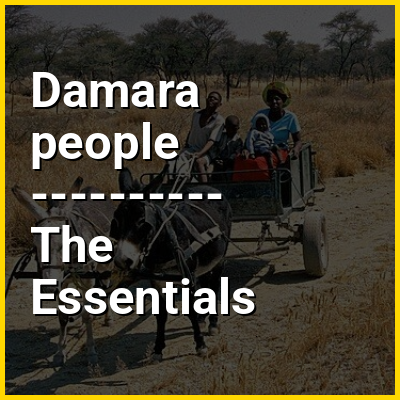
The Damara, plural Damaran (Khoekhoegowab: ǂNūkhoen, Black people, German: Bergdamara, referring to their extended stay in hilly and mountainous sites, also called at various times the Daman or the Damaqua) are an ethnic group who make up 8.5% of Namibia's population. They speak the Khoekhoe language (like the Nama people) and the majority live in the northwestern regions of Namibia, however, they are also found widely across the rest of the country.

Genetic studies have found that Damara are closely related to neighbouring Himba and Herero people, consistent with an origin from Bantu speakers who shifted to a different language and culture.

↓ Menu
HINT:

In this Dossier

Damara people in the context of Namibia

Namibia, officially the Republic of Namibia, is a country in Southern Africa. Its borders include the Atlantic Ocean to the west, Angola and Zambia to the north, Botswana to the east and South Africa to the south; in the northeast, approximating a quadripoint, Zimbabwe lies less than 200 metres (660 feet) away along the Zambezi River near Kazungula, Zambia. Namibia's capital and largest city is Windhoek.

Namibia is the driest country in sub-Saharan Africa, and has been inhabited since prehistoric times by the Khoi, San, Damara and Nama people. Around the 14th century, immigrating Bantu peoples arrived as part of the Bantu expansion. From 1600 the Owambo formed kingdoms, such as Ondonga and Oukwanyama.

View the full Wikipedia page for Namibia
↑ Return to Menu

Damara people in the context of Khoisan

Khoisan (/ˈkɔɪsɑːn/ KOY-sahn) or Khoe-Sān (pronounced [kʰoɪˈsaːn]) is an umbrella term for the various indigenous peoples of Southern Africa who traditionally speak non-Bantu languages, combining the Khoekhoen and the Sān peoples. Khoisan populations traditionally speak click languages. They are considered to be the historical communities throughout Southern Africa, remaining predominant until Bantu and European colonisation. The Khoisan have lived in areas climatically unfavourable to Bantu (sorghum-based) agriculture, from the Cape region to Namibia and Botswana, where Khoekhoe populations of Nama and Damara people are prevalent groups. Considerable mingling with Bantu-speaking groups is evidenced by prevalence of click phonemes in many Southern African Bantu languages, especially Xhosa.

Many Khoesan peoples are the descendants of an early dispersal of anatomically modern humans to Southern Africa before 150,000 years ago. (However, see below for recent work supporting a multi-regional hypothesis that suggests the Khoisan may be a source population for anatomically modern humans.) Their languages show a limited typological similarity, largely confined to the prevalence of click consonants. They are not verifiably derived from a single common proto-language, but are split among at least three separate and unrelated language families (Khoe-Kwadi, Tuu and Kxʼa). It has been suggested that the Khoekhoe may represent Late Stone Age arrivals to Southern Africa, possibly displaced by Bantu expansion reaching the area roughly between 1,500 and 2,000 years ago.

View the full Wikipedia page for Khoisan
↑ Return to Menu