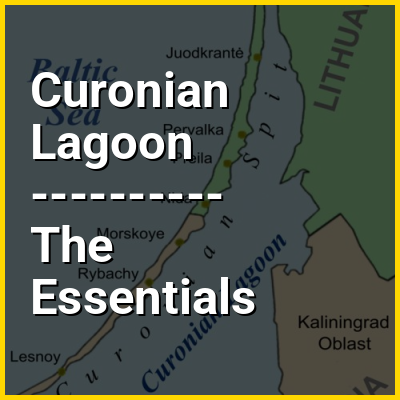
The Curonian Lagoon (or Bay, Gulf; Lithuanian: Kuršių marios, Prussian: Kursjanmari, Russian: Куршский залив) is a freshwater lagoon separated from the Baltic Sea by the Curonian Spit. Its surface area is 1,619 square kilometers (625 sq mi). The Neman River (Lithuanian: Nemunas) supplies about 90% of its inflows; its watershed consists of about 100,450 square kilometres in Lithuania and Russia's Kaliningrad Oblast.
>>>PUT SHARE BUTTONS HERE<<<
In this Dossier
- ⭐ Core Definition: Curonian Lagoon
- Curonian Lagoon in the context of Curonian Spit
- Curonian Lagoon in the context of Old Prussians
- Curonian Lagoon in the context of Nemunas
- Curonian Lagoon in the context of Lithuanian State Border Guard Service
- Curonian Lagoon in the context of Scalovia
- Curonian Lagoon in the context of Lithuania–Russia border
Curonian Lagoon in the context of Curonian Spit
The Curonian Spit, sometimes called Courish Split (Lithuanian: Kuršių nerija; Russian: Ку́ршская коса́ / Kurshskaya kosa, German: Kurische Nehrung), is a 98-kilometre (61 mi) long, thin, curved sand-dune spit that separates the Curonian Lagoon from the Baltic Sea. It is a UNESCO World Heritage Site shared by Lithuania and Russia. Its southern portion lies within Kaliningrad Oblast of Russia, and its northern within southwestern Klaipėda County of Lithuania.
Curonian Lagoon in the context of Old Prussians
Old Prussians, Baltic Prussians or simply Prussians were a Baltic people that inhabited the region of Prussia, on the southeastern shore of the Baltic Sea between the Vistula Lagoon to the west and the Curonian Lagoon to the east. As Balts, they spoke an Indo-European language of the Baltic branch now known as Old Prussian and worshipped pre-Christian deities. Their ethnonym was later adopted by predominantly Low German-speaking inhabitants of the region.
The duchy of the Polans under Mieszko I, which was the predecessor of the Kingdom of Poland, first attempted to conquer and baptize the Baltic tribes during the 10th century, but repeatedly encountered strong resistance. Not until the 13th century were the Old Prussians subjugated and their lands conquered by the Teutonic Order. The remaining Old Prussians were assimilated during the following two centuries. The Old Prussian language, documented only in a limited way, was effectively extinct by the 18th century.
Curonian Lagoon in the context of Nemunas
The Neman (based on Russian spelling), Nioman (Belarusian), Nemunas (Lithuanian), Niemen (Polish), or Memel (German), is a river in Europe that rises in central Belarus and flows through Lithuania then forms the northern border of Kaliningrad Oblast, Russia's western exclave, which specifically follows its southern channel. It drains into the Curonian Lagoon, narrowly connected to the Baltic Sea. The 937 km (582 mi) long Neman is a major Eastern European river. It flows generally west to Grodno within 12 kilometres (7.5 mi) of the Polish border, north to Kaunas, then westward again to the sea.
The largest river in Lithuania, and the third-largest in Belarus, it is navigable for most of its length. It starts from two small headwaters merging about 15 kilometers (9 mi) southwest of the town of Uzda – about 55 km (34 mi) southwest of capital city Minsk. Only 17 kilometres (11 mi), an eastward meander, contributes to the Belarus–Lithuania border. Thereafter the river includes notable loops along a minor tectonic fault.
Curonian Lagoon in the context of Lithuanian State Border Guard Service
The State Border Guard Service or VSAT (Lithuanian: Valstybės sienos apsaugos tarnyba) is a border control institution under the Ministry of the Interior of Lithuania charged with controlling and maintaining the security of the Lithuanian borders on land, in the Baltic Sea and the Curonian Lagoon. VSAT is a member of the EU Frontex and is responsible for the security of about 1,070 kilometres (660 mi) of the external border of the European Union with Kaliningrad Oblast (exclave of Russia) and Belarus.
Curonian Lagoon in the context of Scalovia
Scalovia or Skalvia (Lithuanian: Skalva, German: Sclavonia, Schalauen, Polish: Skalowia, Latin: Sclavonia, Schlavonia) was the area of Prussia originally inhabited by the now extinct Baltic tribe of Skalvians or Scalovians which according to the Chronicon terrae Prussiae of Peter of Dusburg lived to the south of the Curonians, by the lower Nemunas river, in the times around 1240.
Jodocus Hondius mentions in 1641 that in "Sclavonia liegen Ragneta, Tilsa, Renum, Liccovia, Salavia, Labia, Tapia, Vintburg, Christader, Bayria, Cestia, Norbeitia, Bensdorff / Angenburg und Dringofordt" The centre of Scalovia was supposed to be Ragnit (Ragneta)(Raganita)(Rogneta) and in the west it bordered the Curonian Lagoon as far as the town of Russ and with Samogitia up north and with Nadrovia in the south.
Curonian Lagoon in the context of Lithuania–Russia border
The Lithuania–Russia border is an international border between the Republic of Lithuania (EU member) and Kaliningrad Oblast, an exclave of the Russian Federation (CIS member). It is an external border of the European Union. The 274.9 km (170.8 mi) long border passes (from west to south-east clockwise) through the Curonian Spit and Curonian Lagoon, and then follows along the Neman River, Šešupė, Širvinta, Liepona, and Lake Vištytis. The sea border is another 22.2 km (13.8 mi). There is a tripoint between Lithuania, Russia, and Poland with a stone monument at 54°21′48″N 22°47′31″E / 54.36333°N 22.79194°E.
Most of the border follows rivers or lakes. On land, border stations are equipped with engineering and technical facilities (wired fences and the exclusion zone). Most other land areas have no fence, but some places near roads or villages have fences (e.g. at 54°27′11″N 22°42′08″E / 54.45306°N 22.70222°E with Street View coverage). Russians need a Schengen visa to cross the border into Lithuania, and Lithuanians need a Russian visa to go to Russia.