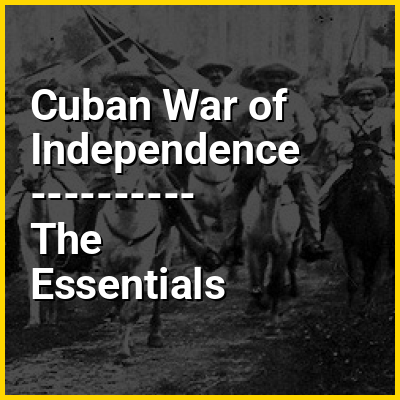
The Cuban War of Independence (Spanish: Guerra de Independencia cubana), also known in Cuba as the Necessary War (Spanish: Guerra Necesaria), fought from 1895 to 1898, was the last of three liberation wars that Cuba fought against Spain, the other two being the Ten Years' War (1868–1878) and the Little War (1879–1880). During the war, Spain sent 220,285 soldiers to Cuba—according to the Library of Congress, the largest army to cross the Atlantic until World War II. The final three months of the conflict escalated to become the Spanish–American War, with United States forces being deployed in Cuba, Puerto Rico, and the Philippines against Spain. Historians disagree as to the extent that United States officials were motivated to intervene for humanitarian reasons but agree that yellow journalism exaggerated atrocities attributed to Spanish forces against Cuban civilians.
>>>PUT SHARE BUTTONS HERE<<<
- ⭐ Core Definition: Cuban War of Independence
- Cuban War of Independence in the context of Spanish–American War
- Cuban War of Independence in the context of Cubans
- Cuban War of Independence in the context of Philippine Revolution
- Cuban War of Independence in the context of Reconcentration policy
- Cuban War of Independence in the context of Decolonization of the Americas
- Cuban War of Independence in the context of Winston Churchill as a writer
- Cuban War of Independence in the context of Ten Years' War
- Cuban War of Independence in the context of Little War (Cuba)
- Cuban War of Independence in the context of Cuban Liberation Army
Cuban War of Independence in the context of Spanish–American War
The Spanish–American War (April 21 – August 13, 1898) was fought between Spain and the United States in 1898. It began with the sinking of the USS Maine in Havana Harbor in Cuba, and resulted in the U.S. acquiring sovereignty over Puerto Rico, Guam, and the Philippines, and establishing a protectorate over Cuba. It represented U.S. intervention in the Cuban War of Independence and Philippine Revolution, with the latter later leading to the Philippine–American War. The Spanish–American War brought an end to almost four centuries of Spanish presence in the Americas, Asia, and the Pacific; the United States meanwhile not only became a major world power, but also gained several island possessions spanning the globe, which provoked rancorous debate over the wisdom of expansionism.
The 19th century represented a clear decline for the Spanish Empire, while the United States went from a newly founded country to a rising power. In 1895, Cuban nationalists began a revolt against Spanish rule, which was brutally suppressed by the colonial authorities. W. Joseph Campbell argues that yellow journalism in the U.S. exaggerated the atrocities in Cuba to sell more newspapers and magazines, which swayed American public opinion in support of the rebels. But historian Andrea Pitzer also points to the actual shift toward savagery of the Spanish military leadership, who adopted the brutal reconcentration policy after replacing the relatively conservative Governor-General of Cuba Arsenio Martínez Campos with the more unscrupulous and aggressive Valeriano Weyler, nicknamed "The Butcher." President Grover Cleveland resisted mounting demands for U.S. intervention, as did his successor William McKinley. Though not seeking a war, McKinley made preparations in readiness for one.
Cuban War of Independence in the context of Cubans
Cubans (Spanish: Cubanos) are the citizens and nationals of Cuba. The Cuban people have varied origins with the most spoken language being Spanish. The larger Cuban diaspora includes individuals that trace ancestry to Cuba and self-identify as Cuban but are not necessarily Cuban by citizenship. The United States has the largest Cuban population in the world after Cuba.
The modern nation of Cuba, located in the Caribbean, emerged as an independent country following the Spanish-American War of 1898, which led to the end of Spanish colonial rule. The subsequent period of American influence, culminating in the formal independence of Cuba in 1902, initiated a complex process of national identity formation. This identity is characterized by a blend of Indigenous Taíno, African, and Spanish cultural elements, reflecting a unique multicultural heritage. The Cuban Revolution of 1959, which brought Fidel Castro to power, marked a significant turning point as it transformed the political landscape, reinforced a sense of national identity centered around revolutionary and socialist ideals and led to the continuing Cuban exodus, establishing the Cuban Diaspora.
Cuban War of Independence in the context of Philippine Revolution
The Philippine Revolution (Filipino: Himagsikang Pilipino or Rebolusyong Pilipino; Spanish: Revolución Filipina or Guerra Tagala) was a war of independence waged by the revolutionary organization Katipunan against the Spanish Empire from 1896 to 1898. It was the culmination of the 333-year colonial rule of Spain in the archipelago. The Philippines was one of the last major colonies of the Spanish Empire, which had already suffered a massive decline in the 1820s. Cuba rebelled in 1895, and in 1898, the United States intervened and the Spanish soon capitulated. In June, Philippine revolutionaries declared independence. However, it was not recognized by Spain, which sold the islands to the United States in the Treaty of Paris.
Led by Andrés Bonifacio, the Katipunan was formed in secrecy in 1892 in the wake of the nascent La Liga Filipina, an organization created by Filipino nationalist José Rizal and others in Spain with goals of Philippine representation to the Spanish Parliament. Katipunan soon gained influence across the islands, and sought an armed revolution. However, that revolution started prematurely in August 1896 upon its discovery by Spanish authorities in Manila. The organization soon declared war against Spain in Caloocan. Early battles and skirmishes were centered around sieging the capital city of Manila led by Bonifacio himself, which ultimately failed. However, revolutionaries in the neighboring provinces fared better, particularly in Cavite, where rebels led by Mariano Álvarez and cousins Baldomero and Emilio Aguinaldo won early major victories. This disparity in success, along with multiple factors, contributed to the eventual power struggle from within Katipunan's leadership. Two factions formed: Bonifacio's Magdiwang and Aguinaldo's Magdalo. This struggle culminated in the 1897 elections in Tejeros, which saw Emilio Aguinaldo elected as president in absentia. Bonifacio nullified the results after a Magdalo member questioned his election as the Secretary of the Interior. This resulted in a schism, with Bonifacio's supporters alleging that the elections were fraudulent, with Bonifacio himself refusing to recognize the results. In April 1897, Aguinaldo ordered the arrest of Bonifacio. A trial was set in Maragondon, where the Magdalo-led jury found Bonifacio and his brother Procopio guilty of treason, sentencing both of them to death. Despite calls for commuting the sentence for the sake of national unity, the brothers were executed in May 1897. Later that year, Aguinaldo's government and Spanish authorities signed the Pact of Biak-na-Bato, which temporarily reduced hostilities. Filipino revolutionary officers exiled themselves to Hong Kong. However, the hostilities never completely ceased.
Cuban War of Independence in the context of Reconcentration policy
The reconcentration policy (Spanish: Reconcentración) was a plan implemented by Spanish military officer Valeriano Weyler during the Cuban War of Independence to relocate Cuba's rural population into concentration camps. It was originally developed by Weyler's predecessor, Arsenio Martínez Campos, as a method of separating Cuban rebels from the rural populace which often supplied or sheltered them. Under the policy, rural Cubans had eight days to relocate to concentration camps in fortified towns, and all who failed to do so were to be shot.
The quality of the camps was abysmal, with the housing being in poor condition and the camp rations insufficient and of poor quality; disease also quickly spread through the camps. By 1898, a third of the Cuban population had been moved into camps where at least 170,000 people died due to either disease or a variety of other causes, resulting in the deaths of at least 10% of all Cubans. The Spanish were eventually defeated in the conflict, and as a result all the camps were shut down.
Cuban War of Independence in the context of Decolonization of the Americas
The decolonization of the Americas occurred over several centuries as most of the countries in the Americas gained their independence from European rule. The American Revolution was the first in the Americas, and the British defeat in the American Revolutionary War (1775–83) was a victory against a great power, aided by France and Spain, Britain's enemies. The French Revolution in Europe followed, and collectively these events had profound effects on the Spanish, Portuguese, and French colonies in the Americas. A revolutionary wave followed, resulting in the creation of several independent countries in Latin America. The Haitian Revolution (1791–1804), perhaps one of the most successful slave uprisings in history, resulted in the independence of the French slave colony of Saint-Domingue (now Haiti). The Peninsular War with France, which resulted from the Napoleonic occupation of Spain, caused Spanish Creoles in Spanish America to question their allegiance to Spain, stoking independence movements that culminated in various Spanish American wars of independence (1808–33), which were primarily fought between opposing groups of colonists and only secondarily against Spanish forces. At the same time, the Portuguese monarchy fled to Brazil during the French invasion of Portugal. After the royal court returned to Lisbon, the prince regent, Pedro, remained in Brazil and in 1822 successfully declared himself emperor of a newly independent Brazilian Empire.
Spain would lose all three of its remaining Caribbean colonies by the end of the 1800s. Santo Domingo declared its first independence from Spain in 1821. The independent state was renamed Republic of Spanish Haiti. Haiti conquered the region shortly afterwards in 1822. Two decades later, in 1844, independence was proclaimed for the second time, and the Dominican Republic was established. This triggered the Dominican War of Independence (1844–56). In 1861, however, Spain regained control of the territory, and the colony was reestablished. The Dominican Restoration War (1863–65), the second war of liberation, led to the second independence from Spain, and the Dominican Republic's third and final independence. Cuba fought for independence from Spain in the Ten Years' War (1868–78) and Little War (1879–80) and finally the Cuban War of Independence (1895–98). American intervention in 1898 became the Spanish–American War and resulted in the United States gaining Puerto Rico, Guam (which are still U.S. territories), and the Philippine Islands in the Pacific Ocean. Under military occupation, Cuba became a U.S. protectorate until its independence in 1902.
Cuban War of Independence in the context of Winston Churchill as a writer
Winston Churchill, in addition to his careers as a military officer and politician, was a prolific writer under the variant of his full name "Winston S. Churchill". After being commissioned into the 4th Queen's Own Hussars in 1895 Churchill gained permission to observe the Cuban War of Independence, and sent war reports to The Daily Graphic. He continued his war journalism in British India, at the Siege of Malakand, then in the Sudan during the Mahdist War and in southern Africa during the Second Boer War.
Churchill's fictional output included one novel and a short story, but his main output comprised non-fiction. After he was elected as an MP, over 130 of his speeches or parliamentary answers were also published in pamphlets or booklets; many were subsequently published in collected editions. Churchill received the Nobel Prize in Literature in 1953 "for his mastery of historical and biographical description as well as for brilliant oratory in defending exalted human values".
Cuban War of Independence in the context of Ten Years' War
The Ten Years' War (Spanish: Guerra de los Diez Años; 1868–1878), also known as the Great War (Guerra Grande) and the War of '68, was part of Cuba's fight for independence from Spain. The uprising was led by Cuban-born planters and other wealthy natives. On 10 October 1868, sugar mill owner Carlos Manuel de Céspedes and his followers proclaimed independence, beginning the conflict. This was the first of three liberation wars that Cuba fought against Spain, the other two being the Little War (1879–1880) and the Cuban War of Independence (1895–1898). The final three months of the last conflict escalated with United States involvement, leading to the Spanish–American War.
Cuban War of Independence in the context of Little War (Cuba)
The Little War or Small War (Spanish: Guerra Chiquita) was the second of three conflicts between Cuban rebels and Spain. It started on 26 August 1879 and after some minor successes ended in rebel defeat in September 1880. It followed the Ten Years' War of 1868–78 and preceded the final war of 1895–98, which resulted in American intervention and Cuban independence.
Cuban War of Independence in the context of Cuban Liberation Army
The Cuban Liberation Army (Spanish: Ejército Libertador de Cuba), colloquially known as the Mambí Army (Ejército Mambí) was an insurgent army which was formed in the last third of the 19th century and fought for independence from Spain and the abolition of slavery. It first saw combat in the Ten Years' War (1868–1878) under the command of Carlos Manuel de Céspedes, Ignacio Agramonte, and Carlos Roloff. The independentists were decentralized and operated within their own regions autonomously of each other, until the Assembly of Guáimaro established the Republic-in-Arms of Cuba and the Liberation Army's command structure. After the Pact of Zanjón, a brief uprising called the Little War saw Majors-General Calixto García and Antonio Maceo lead the Army of Liberation in another attempt at independence and the abolition of slavery, though unsuccessfully. Finally, during the War of Independence, the Liberation Army was once again organized to fight against the Spanish colonial government. The Liberation Army would reach its highest count of active members in the Spanish-American War, when an imminent Cuban-American victory caused hitherto anti-independence elites to join the Liberation Army. These recruits were nicknamed "Sunflowers" because they "point to where the sun is shining".