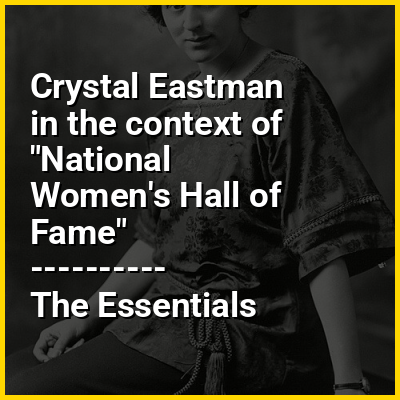
Crystal Catherine Eastman (June 25, 1881 – July 28, 1928) was an American lawyer, antimilitarist, feminist, socialist, and journalist. She was a leader in the fight for women's suffrage, a co-founder and co-editor with her brother Max Eastman of the radical arts and politics magazine The Liberator, co-founder of the Women's International League for Peace and Freedom, and co-founder in 1920 of the American Civil Liberties Union. In 2000, she was inducted into the National Women's Hall of Fame in Seneca Falls, New York.
HINT:
In this Dossier
- ⭐ Core Definition: Crystal Eastman
- Crystal Eastman in the context of Max Eastman
- Crystal Eastman in the context of Equal Rights Amendment
- Crystal Eastman in the context of The Liberator (magazine)
Crystal Eastman in the context of Max Eastman
Max Forrester Eastman (January 4, 1883 – March 25, 1969) was an American writer on literature, philosophy, and society, a poet, and a prominent political activist. Moving to New York City for graduate school, Eastman became involved with radical circles in Greenwich Village. He supported socialism and became a leading patron of the Harlem Renaissance and an activist for a number of liberal and radical causes. For several years, he edited The Masses. With his sister Crystal Eastman, he co-founded in 1917 The Liberator, a radical magazine of politics and the arts.
While residing in the Soviet Union from the fall of 1922 to the summer of 1924, Eastman was influenced by the power struggle between Leon Trotsky and Joseph Stalin and the events leading to Stalin's eventual seizure of power. As a result of the Great Purge and the Soviet Union's totalitarianism, he became highly critical first of Stalinism and then of communism and socialism in general. While remaining an atheist, he became an advocate of free market economics and anti-communism. In 1955, he published Reflections on the Failure of Socialism. He published more frequently in National Review and other conservative journals in later life. He publicly opposed United States involvement in the Vietnam War in the 1960s.
View the full Wikipedia page for Max EastmanCrystal Eastman in the context of Equal Rights Amendment
The Equal Rights Amendment (ERA) is a proposed amendment to the United States Constitution that would explicitly prohibit sex discrimination. It is not currently a part of the Constitution, though its ratification status has long been debated. It was written by Alice Paul and Crystal Eastman and first introduced in Congress in December 1923. With the rise of the women's movement in the United States during the 1960s, the ERA garnered increasing support, and, after being reintroduced by Representative Martha Griffiths in 1971, it was approved by the U.S. House of Representatives that year, and by the U.S. Senate in 1972, thus submitting the ERA to the state legislatures for ratification, as provided by Article Five of the United States Constitution. A seven-year, 1979, deadline was included with the legislation by Congress. A simple majority of Congress later extended the deadline to 1982. Both deadlines passed with the ERA three short of the necessary 38 states for ratification. Even so, there are ongoing efforts to ratify the amendment.
The purpose of the ERA is to guarantee equal legal rights for all American citizens regardless of sex. In the early history of the Equal Rights Amendment, middle-class women were largely supportive, while those speaking for the working class were often opposed, arguing that women should hold more domestic responsibility than men and that employed women needed special protections regarding working conditions and employment hours. Proponents asserted it would end legal distinctions between men and women in matters including divorce, property, and employment. Opponents have argued that it would remove protections from women and open women to be drafted into the military.
View the full Wikipedia page for Equal Rights AmendmentCrystal Eastman in the context of The Liberator (magazine)
The Liberator was a monthly socialist magazine published from 1918 to 1924. It was established by Max Eastman and his sister Crystal Eastman in 1918 to continue the work of The Masses, which was shut down by the wartime mailing regulations of the U.S. government. Intensely political, the magazine included copious quantities of art, poetry, and fiction along with political reporting and commentary. The publication was an organ of the Communist Party of America (CPA) from late 1922 and was merged with two other publications to form The Workers Monthly in 1924.
View the full Wikipedia page for The Liberator (magazine)