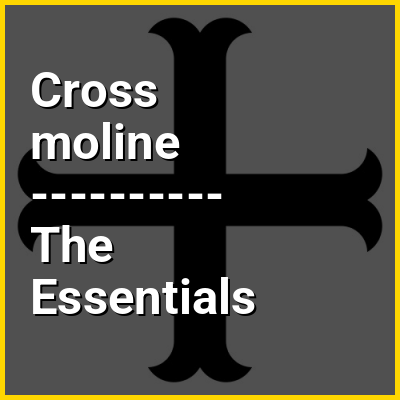
The cross moline (also cross anchory, French croix ancrée "anchor cross") is a Christian cross, constituting a kind of heraldic cross.

The cross moline (also cross anchory, French croix ancrée "anchor cross") is a Christian cross, constituting a kind of heraldic cross.
The Christian cross, seen as symbolizing the crucifixion of Jesus, is a symbol of Christianity. It is related to the crucifix, a cross that includes a corpus (a representation of Jesus's body, usually three-dimensional) and to the more general family of cross symbols. The term cross is now detached from its original specifically Christian meaning, in modern English and many other Western languages.
The basic forms of the cross are the Latin cross with unequal arms and the Greek cross with equal arms; there are numerous variants, partly with confessional significance - such as the tau cross, the double-barred cross, triple-barred cross, and cross-and-crosslets - and many heraldic variants, such as the cross potent, cross pattée, and cross moline, cross fleury.
In heraldry, cadency is any systematic way to distinguish arms displayed by descendants of the holder of a coat of arms when those family members have not been granted arms in their own right. Cadency is necessary in heraldic systems in which a given design may be owned by only one person at any time, generally the head of the senior line of a particular family.
As an armiger's arms may be used 'by courtesy', either by children or spouses, while they are still living, some form of differencing may be required so as not to confuse them with the original undifferenced or "plain coat" arms. Historically, arms were only heritable by males, and therefore cadency marks had no relevance to daughters; in the modern era, Canadian and Irish heraldry include daughters in cadency.