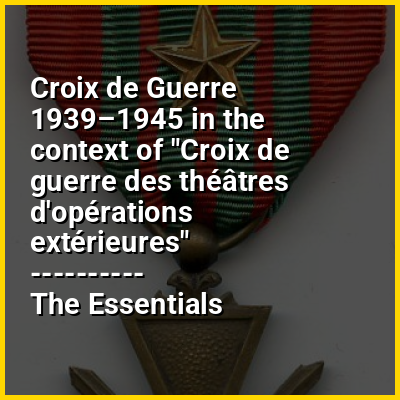
The Croix de Guerre 1939–1945 (English: War Cross 1939–1945) is a French military decoration, a version of the Croix de Guerre created on 26 September 1939 to honour people who fought with the Allies against the Axis forces at any time during World War II. After Germany invaded and overran mainland France in the Battle of France in May and June 1940, this Croix de Guerre was replaced by the pro-Axis Vichy French government with another Croix with a black-and-green ribbon, while the original was upheld by Free France. Since the triumph of the Free French side in World War II, this version is the only one officially recognized by the French government.
HINT:
👉 Croix de Guerre 1939–1945 in the context of Croix de guerre des théâtres d'opérations extérieures
The Croix de guerre des théâtres d'opérations extérieurs (French pronunciation: [kʁwa d(ə) ɡɛʁ de teɑtʁ dɔpeʁɑsjɔ̃ ɛksteʁjœʁ]; "War Cross for Foreign Operational Theatres"), also called the Croix de Guerre TOE for short, is a French military award denoting citations earned in combat in foreign countries. The Armistice of November 11, 1918 ended the war between France and Germany, but French soldiers continued fighting in theatres outside metropolitan France. Combat operations continued in Syria, Palestine, Constantinople, Morocco, French West Africa and French Equatorial Africa.
The Croix de Guerre TOE is the second of three versions of the Croix de Guerre created since the award's inception, (the others being distinct versions for World War I and World War II), and the only one considered active for new awards.