The Cossack raids largely developed as a reaction to the Crimean–Nogai slave raids in Eastern Europe, which began in 1441 and lasted until 1774. From c. 1492 onwards, the Cossacks (the Zaporozhian Cossacks of southern Ukraine and the Don Cossacks of southern Russia) conducted regular military offensives into the lands of the Crimean Khanate, the Nogai Horde, and the Ottoman Empire, where they would free enslaved Christians and return home with a significant amount of plunder and Muslim slaves. Unlike the Tatars, Cossack raiders were capable of capturing and devastating highly fortified cities. Though difficult to calculate, the level of devastation caused by the Cossack raids is roughly estimated to have been on par with that of the Crimean–Nogai slave raids. According to History of Ruthenians, Cossack raids during Sirko's era were a hundred times more devastating than Crimean–Nogai raids.
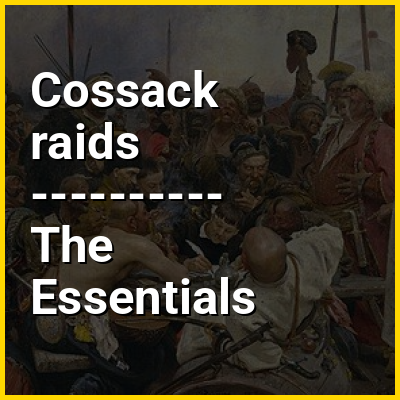
- ⭐ Core Definition: Cossack raids
- Cossack raids in the context of Crimean–Nogai slave raids in Eastern Europe
- Cossack raids in the context of Cossacks
- Cossack raids in the context of Military career of Ivan Sirko
Cossack raids in the context of Crimean–Nogai slave raids in Eastern Europe
Between 1441 and 1774, the Crimean Khanate and the Nogai Horde conducted slave raids throughout lands primarily controlled by Russia and Poland–Lithuania. Concentrated in Eastern Europe, but also stretching to the Caucasus and parts of Central Europe, these raids were often supported by the Ottoman Empire and involved the transportation of European men, women, and children to the Muslim world, where they were put on the market and sold as part of the Crimean slave trade and the Ottoman slave trade. The regular abductions of people over the course of numerous incursions by the Crimeans and the Nogais greatly drained Eastern Europe's human and economic resources, consequently playing an important role in the emergence of the semi-militarized Cossacks, who organized retaliatory campaigns against the raiders and their Ottoman backers.
Trading posts in Crimea had previously been established by the Genoese and the Venetians to facilitate earlier Western European slave routes. The Crimean–Nogai raids largely targeted the "Wild Fields" of the Pontic–Caspian steppe, which extends about 800 kilometres (500 mi) north of the Black Sea and which now contains the majority of the combined population of southeastern Ukraine and southwestern Russia.
View the full Wikipedia page for Crimean–Nogai slave raids in Eastern EuropeCossack raids in the context of Cossacks
The Cossacks are a predominantly East Slavic, Eastern Christian people, originating from the Pontic–Caspian steppe of eastern Ukraine and southern Russia. Cossacks played an important role in defending the southern borders of Ukraine and Russia, countering the Crimean-Nogai raids, alongside economically developing steppe regions north of the Black Sea and around the Azov Sea. Historically, they were a semi-nomadic and semi-militarized people, who were allowed a great degree of self-governance in exchange for military service under the nominal suzerainty of various Eastern European states. Although numerous ethnic, linguistic and religious groups came together to form the Cossacks, most of them gradually coalesced and Slavicized, thereby adopting East Slavic culture, East Slavic languages and Eastern Orthodox Christianity.
The rulers of the Polish–Lithuanian Commonwealth and Russian Empire endowed Cossacks with certain special privileges in return for the military duty to serve in the irregular troops: Zaporozhian Cossacks were mostly infantry soldiers, using war wagons, while Don Cossacks were mostly cavalry soldiers. The various Cossack groups were organized along military lines, with large autonomous groups called hosts. Each host had a territory consisting of affiliated villages called stanitsas.
View the full Wikipedia page for CossacksCossack raids in the context of Military career of Ivan Sirko
The military career of Ivan Sirko spanned for nearly 60 years. He led the Zaporozhian Cossack army first as Polkovnyk (Colonel) and later as Kosh Otaman, position to which he was re-elected at least 8 times. Sirko's exploits against the Ottoman Empire and Crimean Khanate gained attention of entire Europe. He later became an inspiration and key figure of Ilya Repin's Reply of the Zaporozhian Cossacks. Ivan Sirko was particularly memorized in poems and literature. In Ukraine, Sirko is considered to be a national hero.
Ivan Sirko's military career is legendary. According to historian Dmytro Yavornytsky, Sirko led 55 campaigns during his career and never lost a battle. Recent research allows to increase number of Sirko's battles and campaigns, but Sirko wasn't confirmed to have suffered a defeat in any of them. Only Polish sources claim Sirko suffered 3 defeats in battle. New sources put Sirko's military record at over 65 victories in battles.
View the full Wikipedia page for Military career of Ivan Sirko