Coronation of the British monarch in the context of "Regalia"

Play Trivia Questions online!

or

Skip to study material about Coronation of the British monarch in the context of "Regalia"

Ad spacer

⭐ Core Definition: Coronation of the British monarch

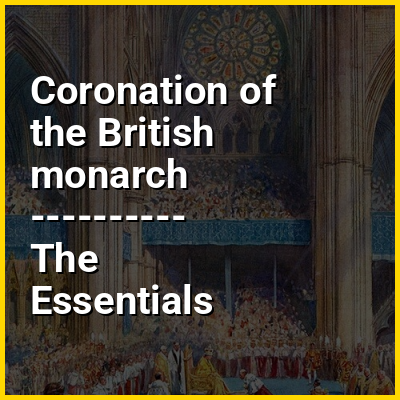
The coronation of the monarch of the United Kingdom is an initiation ceremony in which they are formally invested with regalia and crowned at Westminster Abbey. It corresponds to the coronations that formerly took place in other European monarchies, which have all abandoned coronations in favour of inauguration or enthronement ceremonies. A coronation is a symbolic formality and does not signify the official beginning of the monarch's reign; de jure and de facto his or her reign commences from the moment of the preceding monarch's death or abdication, maintaining legal continuity of the monarchy.

The coronation usually takes place several months after the death of the monarch's predecessor, as it is considered a joyous occasion that would be inappropriate while mourning continues. This interval also gives planners enough time to complete the required elaborate arrangements. The most recent coronation took place on 6 May 2023 to crown King Charles III and Queen Camilla.
↓ Menu

>>>PUT SHARE BUTTONS HERE<<<
In this Dossier

Coronation of the British monarch in the context of Westminster Abbey

Westminster Abbey, formally titled the Collegiate Church of Saint Peter at Westminster, is an Anglican church in the City of Westminster, London, England. Since 1066, it has been the location of the coronations of 40 English and British monarchs and a burial site for 18 English, Scottish, and British monarchs. At least 16 royal weddings have taken place at the abbey since 1100.

Although the origins of the church are obscure, an abbey housing Benedictine monks was on the site by the mid-10th century. The church got its first large building from the 1040s, commissioned by King Edward the Confessor, who is buried inside. Construction of the present church began in 1245 on the orders of Henry III. The monastery was dissolved in 1559, and the church was made a royal peculiar – a Church of England church, accountable directly to the sovereign – by Elizabeth I. The abbey, the Palace of Westminster and St Margaret's Church became a UNESCO World Heritage Site in 1987 because of their historic and symbolic significance.

↑ Return to Menu

Coronation of the British monarch in the context of Coronation of Charles III and Camilla

The coronation of Charles III and his wife, Camilla, as king and queen of the United Kingdom and the 14 other Commonwealth realms, took place on Saturday, 6 May 2023 at Westminster Abbey. Charles acceded to the throne on 8 September 2022 upon the death of his mother, Elizabeth II.

The ceremony was structured around an Anglican service of Holy Communion. It included the King taking an oath, being anointed with holy oil, and receiving the coronation regalia, emphasising his spiritual role and secular responsibilities. Representatives of the Church of England and the British royal family declared their allegiance to him, and people throughout the Commonwealth realms were invited to do so. The Queen was crowned in a shorter and simpler ceremony. After the service, members of the royal family travelled to Buckingham Palace in a state procession and appeared on the palace's rear and front balconies. The service was altered from past British coronations to represent the multiple faiths, cultures, and communities of the United Kingdom, and was shorter than Elizabeth II's coronation. It had a peak UK television audience of 20.4 million, making it the most watched television broadcast of 2023, and attracted a global audience of 2 billion people across 125 countries.

↑ Return to Menu

Coronation of the British monarch in the context of St Edward's Crown

St Edward's Crown is the coronation crown of the Crown Jewels of the United Kingdom. Named after Saint Edward the Confessor, versions of it have traditionally been used to crown English and British monarchs at their coronations since the 13th century. It is normally on public display in the Jewel House at the Tower of London, and is widely regarded as one of the most important pieces of regalia in the British monarchy.

The original crown was a holy relic kept at Westminster Abbey, Edward's burial place, until the regalia were either sold or melted down when Parliament abolished the monarchy in 1649, during the English Civil War. The current St Edward's Crown was made for Charles II in 1661. It is 22-carat gold, 30 centimetres (12 in) tall, weighs 2.23 kilograms (4.9 lb), and is decorated with 444 precious and fine gemstones. The crown is similar in weight and overall appearance to the original, but its arches are Baroque. It was recognised by Guinness World Records as the most valuable crown in the world.

↑ Return to Menu

Coronation of the British monarch in the context of College of Arms

The College of Arms (or Heralds' College) is the heraldic authority for England, Wales, Northern Ireland, and some Commonwealth realms; the heraldic authority for Scotland is the Court of the Lord Lyon. The College is a royal corporation consisting of professional officers of arms who act on behalf of the Crown in matters of heraldry, including the granting of new coats of arms; genealogical research; and the recording of pedigrees. The College is also responsible for matters relating to the flying of flags on land, and maintains the official registers of flags and other national symbols. It is also involved in the planning of ceremonial occasions such as coronations, state funerals, the annual Garter Service, and the State Opening of Parliament. The officers of arms accompany the monarch on many of these occasions.

King Richard III of England founded the College by royal charter in 1484. The College has been located in the City of London since its foundation, and has been at its present site on Queen Victoria Street since 1555. There are thirteen officers or heralds, who are appointed by the monarch: three Kings of Arms, six Heralds of Arms, and four Pursuivants of Arms. There are also seven officers extraordinary, who take part in ceremonial occasions but are not part of the College. The entire corporation is overseen by the Earl Marshal, a hereditary office always held by the Duke of Norfolk.

↑ Return to Menu

Coronation of the British monarch in the context of Crown Jewels of the United Kingdom

The Crown Jewels of the United Kingdom, originally the Crown Jewels of England, are a collection of royal ceremonial objects kept in the Jewel House at the Tower of London, which include the coronation regalia and vestments worn by British monarchs.

The coronation regalia are the only working set in Europe and the collection is the most historically complete of any royal regalia in the world. Objects used at the coronation ceremony variously denote the monarch's roles as head of state of the United Kingdom, Supreme Governor of the Church of England, and head of the British armed forces. The regalia feature heraldic devices and national emblems of England, Scotland, Wales, Northern Ireland, and other Commonwealth countries.

↑ Return to Menu

Coronation of the British monarch in the context of Bishop of Lindisfarne

The bishop of Durham is head of the diocese of Durham in the province of York. The diocese is one of the oldest in England and its bishop is a member of the House of Lords. Paul Butler was the most recent bishop of Durham until his retirement in February 2024.

The bishop is officially styled The Right Reverend (First Name), by Divine Providence Lord Bishop of Durham, but this full title is rarely used. In signatures, the bishop's family name is replaced by Dunelm, from the Latin name for Durham (the Latinised form of Old English Dunholm). In the past, bishops of Durham varied their signatures between Dunelm and the French Duresm. Prior to 1836 the bishop had significant temporal powers over the liberty of Durham and later the county palatine of Durham. The bishop, with the bishop of Bath and Wells, escorts the sovereign at the coronation.

↑ Return to Menu

Coronation of the British monarch in the context of William Walton

Sir William Turner Walton OM (29 March 1902 – 8 March 1983) was an English composer. During a sixty-year career, he wrote music in several classical genres and styles, from film scores to opera. His best-known works include Façade, the cantata Belshazzar's Feast, the Viola Concerto, the First Symphony, and the British coronation marches Crown Imperial and Orb and Sceptre.

Born in Oldham, Lancashire, the son of a musician, Walton was a chorister and then an undergraduate at Christ Church, Oxford. On leaving the university, he was taken up by the literary Sitwell siblings, who provided him with a home and a cultural education. His earliest work of note was a collaboration with Edith Sitwell, Façade, which at first brought him notoriety as a modernist, but later became a popular ballet score.

↑ Return to Menu

Coronation of the British monarch in the context of Princes in the Tower

The Princes in the Tower refers to the mystery of the fate of the deposed King Edward V of England and his younger brother Prince Richard of Shrewsbury, Duke of York, heirs to the throne of King Edward IV of England. The brothers were the only sons of the king by his queen, Elizabeth Woodville, living at the time of their father's death in 1483. Aged 12 and 9 years old, respectively, they were lodged in the Tower of London by their paternal uncle and England's regent, Richard, Duke of Gloucester, in preparation for Edward V's forthcoming coronation. Before the young king's coronation, however, he and his brother were declared illegitimate by Parliament. Gloucester ascended the throne as Richard III.

It is unclear what happened to the two princes after the last recorded sighting of them in the tower. It is generally assumed that they were murdered; a common hypothesis is that the murder was commissioned by Richard III in an attempt to secure his hold on the throne. Their deaths may have occurred sometime in 1483, but apart from their disappearance, the only evidence is circumstantial. As a result, several other theories about their fates have been proposed, including the suggestion that they were murdered by their kinsman the Duke of Buckingham, their future brother-in-law King Henry VII, or his mother Lady Margaret Beaufort, among others. It has also been suggested that one or both princes may have escaped assassination. In 1487, Lambert Simnel initially was crowned in Dublin as "King Edward", but later claimed by others to be York's cousin the Earl of Warwick. And again several years later, from 1491 until his capture in 1497, Perkin Warbeck claimed to be the Duke of York, having supposedly escaped to Flanders. Warbeck's claim was supported by some contemporaries, including York's aunt the Duchess of Burgundy.

↑ Return to Menu