In geometry, a coordinate system is a system that uses one or more numbers, or coordinates, to uniquely determine and standardize the position of the points or other geometric elements on a manifold such as Euclidean space. The coordinates are not interchangeable; they are commonly distinguished by their position in an ordered tuple, or by a label, such as in "the x-coordinate". The coordinates are taken to be real numbers in elementary mathematics, but may be complex numbers or elements of a more abstract system such as a commutative ring. The use of a coordinate system allows problems in geometry to be translated into problems about numbers and vice versa; this is the basis of analytic geometry.

HINT:
In this Dossier
- ⭐ Core Definition: Coordinate
- Coordinate in the context of Two-dimensional
- Coordinate in the context of One-dimensional space
- Coordinate in the context of Mare Undarum
- Coordinate in the context of Sinus Successus
- Coordinate in the context of Ordinate
- Coordinate in the context of Cosmic time
- Coordinate in the context of Parity (physics)
- Coordinate in the context of List of nearest bright stars
- Coordinate in the context of Voxel
- Coordinate in the context of Parametrization (geometry)
- Coordinate in the context of Lacus Perseverantiae
- Coordinate in the context of 2-dimensional
Coordinate in the context of Two-dimensional
A two-dimensional space is a mathematical space with two dimensions, meaning points have two degrees of freedom: their locations can be locally described with two coordinates or they can move in two independent directions. Common two-dimensional spaces are often called planes, or, more generally, surfaces. These include analogs to physical spaces, like flat planes, and curved surfaces like spheres, cylinders, and cones, which can be infinite or finite. Some two-dimensional mathematical spaces are not used to represent physical positions, like an affine plane or complex plane.
View the full Wikipedia page for Two-dimensionalCoordinate in the context of One-dimensional space
A one-dimensional space (1D space) is a mathematical space in which location can be specified with a single coordinate. An example is the number line, each point of which is described by a single real number. Any straight line or smooth curve is a one-dimensional space, regardless of the dimension of the ambient space in which the line or curve is embedded. Examples include the circle on a plane, or a parametric space curve.In physical space, a 1D subspace is called a "linear dimension" (rectilinear or curvilinear), with units of length (e.g., metre).
In algebraic geometry there are several structures that are one-dimensional spaces but are usually referred to by more specific terms. Any field is a one-dimensional vector space over itself. The projective line over denoted is a one-dimensional space. In particular, if the field is the complex numbers then the complex projective line is one-dimensional with respect to (but is sometimes called the Riemann sphere, as it is a model of the sphere, two-dimensional with respect to real-number coordinates).
View the full Wikipedia page for One-dimensional space


Coordinate in the context of Mare Undarum
Mare Undarum /ʌnˈdɛərəm/ (Latin undārum, the "sea of waves") is a shallow, irregular lunar mare located just north of Mare Spumans on the lunar near side, between the crater Firmicus and the eastern limb. It lies within a trough between the third and fourth raised rings formed by the impact that created the Mare Crisium. The selenographic coordinates of this mare are 7.5° N, 68.7° E. It has a maximum diameter of 245 km.
There are five known lunar domes within the mare. The surrounding basin material is of the Nectarian epoch, with the mare basalt being of the Upper Imbrian epoch. The crater Dubyago can be seen on the southern edge of the mare. On the northeastern edge of the mare is the crater Condorcet P.
View the full Wikipedia page for Mare UndarumCoordinate in the context of Sinus Successus
The lunar feature Sinus Successus /ˈsaɪnəs səkˈsɛsəs/ (Latin sinus successūs "Bay of Success") lies along the eastern edge of Mare Fecunditatis. It is an outward bulge that forms a type of bay. The selenographic coordinates of Sinus Successus are 0.9° N, 59.0° E, and the diameter is 132 km.
Along the eastern edge of the bay is the flooded crater Condon, and the crater Webb forms the southern end of the area. There are no other features of significance on the bay. However the terrain just to the northwest of Sinus Successus was the landing site for the Soviet Luna 18 and Luna 20 probes.
View the full Wikipedia page for Sinus SuccessusCoordinate in the context of Ordinate
In mathematics, the abscissa (/æbˈsɪs.ə/; plural abscissae or abscissas) and the ordinate are respectively the first and second coordinate of a point in a Cartesian coordinate system:
Together they form an ordered pair which defines the location of a point in two-dimensional rectangular space.
View the full Wikipedia page for OrdinateCoordinate in the context of Cosmic time
Cosmic time, or cosmological time, is the time coordinate used in the Big Bang models of physical cosmology. This concept of time avoids some issues related to relativity by being defined within a solution to the equations of general relativity widely used in cosmology.
View the full Wikipedia page for Cosmic timeCoordinate in the context of Parity (physics)
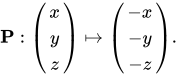
In physics, a parity transformation (also called parity inversion) is the flip in the sign of one spatial coordinate. In three dimensions, it can also refer to the simultaneous flip in the sign of all three spatial coordinates (a point reflection or point inversion):
View the full Wikipedia page for Parity (physics)
Coordinate in the context of List of nearest bright stars
The following nearest bright stars are found within 15.0 parsecs (48.9 ly) of the closest star, the Sun, and have an absolute magnitude of +8.5 or brighter, which is approximately comparable to a listing of stars more luminous than a red dwarf. Right ascension and declination coordinates are for the epoch J2000. The distance measurements are based on the Hipparcos Catalogue and other astrometric data. In the event of a spectroscopic binary, the combined spectral type and absolute magnitude are listed in italics.
View the full Wikipedia page for List of nearest bright starsCoordinate in the context of Voxel
In computing, a voxel is a representation of a value on a three-dimensional regular grid, akin to the two-dimensional pixel. Voxels are frequently used in the visualization and analysis of medical and scientific data (e.g. geographic information systems (GIS)). Voxels also have technical and artistic applications in video games, largely originating with surface rendering in Outcast (1999). Minecraft (2011) makes use of an entirely voxelated world to allow for a fully destructible and constructable environment. Voxel art, of the sort used in Minecraft and elsewhere, is a style and format of 3D art analogous to pixel art.
As with pixels in a 2D bitmap, voxels themselves do not typically have their position (i.e. coordinates) explicitly encoded with their values. Instead, rendering systems infer the position of a voxel based upon its position relative to other voxels (i.e., its position in the data structure that makes up a single volumetric image). Some volumetric displays use voxels to describe their resolution. For example, a cubic volumetric display might be able to show 512×512×512 (or about 134 million) voxels.
View the full Wikipedia page for VoxelCoordinate in the context of Parametrization (geometry)
In mathematics, and more specifically in geometry, parametrization (or parameterization; also parameterisation, parametrisation) is the process of finding parametric equations of a curve, a surface, or, more generally, a manifold or a variety, defined by an implicit equation. The inverse process is called implicitization. "To parameterize" by itself means "to express in terms of parameters".
Parametrization is a mathematical process consisting of expressing the state of a system, process or model as a function of some independent quantities called parameters. The state of the system is generally determined by a finite set of coordinates, and the parametrization thus consists of one function of several real variables for each coordinate. The number of parameters is the number of degrees of freedom of the system.
View the full Wikipedia page for Parametrization (geometry)Coordinate in the context of Lacus Perseverantiae
Lacus Perseverantiae (Latin persevērantiae, "Perseverance") is a small lunar mare extending westward from the northwestern exterior of the crater Firmicus, with smaller extensions to the northeast and northwest at the eastern terminus. Its name is Latin for Lake of Perseverance. The selenographic coordinates are 8.0° N, 62.0° E, and it has a length of 70 km, but a maximum width of less than 15 km.
The name of the lacus was adopted by the IAU in 1979.
View the full Wikipedia page for Lacus PerseverantiaeCoordinate in the context of 2-dimensional
A two-dimensional space is a mathematical space with two dimensions, meaning points have two degrees of freedom: their locations can be locally described with two coordinates or they can move in two independent directions. Common two-dimensional spaces are often called planes, or, more generally, surfaces. These include analogs to physical spaces, like flat planes, and curved surfaces like spheres, cylinders, and cones, which can be infinite or finite. Some two-dimensional mathematical spaces are not used to represent physical positions, like an affine plane or complex plane.
View the full Wikipedia page for 2-dimensional