Continental Marines in the context of "Naval infantry"

Play Trivia Questions online!

or

Skip to study material about Continental Marines in the context of "Naval infantry"

Ad spacer

⭐ Core Definition: Continental Marines

The Continental Marines were the amphibious infantry of the American Colonies (and later the United States) during the American Revolutionary War. The organization was formed by the Continental Congress on November 10, 1775, and was disbanded in 1783. Their mission was multi-purpose, but their most important duty was to serve as onboard security forces, protecting the captain of a ship and his officers. During naval engagements, in addition to manning the cannons along with the crew of the ship, Marine sharpshooters were stationed in the fighting tops of a ship's masts specifically to shoot the opponent's officers, naval gunners, and helmsmen.

In all, there were 131 Colonial Marine officers and probably no more than 2,000 enlisted Colonial Marines. Though individual Marines were enlisted for the few U.S. Naval vessels, the organization would not be re-created until 1798. Despite the gap between the disbanding of the Continental Marines and the current organization, the Continental Marines' successor, U.S. Marine Corps, marks November 10, 1775 as its inception.
↓ Menu

>>>PUT SHARE BUTTONS HERE<<<
In this Dossier

Continental Marines in the context of Marines

Marines (or naval infantry) are military personnel generally trained to operate on both land and sea, with a particular focus on amphibious warfare. Historically, the main tasks undertaken by marines have included raiding ashore (often in support of naval objectives) and the boarding of vessels during ship-to-ship combat or capture of prize ships. Marines also assisted in maintaining security, discipline, and order aboard ships (reflecting the historically pressed-nature of the rest of the ship's company and the risk of mutiny). While maintaining many of their historical roles, in modern times, marines also engage in duties including rapid-response operations, humanitarian aid, disaster relief, special operations roles, and counter-terrorism operations. In most nations, marines are an integral part of that state's navy, such as the United Kingdom's Royal Marines or Russia's Naval Infantry; in some countries their marine forces can instead be part of the land army, such as the French Troupes de marine, or, more uncommonly, a nation’s marine forces may be an independent military branch such as the United States Marine Corps or the Ukrainian Marine Corps.

The exact term "marine" is not found in many languages other than English. In French-speaking countries, two terms which could be translated as "marine", but do not translate exactly: troupes de marine (marine troops) and fusiliers-marins (marine riflemen) and fuzileiros navais in Portuguese (lit.'Naval fusiliers'). The word marine means "navy" in many European languages such as Dutch, French, German, Italian and Norwegian. “Naval infantry” may also refer to sailors forming both temporary and permanent infantry units, such as the British WWI-era 63rd (Royal Naval) Division (an infantry division made-up of Royal Navy sailors and Royal Marines on a semi-permanent basis) or the Imperial Japanese Naval Landing Forces (ad-hoc formations of Imperial Japanese Navy sailors temporarily pressed into service as infantry).

↑ Return to Menu

Continental Marines in the context of Gadsden flag

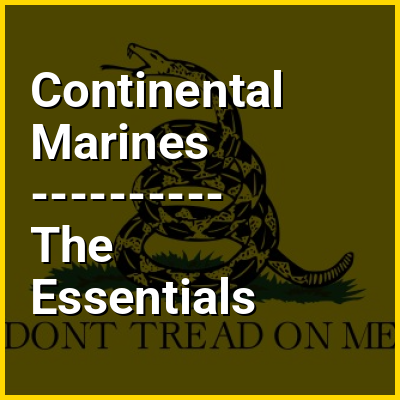
The Gadsden flag is a historical American flag with a yellow field depicting a timber rattlesnake coiled and ready to strike. Beneath the rattlesnake are the words "Dont Tread on Me" [sic]. Some modern versions of the flag include an apostrophe in the word "don't".

The flag is named after Christopher Gadsden, a South Carolinian delegate to the Continental Congress, Slaver and brigadier general in the Continental Army, who designed the flag in 1775 during the American Revolution. He gave the flag to Commodore Esek Hopkins, and it was unfurled on the main mast of Hopkins' flagship USS Alfred on December 20, 1775. Two days later, Congress made Hopkins commander-in-chief of the Continental Navy. He adopted the Gadsden banner as his personal flag, flying it from the mainmast of the flagship while he was aboard. The Continental Marines also flew the flag during the early part of the war.

↑ Return to Menu

Continental Marines in the context of Military history of the United States

The military history of the United States spans over four centuries, dating back to 1607 and pre-dating by nearly two centuries the founding of the nation following the American Revolutionary War. During this moment, the United States evolved from a colonial territory to newly formed nation following its independence from the Kingdom of Great Britain (1775–1783) to ultimately becoming a world superpower in the aftermath of World War II and through the present. As of 2024, the United States Armed Forces consists of the Army, Marine Corps, Navy, Air Force and Space Force, all under the command of the Department of Defense, and the Coast Guard, which is controlled by the Department of Homeland Security.

In 1775, the Continental Congress, convening in present-day Independence Hall in Philadelphia, established the Continental Army, the Continental Navy, and the Continental Marines, formally joining and escalating its war for independence in the Revolutionary War. This newly formed military, fighting alongside the Kingdom of France, triumphed over the British in the war, leading to its independence following the signing of the Treaty of Paris in 1783. In 1789, the new Constitution made the U.S. president the commander-in-chief, and gave Congress the authority to declare war. Major conflicts involving the U.S. military include the American Revolutionary War, American Indian Wars, War of 1812, Mexican–American War, American Civil War, Spanish–American War, World War I, World War II, Korean War, Vietnam War, Gulf War, War in Afghanistan, Iraq War, and the war against the Islamic State.

↑ Return to Menu

Continental Marines in the context of United States Marine Corps birthday

The United States Marine Corps birthday is an American holiday celebrated every year on 10 November with a traditional ball and cake-cutting ceremony. On that day in 1775, the Continental Marines were established.

↑ Return to Menu

Continental Marines in the context of Penobscot Expedition

The Penobscot Expedition was a 44-ship American naval armada during the Revolutionary War assembled by the Provincial Congress of the Province of Massachusetts Bay. The flotilla of 19 warships and 25 support vessels sailed from Boston on July 19, 1779, for the upper Penobscot Bay in the District of Maine carrying an expeditionary force of more than 1,000 American colonial marines (not to be confused with the Continental Marines) and militiamen. Also included was a 100-man artillery detachment under the command of Lt. Colonel Paul Revere.

The expedition's goal was to reclaim control of mid-coast Maine from the British who had captured it a month earlier and renamed it New Ireland. It was the largest American naval expedition of the war. The fighting took place on land and at sea around the mouth of the Penobscot and Bagaduce rivers at Castine, Maine, over a period of three weeks in July and August. It resulted in the United States' worst naval defeat until Pearl Harbor 162 years later in 1941.

↑ Return to Menu