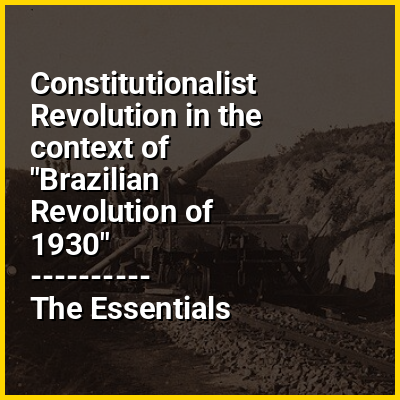
The Constitutionalist Revolution of 1932 (also known as the Paulista War or Brazilian Civil War) was the uprising by the population of the Brazilian state of São Paulo against the 1930 revolution, when Getúlio Vargas assumed the nation's presidency. Vargas was supported by the people, the military and the political elite of Minas Gerais, Rio Grande do Sul and Paraíba. The movement grew out of local resentment over Vargas' rule by decree, unbound by a constitution, in a provisional government. The 1930 revolution affected São Paulo by eroding the autonomy that Brazilian states had under the 1891 constitution, preventing the inauguration of São Paulo governor Júlio Prestes (who had been elected president of Brazil in 1930 and overthrowing President Washington Luís, governor of São Paulo from 1920 to 1924. These events marked the end of the First Brazilian Republic.
The revolution's main goal was to press Vargas' provisional government to adopt and abide by a new constitution, since Prestes was prevented from taking office. As the movement developed and resentment of Vargas and his revolutionary government grew deeper, it came to advocate the overthrow of the federal government. It was speculated that one of the revolutionaries' goals was the secession of São Paulo from the Brazilian federation. This scenario was used as a guerrilla tactic by the federal government to turn the rest of Brazil's population against the state of São Paulo, but there is no evidence that the movement's commanders sought separatism.