Constant factor in the context of Time complexity


Constant factor in the context of Time complexity

Constant factor Study page number 1 of 1

Play TriviaQuestions Online!

or

Skip to study material about Constant factor in the context of "Time complexity"


⭐ Core Definition: Constant factor

Big O notation is a mathematical notation that describes the approximate size of a function on a domain. Big O is a member of a family of notations invented by German mathematicians Paul Bachmann and Edmund Landau and expanded by others, collectively called Bachmann–Landau notation. The letter O was chosen by Bachmann to stand for Ordnung, meaning the order of approximation.

In computer science, big O notation is used to classify algorithms according to how their run time or space requirements grow as the input size grows. In analytic number theory, big O notation is often used to express bounds on the growth of an arithmetical function; one well-known example is the remainder term in the prime number theorem.In mathematical analysis, including calculus,Big O notation is used to bound the error when truncating a power series and to express the qualityof approximation of a real or complex valued functionby a simpler function.
↓ Menu
HINT:

In this Dossier

Constant factor in the context of Polynomial time

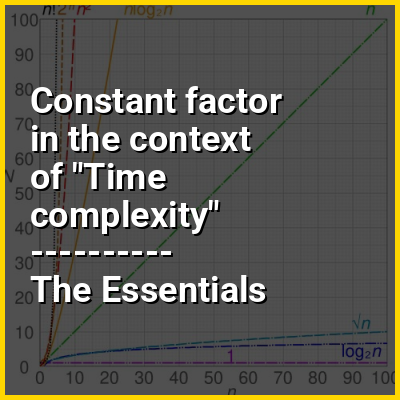
In theoretical computer science, the time complexity is the computational complexity that describes the amount of computer time it takes to run an algorithm. Time complexity is commonly estimated by counting the number of elementary operations performed by the algorithm, supposing that each elementary operation takes a fixed amount of time to perform. Thus, the amount of time taken and the number of elementary operations performed by the algorithm are taken to be related by a constant factor.

Since an algorithm's running time may vary among different inputs of the same size, one commonly considers the worst-case time complexity, which is the maximum amount of time required for inputs of a given size. Less common, and usually specified explicitly, is the average-case complexity, which is the average of the time taken on inputs of a given size (this makes sense because there are only a finite number of possible inputs of a given size). In both cases, the time complexity is generally expressed as a function of the size of the input. Since this function is generally difficult to compute exactly, and the running time for small inputs is usually not consequential, one commonly focuses on the behavior of the complexity when the input size increases—that is, the asymptotic behavior of the complexity. Therefore, the time complexity is commonly expressed using big O notation, typically , , , , etc., where n is the size in units of bits needed to represent the input.

View the full Wikipedia page for Polynomial time
↑ Return to Menu