Conservation law in the context of "Energy transfer"

Play Trivia Questions online!

or

Skip to study material about Conservation law in the context of "Energy transfer"

Ad spacer

⭐ Core Definition: Conservation law

In physics, a conservation law states that a particular measurable property of an isolated physical system does not change as the system evolves over time. Exact conservation laws include conservation of mass-energy, conservation of linear momentum, conservation of angular momentum, and conservation of electric charge. There are also many approximate conservation laws, which apply to such quantities as mass, parity, lepton number, baryon number, strangeness, hypercharge, etc. These quantities are conserved in certain classes of physics processes, but not in all.

A local conservation law is usually expressed mathematically as a continuity equation, a partial differential equation which gives a relation between the amount of the quantity and the "transport" of that quantity. It states that the amount of the conserved quantity at a point or within a volume can only change by the amount of the quantity which flows in or out of the volume.

↓ Menu

>>>PUT SHARE BUTTONS HERE<<<
In this Dossier

Conservation law in the context of Energy

Energy (from Ancient Greek ἐνέργεια (enérgeia) 'activity') is the quantitative property that is transferred to a body or to a physical system, recognizable in the performance of work and in the form of heat and light. Energy is a conserved quantity—the law of conservation of energy states that energy can be converted in form, but not created or destroyed. The unit of measurement for energy in the International System of Units (SI) is the joule (J).

Forms of energy include the kinetic energy of a moving object, the potential energy stored by an object (for instance due to its position in a field), the elastic energy stored in a solid object, chemical energy associated with chemical reactions, the radiant energy carried by electromagnetic radiation, the internal energy contained within a thermodynamic system, and rest energy associated with an object's rest mass. These are not mutually exclusive.

↑ Return to Menu

Conservation law in the context of Conservation of energy

The law of conservation of energy states that the total energy of an isolated system remains constant; it is said to be conserved over time. In the case of a closed system, the principle says that the total amount of energy within the system can only be changed through energy entering or leaving the system. Energy can neither be created nor destroyed; rather, it can only be transformed or transferred from one form to another. For instance, chemical energy is converted to kinetic energy when a stick of dynamite explodes. If one adds up all forms of energy that were released in the explosion, such as the kinetic energy and potential energy of the pieces, as well as heat and sound, one will get the exact decrease of chemical energy in the combustion of the dynamite.

Classically, the conservation of energy was distinct from the conservation of mass. However, special relativity shows that mass is related to energy and vice versa by , the equation representing mass–energy equivalence, and science now takes the view that mass-energy as a whole is conserved. This implies that mass can be converted to energy, and vice versa. This is observed in the nuclear binding energy of atomic nuclei, where a mass defect is measured. It is believed that mass-energy equivalence becomes important in extreme physical conditions, such as those that likely existed in the universe very shortly after the Big Bang or when black holes emit Hawking radiation.

↑ Return to Menu

Conservation law in the context of Nature park

A nature park, or sometimes natural park, is a designation for a protected area by means of long-term land planning, sustainable resource management and limitation of agricultural and real estate developments. These valuable landscapes are preserved in their present ecological state and promoted for ecotourism purposes.

In most countries nature parks are subject to legally regulated protection, which is part of their conservation laws.

↑ Return to Menu

Conservation law in the context of Angular momentum

Angular momentum (sometimes called moment of momentum or rotational momentum) is the rotational analog of linear momentum. It is an important physical quantity because it is a conserved quantity – the total angular momentum of a closed system remains constant. Angular momentum has both a direction and a magnitude, and both are conserved. Bicycles and motorcycles, flying discs, rifled bullets, and gyroscopes owe their useful properties to conservation of angular momentum. Conservation of angular momentum is also why hurricanes form spirals and neutron stars have high rotational rates. In general, conservation limits the possible motion of a system, but it does not uniquely determine it.

The three-dimensional angular momentum for a point particle is classically represented as a pseudovector r × p, the cross product of the particle's position vector r (relative to some origin) and its momentum vector; the latter is p = mv in Newtonian mechanics. Unlike linear momentum, angular momentum depends on where this origin is chosen, since the particle's position is measured from it.

↑ Return to Menu

Conservation law in the context of Particle decay

In particle physics, particle decay is the spontaneous process of one unstable subatomic particle transforming into multiple other particles. The particles created in this process (the final state) must each be less massive than the original, although the total mass of the system must be conserved. A particle is unstable if there is at least one allowed final state that it can decay into. Unstable particles will often have multiple ways of decaying, each with its own associated probability. Decays are mediated by one or several fundamental forces. The particles in the final state may themselves be unstable and subject to further decay.

The term is typically distinct from radioactive decay, in which an unstable atomic nucleus is transformed into a lighter nucleus accompanied by the emission of particles or radiation, although the two are conceptually similar and are often described using the same terminology.

↑ Return to Menu

Conservation law in the context of Chemical stability

In chemistry, chemical stability is the thermodynamic stability of a chemical system, in particular a chemical compound or a polymer. Colloquially, it may instead refer to kinetic persistence, the shelf-life of a metastable substance or system; that is, the timescale over which it begins to degrade.

Thermodynamic stability occurs when a system is in its lowest energy state, or in chemical equilibrium with its environment. This may be a dynamic equilibrium in which individual atoms or molecules change form, but their overall number in a particular form is conserved. This type of chemical thermodynamic equilibrium will persist indefinitely unless the system is changed. Chemical systems might undergo changes in the phase of matter or a set of chemical reactions.

↑ Return to Menu

Conservation law in the context of Lepton number

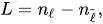
In particle physics, lepton number (historically also called lepton charge)is a conserved quantum number representing the difference between the number of leptons and the number of antileptons in an elementary particle reaction.Lepton number is an additive quantum number, so its sum is preserved in interactions (as opposed to multiplicative quantum numbers such as parity, where the product is preserved instead). The lepton number is defined bywhere

  • is the number of leptons and
  • is the number of antileptons.

Lepton number was introduced in 1953 to explain the absence of reactions such as

↑ Return to Menu