Conquest of Wu by Jin in the context of "Eastern Wu"

Play Trivia Questions online!

or

Skip to study material about Conquest of Wu by Jin in the context of "Eastern Wu"


⭐ Core Definition: Conquest of Wu by Jin

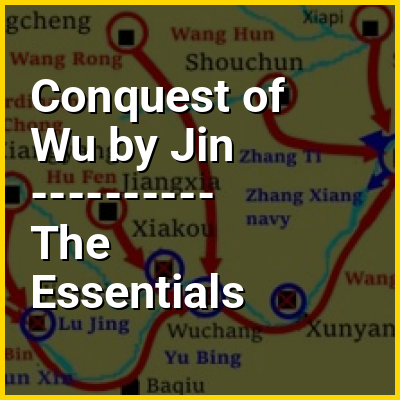
The conquest of Wu by Jin was a military campaign launched by the Jin dynasty against the state of Wu from late 279 to mid 280 at the end of the Three Kingdoms period of China. The campaign, which started in December 279 or January 280, concluded with complete victory for the Jin dynasty on 1 May 280 when the Wu emperor Sun Hao surrendered. After the campaign, the Jin emperor Sima Yan (Emperor Wu) changed the era name of his reign from "Xianning" to "Taikang". Hence, the campaign has also been referred to as the Taikang campaign.

The campaign is significant in pre-1911 Chinese military history as it not only ended the chaos of the Three Kingdoms period and reunified China under the Jin dynasty, but was also the first successful large-scale military operation in Chinese history that involved a massive invasion force crossing the Yangtze. Among other aspects, its multi-directional approach, invasions by both land and water, and the sending of a naval fleet downstream along the Yangtze, have had strong influences on subsequent battles in Chinese military history.
↓ Menu

In this Dossier

Conquest of Wu by Jin in the context of Three Kingdoms

The Three Kingdoms of Cao Wei, Shu Han, and Eastern Wu dominated China from AD 220 to 280 following the end of the Han dynasty. This period was preceded by the Eastern Han dynasty and followed by the Western Jin dynasty. Academically, the periodisation begins with the establishment of Cao Wei in 220 and ends with the conquest of Wu by Jin in 280. The period immediately preceding the Three Kingdoms, from 184 to 220, was marked by chaotic infighting among warlords across China as Han authority collapsed. The period from 220 to 263 was marked by a comparatively stable arrangement between Cao Wei, Shu Han, and Eastern Wu. This stability broke down with the conquest of Shu by Wei in 263, followed by the usurpation of Cao Wei by Jin in 266 and ultimately the conquest of Wu by Jin in 280.

The Three Kingdoms period including the collapse of the Han was one of the most dangerous in Chinese history due to multiple plagues, widespread famines, and civil war. A nationwide census taken in 280, following the reunification of the Three Kingdoms under the Jin showed a total of 2,459,840 households and 16,163,863 individuals which was only a fraction of the 10,677,960 households, and 56,486,856 individuals reported during the Han era. While the census may not have been particularly accurate due to a multitude of factors of the times, in 280, the Jin did make an attempt to account for all individuals where they could.

↑ Return to Menu

Conquest of Wu by Jin in the context of Emperor Wu of Jin

Emperor Wu of Jin (simplified Chinese: 晋武帝; traditional Chinese: 晉武帝; pinyin: Jìn Wǔ Dì; Wade–Giles: Chin Wu-Ti; 236 – 16 May 290), personal name Sima Yan (Chinese: 司馬炎; pinyin: Sīmǎ Yán), courtesy name Anshi (安世), was a grandson of Sima Yi, nephew of Sima Shi and son of Sima Zhao. He became the first emperor of the Jin dynasty after forcing Cao Huan, last emperor of the state of Cao Wei, to abdicate to him. He reigned from 266 to 290, and after conquering the state of Eastern Wu in 280, was the emperor of a reunified China. Emperor Wu was also known for his extravagance and sensuality, especially after the unification of China; legends boasted of his incredible potency among ten thousand concubines.

Emperor Wu was commonly viewed as generous and kind, but also wasteful. His generosity and kindness undermined his rule, as he became overly tolerant of the noble families' (世族 or 士族, a political/bureaucratic landlord class from Eastern Han to Tang dynasty) corruption and wastefulness, which drained the people's resources. Further, when Emperor Wu established the Jin Dynasty, he was concerned about his regime's stability, and, believing that the predecessor state, Cao Wei, had been doomed by its failures to empower the princes of the imperial clan, he greatly empowered his uncles, his cousins, and his sons with authority, including independent military authority. This ironically led to the destabilization of the Western Jin, as the princes engaged in an internecine struggle known as the War of the Eight Princes soon after his death, and then the "Five Barbarians" uprisings that destroyed the Western Jin and forced its successor, Eastern Jin, to relocate to the region south of the Huai River.

↑ Return to Menu

Conquest of Wu by Jin in the context of Sun Hao

Sun Hao (242 – January or February 284), courtesy name Yuanzong, originally named Sun Pengzu with the courtesy name Haozong, was the fourth and last emperor of the state of Eastern Wu during the Three Kingdoms period of China. He was a son of Sun He, a one-time heir apparent of the founding emperor Sun Quan. He ascended the throne in September 264 after the death of his uncle, Sun Xiu (Emperor Jing), in light of the desire of the people to have an older emperor, considering the recent destruction of Wu's ally state Shu Han. However, he turned out to be a most unfortunate choice, as his cruelty, extravagance and inability to handle domestic matters doomed Wu, which was eventually conquered by the Jin dynasty in 280, ending the Three Kingdoms period.

Sun Hao is also known by other titles: Marquis of Wucheng (烏程侯), which he held before he became emperor; Marquis Guiming (歸命侯; literally "the Marquis who resigns to his fate"), the title given to him by the Jin dynasty after his surrender; Later Lord of Wu (吳後主) and Last Emperor of Wu (吳末帝), which were used by historians to refer to him.

↑ Return to Menu