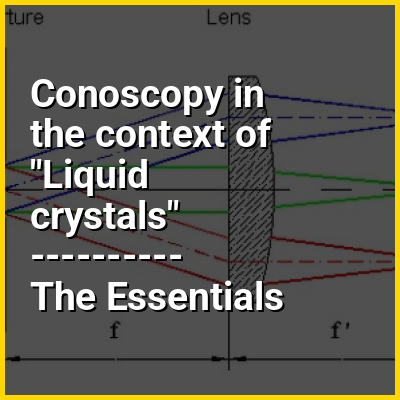
Conoscopy is an optical technique to make observations of a transparent specimen in a cone of converging rays of light. The various directions of light propagation are observable simultaneously.
A conoscope is an apparatus to carry out conoscopic observations and measurements, often realized by a microscope with a Bertrand lens for observation of the direction's image. The earliest reference to the use of conoscopy (i.e., observation in convergent light with a polarization microscope with a Bertrand lens) for evaluation of the optical properties of liquid crystalline phases (i.e., orientation of the optical axes) is in 1911 when it was used by Charles-Victor Mauguin to investigate the alignment of nematic and chiral-nematic phases.