Confession in the Lutheran Church in the context of "Luther's Small Catechism"

Play Trivia Questions online!

or

Skip to study material about Confession in the Lutheran Church in the context of "Luther's Small Catechism"

Ad spacer

⭐ Core Definition: Confession in the Lutheran Church

In the Lutheran Church, Confession (also called Holy Absolution) is the sacrament given by Christ to the Church by which individual men and women may receive the forgiveness of sins. According to the Large Catechism, the third sacrament of Holy Absolution is related to Holy Baptism.

In the Lutheran Churches, the Office of the Keys exercised through confession and absolution is the "authority which Christ has given to His Church on earth: to forgive the sins of the penitent sinners, but to retain the sins of the impenitent as long as they do not repent."

↓ Menu

>>>PUT SHARE BUTTONS HERE<<<

👉 Confession in the Lutheran Church in the context of Luther's Small Catechism

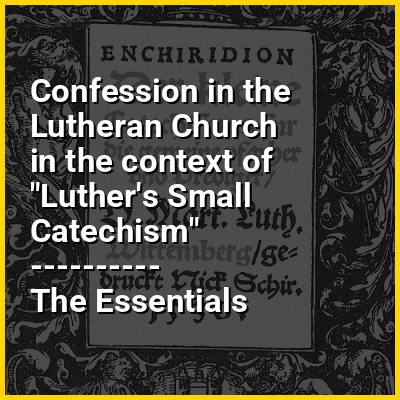
Luther's Small Catechism (German: Der Kleine Katechismus) is a catechism written by Martin Luther and published in 1529 for the training of children. Luther's Small Catechism reviews the Ten Commandments, the Apostles' Creed, the Lord's Prayer, the Sacrament of Holy Baptism, the Office of the Keys and Confession and the Sacrament of the Eucharist. It is included in the Book of Concord as an authoritative statement of what Lutherans believe. Martin Luther took it upon himself to solve the problem of regular household Christians not being able to truly understand the key points of Christianity. He wanted to create a simple and understandable book for the regular person to grow their knowledge in the religion [1]. It was made to help shape every Christian's life and develop their faith. Many pastors in the early 1500s did not have the knowledge that the Small Catechism contains, which Luther saw as a problem because then many people could not hear these important aspects. He said, “Yet all the people are supposed to be Christians, have been baptized, and receive the Holy Sacrament even though they do not know the Our Father.” Martin Luther intended this book to simplify the values of Christianity for all. This book is still used today in many services.[2]

The Small Catechism is quite short. Many modern editions are over 200 pages long because of added commentaries and explanations. The catechism itself is only approximately 20 pages long, depending on paper size and font size. Some of the earliest editions in the 1520s and 1530s were printed as posters, given the brevity of the work, to be hung on the walls in classrooms and in family homes.

↓ Explore More Topics
In this Dossier

Confession in the Lutheran Church in the context of Examination of conscience

Examination of conscience is a review of one's past thoughts, words, actions, and omissions for the purpose of ascertaining their conformity with, or deviation from, the moral law. Among Christians, this is generally a private review; secular intellectuals have, on occasion, published autocritiques for public consumption. In the Catholic Church, penitents who wish to receive the sacrament of penance are encouraged to examine their conscience using the Ten Commandments as a guide, or the Beatitudes, or the virtues and vices. The doctrine of examination of conscience is taught in Lutheran Churches, where penitents who wish to receive Holy Absolution are asked to use the Ten Commandments as a guide before confessing their sins to the priest (pastor).

"The excellence of this practice and its fruitfulness for Christian virtue," preached Pope Pius X, "are clearly established by the teaching of the great masters of the spiritual life." St. Ignatius of Loyola considered the examination of conscience as the single most important spiritual exercise. In his Spiritual Exercises he presents different forms of it in the particular and general examination (24-43). Of the general examination he writes; "The first point is to give thanks to God our Lord for the favors received" (43). This point has become a highly developed part of Ignatian spirituality in modern times, and has led to many more positive practices, generally called examen of consciousness. In twice-daily "examens" one might review the ways God has been present through one to others, and to oneself through others, and how one has responded, and to proceed with one's day with gratitude, more aware of the presence of God in one's life.
↑ Return to Menu