Conditional probability distribution in the context of Joint distribution


Conditional probability distribution in the context of Joint distribution

Conditional probability distribution Study page number 1 of 1

Play TriviaQuestions Online!

or

Skip to study material about Conditional probability distribution in the context of "Joint distribution"


⭐ Core Definition: Conditional probability distribution

In probability theory and statistics, the conditional probability distribution is a probability distribution that describes the probability of an outcome given the occurrence of a particular event. Given two jointly distributed random variables and , the conditional probability distribution of given is the probability distribution of when is known to be a particular value; in some cases the conditional probabilities may be expressed as functions containing the unspecified value of as a parameter. When both and are categorical variables, a conditional probability table is typically used to represent the conditional probability. The conditional distribution contrasts with the marginal distribution of a random variable, which is its distribution without reference to the value of the other variable.

If the conditional distribution of given is a continuous distribution, then its probability density function is known as the conditional density function. The properties of a conditional distribution, such as the moments, are often referred to by corresponding names such as the conditional mean and conditional variance.

↓ Menu
HINT:

In this Dossier

Conditional probability distribution in the context of Joint probability distribution

Given random variables , that are defined on the same probability space, the multivariate or joint probability distribution for is a probability distribution that gives the probability that each of falls in any particular range or discrete set of values specified for that variable. In the case of only two random variables, this is called a bivariate distribution, but the concept generalizes to any number of random variables.

The joint probability distribution can be expressed in terms of a joint cumulative distribution function and either in terms of a joint probability density function (in the case of continuous variables) or joint probability mass function (in the case of discrete variables). These in turn can be used to find two other types of distributions: the marginal distribution giving the probabilities for any one of the variables with no reference to any specific ranges of values for the other variables, and the conditional probability distribution giving the probabilities for any subset of the variables conditional on particular values of the remaining variables.

View the full Wikipedia page for Joint probability distribution
↑ Return to Menu

Conditional probability distribution in the context of Regression coefficient

In statistics, linear regression is a model that estimates the relationship between a scalar response (dependent variable) and one or more explanatory variables (regressor or independent variable). A model with exactly one explanatory variable is a simple linear regression; a model with two or more explanatory variables is a multiple linear regression. This term is distinct from multivariate linear regression, which predicts multiple correlated dependent variables rather than a single dependent variable.

In linear regression, the relationships are modeled using linear predictor functions whose unknown model parameters are estimated from the data. Most commonly, the conditional mean of the response given the values of the explanatory variables (or predictors) is assumed to be an affine function of those values; less commonly, the conditional median or some other quantile is used. Like all forms of regression analysis, linear regression focuses on the conditional probability distribution of the response given the values of the predictors, rather than on the joint probability distribution of all of these variables, which is the domain of multivariate analysis.

View the full Wikipedia page for Regression coefficient
↑ Return to Menu

Conditional probability distribution in the context of Conditional expectation

In probability theory, the conditional expectation, conditional expected value, or conditional mean of a random variable is its expected value evaluated with respect to the conditional probability distribution. If the random variable can take on only a finite number of values, the "conditions" are that the variable can only take on a subset of those values. More formally, in the case when the random variable is defined over a discrete probability space, the "conditions" are a partition of this probability space.

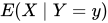
Depending on the context, the conditional expectation can be either a random variable or a function. The random variable is denoted analogously to conditional probability. The function form is either denoted or a separate function symbol such as is introduced with the meaning .

View the full Wikipedia page for Conditional expectation
↑ Return to Menu