Compressed air in the context of "Fluid power"

Play Trivia Questions online!

or

Skip to study material about Compressed air in the context of "Fluid power"

Ad spacer

⭐ Core Definition: Compressed air

Compressed air is air kept under a pressure that is greater than atmospheric pressure. Compressed air in vehicle tires and shock absorbers are commonly used for improved traction and reduced vibration. Compressed air is an important medium for the transfer of energy in industrial processes and is used for power tools such as air hammers, drills, wrenches, and others, as well as to atomize paint, to operate air cylinders for automation, and can also be used to propel vehicles. Brakes applied by compressed air made large railway trains safer and more efficient to operate. Compressed air brakes are also found on large highway vehicles.

Compressed air is used as a breathing gas by underwater divers. The diver may carry it in a high-pressure diving cylinder, or supplied from the surface at lower pressure through an air line or diver's umbilical. Similar arrangements are used in breathing apparatus used by firefighters, mine rescue workers and industrial workers in hazardous atmospheres.
↓ Menu

>>>PUT SHARE BUTTONS HERE<<<
In this Dossier

Compressed air in the context of Sand blaster

Sandblasting, sometimes known as abrasive blasting, is the operation of forcibly propelling a stream of abrasive material against a surface under high pressure to smooth a rough surface, roughen a smooth surface, shape a surface or remove surface contaminants. A pressurised fluid, typically compressed air, or a centrifugal wheel is used to propel the blasting material (often called the media). The first abrasive blasting process was patented by Benjamin Chew Tilghman on 18 October 1870.

There are several variants of the process, using various media; some are highly abrasive, whereas others are milder. The most abrasive are shot blasting (with metal shot) and sandblasting (with sand). Moderately abrasive variants include glass bead blasting (with glass beads) and plastic media blasting (PMB) with ground-up plastic stock or walnut shells and corncobs. Some of these substances can cause anaphylactic shock to individuals allergic to the media. A mild version is sodablasting (with baking soda). In addition, there are alternatives that are barely abrasive or nonabrasive, such as ice blasting and dry-ice blasting.

↑ Return to Menu

Compressed air in the context of Pneumatics

Pneumatics (from Greek πνεῦμα pneuma 'wind, breath') is the use of gas or pressurized air in mechanical systems.

Pneumatic systems used in industry are commonly powered by compressed air or compressed inert gases. A centrally located and electrically-powered compressor powers cylinders, air motors, pneumatic actuators, and other pneumatic devices. A pneumatic system controlled through manual or automatic solenoid valves is selected when it provides a lower cost, more flexible, or safer alternative to electric motors, and hydraulic actuators.

↑ Return to Menu

Compressed air in the context of Sodablasting

Soda blasting is a mild form of abrasive blasting in which sodium bicarbonate particles are blasted against a surface using compressed air. It has a much milder abrasive effect than sandblasting. An early use was in the conservation-restoration of the Statue of Liberty in the 1980s.

Soda blasting is a non-destructive method for many applications in cleaning, paint and varnish stripping, automotive restoration, industrial equipment maintenance, rust removal, graffiti removal, molecular steel passivation against rust, oil removal by saponification and translocation, masonry cleaning and restoration, soot remediation, boat hull cleaning and for food processing facilities and equipment and tooth cleaning at the dental laboratory.

↑ Return to Menu

Compressed air in the context of Ice blasting (cleaning)

Ice blasting (also known as wet-ice blasting, frozen-ice blasting, or water-ice blasting) is a form of non-abrasive blasting where frozen water particles are combined with compressed air and propelled towards a surface for cleaning purposes. Ice is one of several different media commonly used for blast cleaning. Another common method of non-abrasive blasting is dry ice blasting, which uses solid carbon dioxide as a blast media. Other forms of abrasive blasting use mediums such as sand, plastic beads, and baking soda.

↑ Return to Menu

Compressed air in the context of Scuba diver

Scuba diving is an underwater diving mode where divers use breathing equipment completely independent of a surface breathing gas supply, and therefore has a limited but variable endurance. The word scuba is an acronym for "Self-Contained Underwater Breathing Apparatus" and was coined by Christian J. Lambertsen in a patent submitted in 1952. Scuba divers carry their source of breathing gas, affording them greater independence and movement than surface-supplied divers, and more time underwater than freedivers. Although compressed air is commonly used, other gas blends are also employed.

Open-circuit scuba systems discharge the breathing gas into the environment as it is exhaled and consist of one or more diving cylinders containing breathing gas at high pressure which is supplied to the diver at ambient pressure through a diving regulator. They may include additional cylinders for range extension, decompression gas or emergency breathing gas. Closed-circuit or semi-closed circuit rebreather scuba systems allow recycling of exhaled gases. The volume of gas used is reduced compared to that of open-circuit, making longer dives feasible. Rebreathers extend the time spent underwater compared to open-circuit for the same metabolic gas consumption. They produce fewer bubbles and less noise than open-circuit scuba, which makes them attractive to covert military divers to avoid detection, scientific divers to avoid disturbing marine animals, and media diver to avoid bubble interference.

↑ Return to Menu

Compressed air in the context of Actuator

An actuator is a component of a machine that produces force, torque, or displacement, when an electrical, pneumatic or hydraulic input is supplied to it in a system (called an actuating system). The effect is usually produced in a controlled way. An actuator translates a stimulus such as an input signal into the required form of mechanical energy. It is a type of transducer. In simple terms, it is a "mover".

An actuator requires a control device (which provides control signal) and a source of energy. The control signal is relatively low in energy and may be voltage, electric current, pneumatic, or hydraulic fluid pressure, or even human power. In the electric, hydraulic, and pneumatic sense, it is a form of automation or automatic control.

↑ Return to Menu

Compressed air in the context of Air compressor

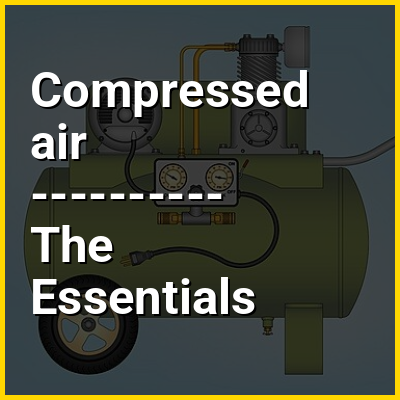
An air compressor is a machine that takes ambient air from the surroundings and discharges it at a higher pressure. It is an application of a gas compressor and a pneumatic device that converts mechanical power (from an electric motor, diesel or gasoline engine, etc.) into potential energy stored in compressed air, which has many uses. A common application is to compress air into a storage tank, for immediate or later use. When the delivery pressure reaches its set upper limit, the compressor is shut off, or the excess air is released through an overpressure valve. The compressed air is stored in the tank until it is needed. The pressure energy provided by the compressed air can be used for a variety of applications such as pneumatic tools as it is released. When tank pressure reaches its lower limit, the air compressor turns on again and re-pressurizes the tank.A compressor is different from a pump because it works on a gas, while pumps work on a liquid.

↑ Return to Menu

Compressed air in the context of Tire

A tire (North American English) or tyre (Commonwealth English) is a ring-shaped component that surrounds a wheel's rim to transfer a vehicle's load from the axle through the wheel to the ground and to provide traction on the surface over which the wheel travels. Most tires, such as those for automobiles and bicycles, are pneumatically inflated structures, providing a flexible cushion that absorbs shock as the tire rolls over rough features on the surface. Tires provide a footprint, called a contact patch, designed to match the vehicle's weight and the bearing on the surface that it rolls over by exerting a pressure that will avoid deforming the surface.

The materials of modern pneumatic tires are synthetic rubber, natural rubber, fabric, and wire, along with carbon black and other chemical compounds. They consist of a tread and a body. The tread provides traction while the body provides containment for a quantity of compressed air. Before rubber was developed, tires were metal bands fitted around wooden wheels to hold the wheel together under load and to prevent wear and tear. Early rubber tires were solid (not pneumatic). Pneumatic tires are used on many vehicles, including cars, bicycles, motorcycles, buses, trucks, heavy equipment, and aircraft. Metal tires are used on locomotives and railcars, and solid rubber (or other polymers) tires are also used in various non-automotive applications, such as casters, carts, lawnmowers, and wheelbarrows.

↑ Return to Menu