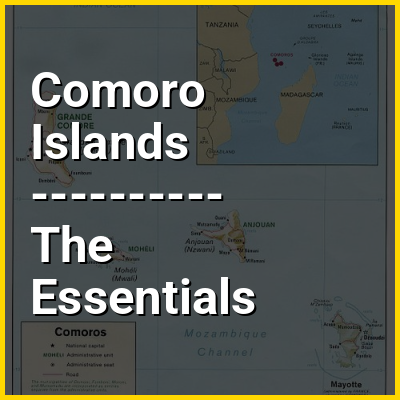
The Comoro Islands are a group of volcanic islands in the Mozambique Channel, an arm of the Indian Ocean lying between Madagascar and the African mainland. Three of the islands form the Union of the Comoros, a sovereign nation, while Mayotte belongs to France.
>>>PUT SHARE BUTTONS HERE<<<
In this Dossier
- ⭐ Core Definition: Comoro Islands
- Comoro Islands in the context of Comoros
- Comoro Islands in the context of Swahili people
- Comoro Islands in the context of List of Madagascar and Indian Ocean Island animals extinct in the Holocene
- Comoro Islands in the context of Ethiopian Airlines Flight 961
- Comoro Islands in the context of Comorian languages
- Comoro Islands in the context of Streptocarpus
- Comoro Islands in the context of Union of the Comoros
Comoro Islands in the context of Comoros
The Comoros, officially the Union of the Comoros, is an archipelagic country made up of three islands in Southeastern Africa, located at the northern end of the Mozambique Channel in the Indian Ocean. Its capital and largest city is Moroni. The religion of the majority of the population, and the official state religion, is Islam. Comoros proclaimed its independence from France on 6 July 1975. The Comoros is the only country of the Arab League which is entirely in the Southern Hemisphere. It is a member state of the African Union, the Organisation internationale de la Francophonie, the Organisation of Islamic Co-operation, and the Indian Ocean Commission. The country has three official languages: Comorian, French and Arabic.
At 1,659 km (641 sq mi), the Comoros is the third-smallest African country by area after São Tomé and Príncipe and Seychelles. In 2019, its population was estimated to be 850,886. The sovereign state consists of three major islands and numerous smaller islands, all of the volcanic Comoro Islands with the exception of Mayotte. Mayotte voted against independence from France in a referendum in 1974, and continues to be administered by France as an overseas department. France has vetoed a United Nations Security Council resolution that would have affirmed Comorian sovereignty over the island. Mayotte became an overseas department and a region of France in 2011 following a referendum which was passed overwhelmingly.
Comoro Islands in the context of Swahili people
The Swahili people (Swahili: Waswahili, وَسوَحِيلِ) comprise mainly Bantu, Afro-Arab, and Comorian ethnic groups inhabiting the Swahili coast, an area encompassing the East African coast across southern Somalia, Kenya, Tanzania, and northern Mozambique, and various archipelagos off the coast, such as Zanzibar, Lamu, and the Comoro Islands.
The original Swahili distinguished themselves from other Bantu peoples by self-identifying as Waungwana (the civilised ones). In certain regions, such as Lamu Island, this differentiation is even more stratified in terms of societal grouping and dialect, hinting at the historical processes by which the Swahili have coalesced over time. More recently, through a process of Swahilization, this identity extends to any person of African descent who speaks Swahili as their first language, is Muslim, and lives in a town of the main urban centres of most of modern-day Tanzania and coastal Kenya, northern Mozambique, or the Comoros.
Comoro Islands in the context of List of Madagascar and Indian Ocean Island animals extinct in the Holocene
This is a list of Madagascar and Indian Ocean Island animals extinct in the Holocene that covers extinctions from the Holocene epoch, a geologic epoch that began about 11,650 years before present (about 9700 BCE) and continues to the present day.
The Republic of Madagascar is a large island country in the Indian Ocean, off the coast of East Africa. Other Indian Ocean islands near Madagascar include the Mascarene Islands (split between the Republic of Mauritius and the French department of Réunion), the Republic of Seychelles, and the Comoro Islands (split between the Union of Comoros and the French department of Mayotte).
Comoro Islands in the context of Ethiopian Airlines Flight 961
Ethiopian Airlines Flight 961 was a scheduled international flight serving the route Addis Ababa–Nairobi–Brazzaville–Lagos–Abidjan. On 23 November 1996, the aircraft serving the flight, a Boeing 767-200ER, was hijacked en route from Addis Ababa to Nairobi by three Ethiopians seeking asylum in Australia. The plane crash-landed in the Indian Ocean near Grande Comore, Comoros Islands, due to fuel exhaustion. Of those onboard, 125 of 175 died in the ditching (water landing), including all three hijackers and six of the 12 crew. It was the first recorded instance of the ditching of a wide-body aircraft.
Comoro Islands in the context of Comorian languages
Comorian (Shikomori, or Shimasiwa, the "language of islands") is the name given to a group of four Bantu languages spoken in the Comoro Islands, an archipelago in the southwestern Indian Ocean between Mozambique and Madagascar. It is named as one of the official languages of the Union of the Comoros in the Comorian constitution. Shimaore, one of the languages, is spoken on the disputed island of Mayotte, a French department claimed by Comoros.
Like Swahili, the Comorian languages are Sabaki languages, part of the Bantu language family. Each island has its own language, and the four are conventionally divided into two groups: the eastern group is composed of Shindzuani (spoken on Ndzuani) and Shimaore (Mayotte), while the western group is composed of Shimwali (Mwali) and Shingazija (Ngazidja). Although the languages of different groups are not usually mutually intelligible, only sharing about 80% of their lexicon, there is mutual intelligibility between the languages within each group, suggesting that Shikomori should be considered as two language groups, each including two languages, rather than four distinct languages.
Comoro Islands in the context of Streptocarpus
Streptocarpus ("twisted fruit" from Greek στρεπτός (streptos) "twisted" and καρπός (karpos) "fruit") is an Afrotropical genus of flowering plants in the family Gesneriaceae. The genus is native to Afromontane biotopes from central, eastern and southern Africa, including Madagascar and the Comoro Islands. The flowers are five-petalled, salverform tubes, almost orchid-like in appearance, and hover or arch over the plant, while the pointed, elongate fruit is of a helical form similar to that of the "tusk" of a narwhal. In the wild, species can be found growing on shaded rocky hillsides or cliffs, on the ground, in rock crevices, and almost anywhere the seed can germinate and grow. For the home, there are now many hybrids of various colours and forms available.
Although generally referred to simply as "Streptocarpus" or "Streps", the common name for subgenus Streptocarpus is Cape primrose, referring to the nativity of several species to South Africa and their superficial resemblance to the unrelated genus Primula. The common name for subgenus Streptocarpella is nodding violet. Streptocarpus sect. Saintpaulia ("African violet") is a separate section within Streptocarpus subgenus Streptocarpella.
Comoro Islands in the context of Union of the Comoros
The Comoros, officially the Union of the Comoros, is an archipelagic country made up of three islands in Southeastern Africa, located at the northern end of the Mozambique Channel in the Indian Ocean. Its capital and largest city is Moroni. The religion of the majority of the population, and the official state religion, is Islam. Comoros proclaimed its independence from France on 6 July 1975. The Comoros is the only country of the Arab League which is entirely in the Southern Hemisphere. It is a member state of the African Union, the Organisation internationale de la Francophonie, the Organisation of Islamic Co-operation, and the Indian Ocean Commission. The country has three official languages: Comorian, French and Arabic.
At 1,659 km (641 mi), the Comoros is the third-smallest African country by area after São Tomé and Príncipe and Seychelles. In 2019, its population was estimated to be 850,886. The sovereign state consists of three major islands and numerous smaller islands, all of the volcanic Comoro Islands with the exception of Mayotte. Mayotte voted against independence from France in a referendum in 1974, and continues to be administered by France as an overseas department. France has vetoed a United Nations Security Council resolution that would have affirmed Comorian sovereignty over the island. Mayotte became an overseas department and a region of France in 2011 following a referendum which was passed overwhelmingly.