Colonial Building in the context of Newfoundland and Labrador House of Assembly


Colonial Building in the context of Newfoundland and Labrador House of Assembly

⭐ Core Definition: Colonial Building

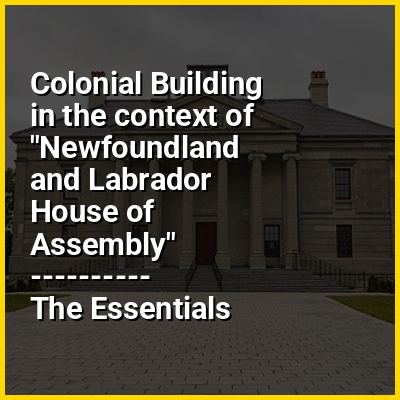
The Colonial Building is a historic government building located in St. John's, Newfoundland and Labrador, Canada. The building was the home of the colonial and later provincial Newfoundland government and the House of Assembly from January 28, 1850 to July 28, 1959. In 1974, it was declared a Provincial Historic Site.

In 1832 when the Colony of Newfoundland governed itself by representative government there was not a formal building assigned to house the legislature. The first home of the legislature was a tavern and lodging house on Duckworth Street owned and operated by a Mrs. Mary Travers. The stay was brief as in the legislature's haste and inexperience it forgot to vote approval for the funds to pay rent. The first building was destroyed in city fire of 1846. For the next seventeen years they would meet in various temporary quarters including the local courthouse. In 1846 an act was approved authorizing the construction of the Colonial Building as a permanent home.
↓ Menu
HINT:

In this Dossier

Colonial Building in the context of House of Assembly of Newfoundland and Labrador

The Newfoundland and Labrador House of Assembly (French: Chambre d'assemblée de Terre-Neuve-et-Labrador) is the unicameral deliberative assembly of the General Assembly of Newfoundland and Labrador of the province of Newfoundland and Labrador, Canada. It meets in the Confederation Building in St. John's. Bills passed by the assembly are given royal assent by the lieutenant governor of Newfoundland and Labrador, in the name of the Sovereign.

The governing party sits on the left side of the speaker of the House of Assembly as opposed to the traditional right side of the speaker. This tradition dates back to the 1850s as the heaters in the Colonial Building were located on the left side. Thus, the government chose to sit near the heat, and leave the opposition sitting in the cold.

View the full Wikipedia page for House of Assembly of Newfoundland and Labrador
↑ Return to Menu

Colonial Building in the context of Newfoundland Royal Commission

The Newfoundland Royal Commission or Amulree Commission (as it came to be known) was a royal commission established on February 17, 1933 by the Government of the United Kingdom "to examine into the future of Newfoundland and in particular to report on the financial situation and prospects therein."

During the Great Depression Newfoundland faced an economic crisis; Canadian banks extended credit to the colonial government, but did so under harsh terms. On 5 April 1932 a riot at the Colonial Building in St John's precipitated the government's collapse.

View the full Wikipedia page for Newfoundland Royal Commission
↑ Return to Menu

Colonial Building in the context of Confederation Building (Newfoundland and Labrador)

The Confederation Building serves as the home of the Newfoundland and Labrador House of Assembly. It is located on Confederation Hill overlooking Newfoundland and Labrador's capital city, St. John's. The brick- and concrete-clad building has 11 stories and is 64 metres (210 ft) tall. It was completed in 1960 at a cost of $9 million to replace the Colonial Building. A lantern is located at the top of the copper roof of the central tower and acts as a beacon when turned on at night.

In 1982, construction began on the West Block extension, a modern 7-storey structure, which is a six-storey building, with a gross floor area of 34,838 square metres (374,990 sq ft). The original building is now considered the East Block of the Confederation Building. A third building on the legislature campus is the Service Building Annex a two-storey building housing a day care centre and garage for some provincial government vehicles.

View the full Wikipedia page for Confederation Building (Newfoundland and Labrador)
↑ Return to Menu