Codex Gigas in the context of "Satan"

Play Trivia Questions online!

or

Skip to study material about Codex Gigas in the context of "Satan"

Ad spacer

⭐ Core Definition: Codex Gigas

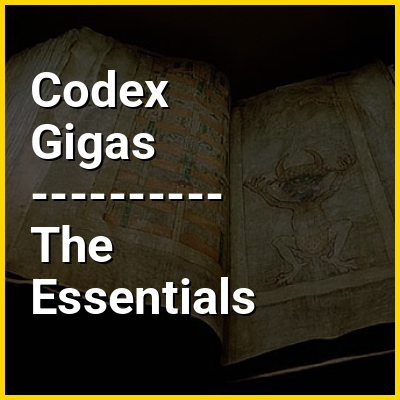
The Codex Gigas ("Giant Book"; Czech: Obří kniha) is the largest extant medieval illuminated manuscript in the world, at a length of 92 cm (36 in). It is a Romanesque Latin Bible, with other texts, some secular, added in the second half of the book. Very large illuminated bibles were typical of Romanesque monastic book production, but even among these, the page-size of the Codex Gigas is exceptional. The manuscript is also known as the Devil's Bible due to its highly unusual full-page portrait of Satan, the Devil, and the legend surrounding the book's creation. Apart from the famous page with an image of the Devil, the book is not very heavily illustrated with figurative miniatures, compared to other grand contemporary Bibles.

The manuscript was created in the early 13th century in the Benedictine monastery of Podlažice in Chrast, Bohemia, now a region in the modern-day Czech Republic. The manuscript contains the complete Latin Bible in the Vulgate version, as well as other popular works, all written in Latin. Between the Old and New Testaments is a selection of other popular medieval reference works: Flavius Josephus's Antiquities of the Jews and The Jewish War, Isidore of Seville's encyclopedia Etymologiae, the chronicle of Cosmas of Prague (Chronica Boemorum), and medical works: an early version of the Ars medicinae compilation of treatises, and two books by Constantine the African.
↓ Menu

>>>PUT SHARE BUTTONS HERE<<<

👉 Codex Gigas in the context of Satan

Satan, also known as the Devil, is an entity in Abrahamic religions who entices humans into sin or falsehood. In Judaism, Satan is seen as an agent subservient to God, typically regarded as a metaphor for the yetzer hara, or 'evil inclination'. In Christianity and Islam, he is usually seen as a fallen angel or jinn who has rebelled against God, who nevertheless allows him temporary power over the fallen world and a host of demons. In the Baháʼí Faith, Satan is not regarded as an independent evil power, but signifies the lower nature of humans.

A figure known as ha-satan ("the satan") first appears in the Hebrew Bible as a heavenly prosecutor, subordinate to Yahweh (God); he prosecutes the nation of Judah in the heavenly court and tests the loyalty of Yahweh's followers. During the intertestamental period, possibly due to influence from the Zoroastrian figure of Angra Mainyu, the satan developed into a malevolent entity with abhorrent qualities in dualistic opposition to God. In the apocryphal Book of Jubilees, Yahweh grants the satan (referred to as Mastema) authority over a group of fallen angels, or their offspring, to tempt humans to sin and punish them.

↓ Explore More Topics
In this Dossier

Codex Gigas in the context of Codex

The codex (pl.: codices /ˈkdɪsz/) was the historical ancestor format of the modern book. Technically, the vast majority of modern books use the codex format of a stack of pages bound at one edge, along the side of the text. However, the term codex is now reserved for older manuscript books, which mostly used sheets of vellum, parchment, or papyrus, rather than paper.

By convention, the term is also used for any Aztec codex (although the earlier examples do not actually use the codex format), Maya codices and other pre-Columbian manuscripts. Library practices have led to many European manuscripts having "codex" as part of their usual name, as with the Codex Gigas, while most do not.

↑ Return to Menu

Codex Gigas in the context of Mark 1

Mark 1 is the first chapter of the Gospel of Mark in the New Testament of the Christian Bible. It recounts the proclamation of John the Baptist, the baptism of Jesus Christ, his temptations and the beginning of his ministry in Galilee.

↑ Return to Menu