Clement of Rome in the context of "Apostolic Fathers"

Play Trivia Questions online!

or

Skip to study material about Clement of Rome in the context of "Apostolic Fathers"

Ad spacer

⭐ Core Definition: Clement of Rome

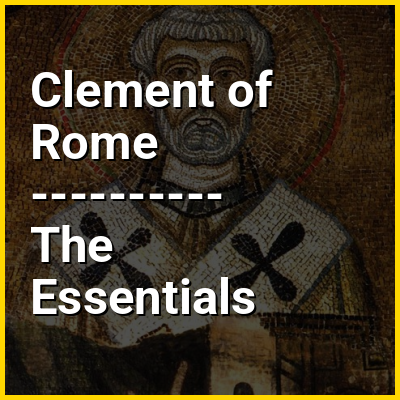
Clement of Rome (Latin: Clemens Romanus; Ancient Greek: Κλήμης Ῥώμης, romanizedKlēmēs Rōmēs; died c. 100), also known as Pope Clement I, was the Bishop of Rome in the late first century. He is considered to be the first of the Apostolic Fathers of the Church.

Little is known about Clement's life. Tertullian claimed that Clement was ordained by Saint Peter. Early church lists place him as the second or third bishop of Rome. Eusebius, in his book Church History mentioned Clement as the third bishop of Rome and as the "co-laborer" of Paul. In Against Heresies, Irenaeus described Clement as the successor to Anacletus, who was the third bishop of Rome, and as a personal acquaintance of the Apostles. According to the Annuario Pontificio, Clement was the fourth bishop of Rome, holding office at the very end of the 1st century. It is likely that Clement died in exile, and was possibly martyred. According to apocryphal stories dating back to the 4th century by authors such as Rufinus, Clement was imprisoned by Roman Emperor Trajan, and was executed by being tied to an anchor and thrown into the sea. The Liber Pontificalis states that Clement died in Greece in the third year of Trajan's reign, or 100.
↓ Menu

>>>PUT SHARE BUTTONS HERE<<<
In this Dossier

Clement of Rome in the context of Theophorus

Ignatius of Antioch (/ɪɡˈnʃəs/; Ancient Greek: Ἰγνάτιος Ἀντιοχείας, romanizedIgnátios Antiokheías; died c. 108/140), also known as Ignatius Theophorus (Ἰγνάτιος ὁ Θεοφόρος, Ignátios ho Theophóros, 'the God-bearing'), was an early Christian writer and Patriarch of Antioch. While en route to Rome, where he met his martyrdom, Ignatius wrote a series of letters. This correspondence forms a central part of a later collection of works by the Apostolic Fathers. He is considered one of the three most important of these, together with Clement of Rome and Polycarp. Although the authenticity of his letters has been questioned, they continue to serve as an example of early Christian theology, and address important topics including ecclesiology, the sacraments, and the role of bishops.

↑ Return to Menu

Clement of Rome in the context of Early Christian writers

Various early Christian writers wrote gospels and other books, some of which were canonized as the New Testament canon developed. The Apostolic Fathers were prominent writers who are traditionally understood to have met and learned from Jesus's personal disciples. The Church Fathers are later writers with no direct connection to the disciples (other than the claim to apostolic succession). Early Christian apologists tried to defend Christianity against its critics, especially the Ancient Greek and Roman philosophers. Dates given, if not otherwise specified, are of their writings or bishopric, not of their lives.

↑ Return to Menu

Clement of Rome in the context of Polycarp

Polycarp (/ˈpɒlikɑːrp/; Greek: Πολύκαρπος, Polýkarpos; Latin: Polycarpus; AD 69 – 155) was a Christian bishop of Smyrna. According to the Martyrdom of Polycarp, he died a martyr, bound and burned at the stake, then stabbed when the fire failed to consume his body. Polycarp is regarded as a saint and Church Father in the Eastern Orthodox Church, the Catholic Church, Oriental Orthodox Churches, Lutheranism, and Anglicanism.

Both Irenaeus and Tertullian say that Polycarp had been a disciple of John the Apostle, one of Jesus's disciples. In On Illustrious Men, Jerome similarly writes that Polycarp was a disciple of John the Apostle, who had ordained him as a bishop of Smyrna. Polycarp is regarded as one of three chief Apostolic Fathers, along with Clement of Rome and Ignatius of Antioch.

↑ Return to Menu

Clement of Rome in the context of San Clemente

San Clemente (/ˌsæn kləˈmɛnti/ san kleh-MEN-tee; Spanish for 'St. Clement' Spanish: [saŋ kleˈmente]) is a coastal city in southern Orange County, California, United States. It was named in 1925 after the Spanish colonial island (which was named after a Pope from the first century). Located in the Orange Coast region of the South Coast of California, San Clemente's population was 64,293 in the 2020 census. Situated roughly midway between Los Angeles and San Diego, San Clemente is a popular tourist destination in Southern California, known for its beaches, Spanish Colonial Revival architecture, and hospitality industry. San Clemente's city slogan is "Spanish Village by the Sea."

↑ Return to Menu

Clement of Rome in the context of Ancient church orders

The ancient church orders form a genre of early Christian literature, ranging from 1st to 5th century, which has the purpose of offering authoritative "apostolic" prescriptions on matters of moral conduct, liturgy and Church organization. These texts are extremely important in the study of early liturgy and served as the basis for much ancient ecclesiastical legislation.

A characteristic of this genre is their pseudepigraphic form. Many of them profess to have been handed down by the Twelve Apostles, in some cases purporting to have been gathered by Clement of Rome or by Hippolytus of Rome. In the earliest of them, the Didache, extends to the title: The teaching of the Lord to the Gentiles by the Twelve Apostles. The later Testamentum Domini declares itself to be the legacy left by Jesus Christ himself to his Apostles before the Ascension, and to give his own words and commands as to the government of the Church. Apart from the Apostolic Constitutions, which was printed before 1563, all other texts have been discovered and published in the 19th or early 20th century.

↑ Return to Menu

Clement of Rome in the context of Clementine literature

The Clementine literature (also referred to as the Clementine Romance or Pseudo-Clementine Writings) is a late antique third-century Christian romance containing an account of the conversion of Clement of Rome to Christianity, his subsequent life and travels with the apostle Peter and an account of how they became traveling companions, Peter's discourses, and finally Clement's family history and eventual reunion with his family. To reflect the pseudonymous nature of the authorship, the author is sometimes referred to as Pseudo-Clement. In all likelihood, the original text went by the name of Periodoi Petrou ("Circuits of Peter"); sometimes historians refer to it as the "Grundschrift" ("Basic Writing").

Though lost, the original survives in two recensions known as the Clementine Homilies and the Clementine Recognitions. The overlap between the two has been used to produce a provisional reconstruction of the Circuits of Peter. Respectively, the original titles for these two texts were the Klementia and the Recognitions of the Roman Clement. Both were composed in the fourth-century. In turn, there was plausibly a second-century document (referred to as the Kerygmata Petrou ("Preaching of Peter")) that was used as a source for the original Clementine literature text. The Kerygma is thought to consist of a letter from Peter to James, lectures and debates of Peter, and James's testimony about the letters recipients.

↑ Return to Menu