Church of Notre-Dame of Dijon in the context of "Black Madonna"

Play Trivia Questions online!

or

Skip to study material about Church of Notre-Dame of Dijon in the context of "Black Madonna"


⭐ Core Definition: Church of Notre-Dame of Dijon

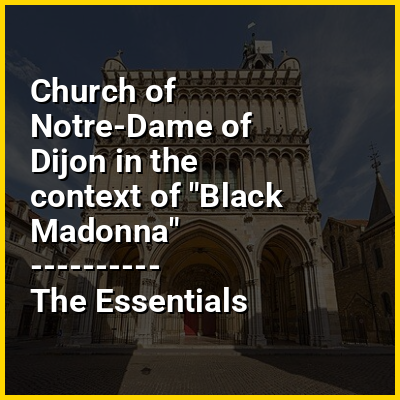
The Church of Notre-Dame of Dijon is a Roman Catholic church in Dijon. Considered a masterpiece of 13th-century Gothic architecture, it is situated at the heart of the preserved old centre of the city. It is located in Place Notre-Dame, near the Palace of the Dukes of Burgundy and opposite the rue Musette.

Work on the church began around 1230.The church contains the statue of Notre-Dame de Bon-Espoir, formerly called the Black Madonna. The church's decorations also include two symbols of Dijon: the jacquemart (bell-striking automaton) and the owl. The church was classified as a Monument Historique in the List of historic monuments of 1840. The chapel of the Assumption, the sacristy, and the gallery that links them have been listed as Monuments Historiques since 5 July 2002.
↓ Menu

In this Dossier

Church of Notre-Dame of Dijon in the context of Jacquemart (bellstriker)

A jacquemart (sometimes jaquemart and also called a quarter-jack) is an automaton, an animated, mechanised figure of a person, usually made from wood or metal, which strikes the hours on a bell with a hammer. Jacquemarts are usually part of clocks or clocktowers, and are often near or at the top of the construction. The figurine is also known as Jack of the Clock or Jack o'Clock.

One of the oldest and best-known jacquemarts is found on the south tower of the cathedral Church of Notre Dame of Dijon: it was installed by Philippe II of Burgundy in 1383. Other well-known historic jacquemarts are found on top of the Zytglogge tower in Bern, Switzerland and the Moors on the Torre dell'Orlogio di San Marco in Venice, Italy.

↑ Return to Menu