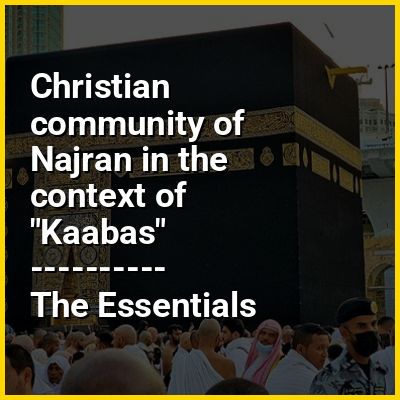
The Christians of Najran were the most notable community of Christians in pre-Islamic Arabia. Christianity appears to have spread into the region by the fifth century, if not earlier. In some Islamic tradition, Najran is thought to have been the site that allowed Christianity to first get a foothold in South Arabia. Najran was the home of several Christian bishops as well, including the legendary Quss Ibn Sa'ida al-Iyadi, a contemporary of and possible influence on Muhammad. Some traditions suggest the existence of a Kaaba of Najran, which had a similar architectural style to the Kaaba of Mecca.
The Christians of Najran are best known for having been persecuted and massacred during the reign of the Jewish Himyarite king, Dhu Nuwas. The outrage that followed in the international Christian community made this what has described as "the most widely broadcast episode of the early sixth century," with the works written on it now forming an important source for the history of the community. The massacre also instigated an invasion of the Himyarite Kingdom by its Christian neighbour, the Ethiopian Aksumite Kingdom, ushering in an era of Christian rule over South Arabia during much of the sixth century. The Christians of Najran persisted, and are said to have sent a delegation that met with the Islamic prophet Muhammad, who allowed them to worship in his mosque, and their interaction is believed to be the occasion in which Surah 112 of the Quran was revealed. The Quranic story of the People of the Ditch in Surah 85 is also often interpreted as recounting the massacre of Najran's Christians.