Chincoteague pony in the context of Chincoteague Fire Department


Chincoteague pony in the context of Chincoteague Fire Department

⭐ Core Definition: Chincoteague pony

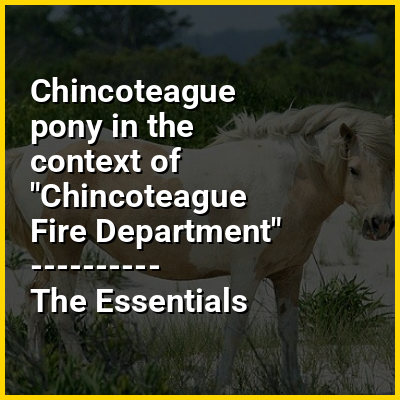
The Chincoteague pony, also known as the Assateague horse, is an American feral herd on Assateague Island of Virginia and Maryland. The breed was made famous by the Misty of Chincoteague novels, written by Marguerite Henry, and first published in 1947. Although popularly known as Chincoteague ponies, the feral ponies live on Assateague Island which is owned by the US government and is split by a fence at the Maryland–Virginia state line. A herd of around 150 ponies are maintained on the Virginia side of the fence, and 80 on the Maryland side.

The two herds are managed by separate agencies. The Maryland herd (referred to in the literature of the National Park Service as Assateague horses) live within Assateague Island National Seashore. They are generally treated as wild animals, given no more or less assistance than any other species on the island, other than contraceptive treatments to curb overpopulation. Conversely, the Virginia herd (referred to as Chincoteague ponies) live within the Chincoteague National Wildlife Refuge and are owned by the Chincoteague Volunteer Fire Company. The Virginia ponies are treated to twice-yearly veterinary inspections, which prepare them for life among the domestic equine population if they are sold at auction. While only around 300 feral ponies live on Assateague Island, around 1,000 more live off-island, having been purchased or bred by private owners.
↓ Menu
HINT:

In this Dossier

Chincoteague pony in the context of Feral horse

A feral horse is a free-roaming horse of domesticated stock. As such, a feral horse is not a wild animal in the sense of an animal without domesticated ancestors. However, some populations of feral horses are managed as wildlife, and these horses often are popularly called "wild" horses. Feral horses are descended from domestic horses that strayed, escaped, or were deliberately released into the wild and remained to survive and reproduce there. Away from humans, over time, these animals' patterns of behavior revert to behavior more closely resembling that of wild horses. Some horses that live in a feral state but may be occasionally handled or managed by humans, particularly if privately owned, are referred to as "semi-feral".

Feral horses live in groups called a herd, band, harem, or mob. Feral horse herds, like those of wild horses, are usually made up of small harems led by a dominant mare, containing additional mares, their foals, and immature horses of both sexes. There is usually one herd stallion, though occasionally a few less-dominant males may remain with the group. Horse "herds" in the wild are best described as groups of several small bands who share the same territory. Bands are normally on the small side, as few as three to five animals, but sometimes over a dozen. The makeup of bands shift over time as young animals are driven out of the band they were born into and join other bands, or as young stallions challenge older males for dominance. However, in a closed ecosystem (such as the isolated refuges in which most feral horses live today), to maintain genetic diversity, the minimum size for a sustainable free-roaming horse or burro population is 150–200 animals.

View the full Wikipedia page for Feral horse
↑ Return to Menu