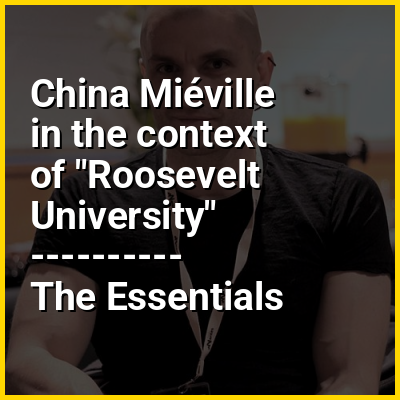
China Miéville in the context of Roosevelt University


China Miéville in the context of Roosevelt University

⭐ Core Definition: China Miéville

China Tom Miéville FRSL (/miˈvəl/ mee-AY-vəl, born 6 September 1972) is a British speculative fiction writer and literary critic. He often describes his work as "weird fiction", and is allied to the loosely associated movement of writers called New Weird.

Miéville has won multiple awards for his fiction, including the Arthur C. Clarke Award, British Fantasy Award, BSFA Award, Hugo Award, Locus Award, and World Fantasy Awards. He holds the record for the most Arthur C. Clarke Award wins (three). His novel Perdido Street Station was ranked by Locus as the 6th best fantasy novel published in the 20th century. During 2012–13, he was writer-in-residence at Roosevelt University in Chicago. He became a Fellow of the Royal Society of Literature in 2015.
↓ Menu
HINT:

In this Dossier

China Miéville in the context of Weird fiction

Weird fiction is a subgenre of speculative fiction originating in the late 19th and early 20th centuries. Weird fiction either eschews or radically reinterprets traditional antagonists of supernatural horror fiction, such as ghosts, vampires, and werewolves. Writers on the subject of weird fiction, such as China Miéville, sometimes use "the tentacle" to represent this type of writing. The tentacle is a limb-type absent from most of the monsters of European Gothic fiction, but often attached to the monstrous creatures created by weird fiction writers, such as William Hope Hodgson, M. R. James, Clark Ashton Smith, and H. P. Lovecraft.

Weird fiction often attempts to inspire awe as well as fear in response to its fictional creations, causing commentators like Miéville to paraphrase Goethe in saying that weird fiction evokes a sense of the numinous. Although "weird fiction" has been chiefly used as a historical description for works through the 1930s, it experienced a resurgence in the 1980s and 1990s, under the label of New Weird, which continues into the 21st century.

View the full Wikipedia page for Weird fiction
↑ Return to Menu

China Miéville in the context of New weird

The new weird is a literary genre that emerged in the 1990s through early 2000s with characteristics of weird fiction and other speculative fiction subgenres. M. John Harrison is credited with creating the term "New Weird" in the introduction to The Tain in 2002. The writers involved are mostly novelists who are considered to be part of the horror or speculative fiction genres but who often cross genre boundaries. Notable authors include K. J. Bishop, Paul Di Filippo, M. John Harrison, Jeffrey Ford, Storm Constantine, China Miéville, Alastair Reynolds, Justina Robson, Steph Swainston, Mary Gentle, Alistair Rennie, Michael Cisco, Jeff VanderMeer and Conrad Williams. The movement was further defined and cataloged in 2008 with the publication of The New Weird, an anthology edited by Ann and Jeff VanderMeer that compiled seminal stories and essays from the genre's proponents.

View the full Wikipedia page for New weird
↑ Return to Menu