Charles Pratt, 1st Earl Camden in the context of Her Majesty's Most Honourable Privy Council


Charles Pratt, 1st Earl Camden in the context of Her Majesty's Most Honourable Privy Council

⭐ Core Definition: Charles Pratt, 1st Earl Camden

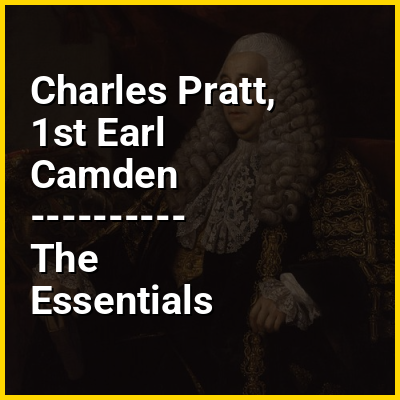
Charles Pratt, 1st Earl Camden, PC (baptised 21 March 1714 – 18 April 1794) was an English lawyer, judge and Whig politician who was first to hold the title of Earl Camden. As a lawyer and judge he was a leading proponent of civil liberties, championing the rights of the jury, and limiting the powers of the State in leading cases such as Entick v Carrington.

He held the offices of Chief Justice of the Common Pleas, Attorney-General and Lord High Chancellor of Great Britain, and was a confidant of Pitt the Elder, supporting Pitt in the controversies over John Wilkes and American independence. However, he clung to office himself, even when Pitt was out of power, serving in the cabinet for fifteen years and under five different prime ministers.

↓ Menu
HINT:

In this Dossier

Charles Pratt, 1st Earl Camden in the context of No taxation without representation

"No taxation without representation" is a political slogan that originated in the American Revolution, and which expressed one of the primary grievances of the American colonists for Great Britain. In short, many colonists believed that as they were not represented in the distant British parliament, any taxes it imposed on the colonists (such as the Stamp Act and the Townshend Acts) were unconstitutional and were a denial of the colonists' rights as Englishmen since Magna Carta.

The firm belief that the government should not tax a populace unless that populace is represented in some manner in the government developed in the English Civil War, following the refusal of parliamentarian John Hampden to pay ship money tax. In the context of British taxation of its American colonies, the slogan "No taxation without representation" appeared for the first time in a headline of a February 1768 London Magazine printing of Lord Camden's "Speech on the Declaratory Bill of the Sovereignty of Great Britain over the Colonies," which was given in parliament. The British government argued for virtual representation, the idea that people were represented by members of Parliament even if they didn't have any recourse to remove then if they were unsatisfied with the representation, i.e. through elections.

View the full Wikipedia page for No taxation without representation
↑ Return to Menu

Charles Pratt, 1st Earl Camden in the context of Camden, New Jersey

Camden is a city in Camden County, in the U.S. state of New Jersey. It is part of the Delaware Valley metropolitan region. The city was incorporated on February 13, 1828. Camden has been the county seat of Camden County since the county's formation on March 13, 1844. The city derives its name from Charles Pratt, 1st Earl Camden. Camden is made up of over 20 neighborhoods. Camden is the second most populous municipality in South Jersey, with a population of 71,791 from the 2020 census and 71,749 from 2024 estimates.

The initial growth of Camden industrially is often credited to the "big three" employers: RCA Victor, Campbell's Soup Company and New York Shipbuilding Corporation. The "big three" felt compelled to move away from Camden in the mid-to-late-20th century as they could find cheaper workers elsewhere. Though the city has declined in recent decades since the decline of heavy industry in the area and white flight to the suburbs, the city has made efforts to revitalize itself through various infrastructure and community projects.

View the full Wikipedia page for Camden, New Jersey
↑ Return to Menu

Charles Pratt, 1st Earl Camden in the context of Marquess Camden

Marquess Camden is a title in the Peerage of the United Kingdom. It was created in 1812 for the politician John Pratt, 2nd Earl Camden. The Pratt family descends from Sir John Pratt, Lord Chief Justice from 1718 to 1725. His third son from his second marriage, Sir Charles Pratt, was also a prominent lawyer and politician and served as Lord Chancellor between 1766 and 1770. In 1765 he was raised to the Peerage of Great Britain as Baron Camden, of Camden Place in the County of Kent, and in 1786 he was further honoured when he was created Viscount Bayham, of Bayham Abbey in the County of Kent, and Earl Camden. These titles are also in the Peerage of Great Britain. Lord Camden was married to Elizabeth, daughter of Nicholas Jeffreys, of The Priory, Brecknockshire, in Wales.

Their son, the second Earl, was a politician and notably served as Lord Lieutenant of Ireland and as Lord President of the Council. In 1812 he was created Earl of the County of Brecknock (usually shortened to Earl of Brecknock) and Marquess Camden. His son, the second Marquess, represented Ludgershall, Bath and Dunwich in the House of Commons and also served as Lord Lieutenant of Brecknockshire. In 1835 Lord Camden was called to the House of Lords through a writ of acceleration in his father's junior title of Baron Camden. His son, the third Marquess, briefly sat as a Member of Parliament for Brecon in 1866, before he succeeded his father and took his seat in the House of Lords. On his early death, the titles passed to his three-month-old son, the fourth Marquess. He was notably Lord Lieutenant of Kent from 1905 to 1943. As of 2017 the peerages are held by his grandson, the sixth Marquess, who succeeded his father in 1983.

View the full Wikipedia page for Marquess Camden
↑ Return to Menu

Charles Pratt, 1st Earl Camden in the context of Entick v Carrington

Entick v Carrington [1765] EWHC KB J98 is a leading case in English law and UK constitutional law establishing the civil liberties of individuals and limiting the scope of executive power. The case has also been influential in other common law jurisdictions and was an important motivation for the Fourth Amendment to the United States Constitution. It is famous for the dictum of Lord Camden: "If it is law, it will be found in our books."

View the full Wikipedia page for Entick v Carrington
↑ Return to Menu