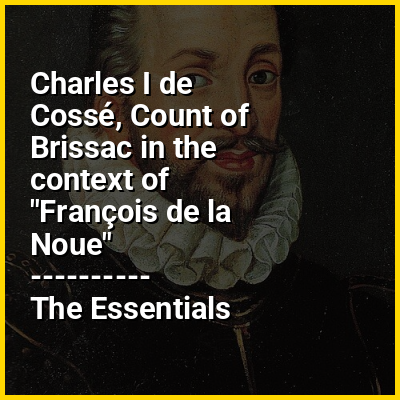
Charles de Cossé, Count of Brissac (1505 (O.S.)/06 – 1563), was a French courtier and soldier, named beau Brissac at court and remembered as the Maréchal Brissac. A member of the nobility of Anjou, he was appointed in 1540 to his father's prestigious former post of Grand Falconer of France, one of the Great Officers of the Maison du Roi. This was not purely honorary, as the king still hunted with falcons. Brissac was also Grand Panetier, and his position as colonel general of the cavalry (1548–49) was a court appointment. Raised to Marshal of France in 1550, he was Grand Master of the Artillery. He was eventually given the title of Count of Brissac. His son, Charles II de Cossé, became the first Duke of Brissac.
HINT:
👉 Charles I de Cossé, Count of Brissac in the context of François de la Noue
François de la Noue (1531 – August 4, 1591), called Bras-de-Fer (Iron Arm), was one of the Huguenot captains of the 16th century. He was born near Nantes in 1531, of an ancient Breton family.
He served in Italy under Marshal Brissac, and in the first Huguenot war, but his first great exploit was the capture of Orléans at the head of only fifteen cavaliers in 1567, during the second war. During the third war, at the battle of Jarnac in March 1569 he commanded the rearguard, and at Moncontour the following October he was taken prisoner; but he was exchanged in time to resume the governorship of Poitou, and to inflict a signal defeat on the royalist troops before Rochefort.