Ceryneian Hind in the context of "Eurystheus"

Play Trivia Questions online!

or

Skip to study material about Ceryneian Hind in the context of "Eurystheus"

Ad spacer

⭐ Core Definition: Ceryneian Hind

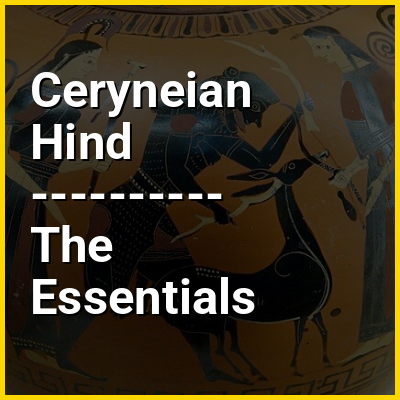
In Greek mythology, the Ceryneian hind (Ancient Greek: Κερυνῖτις ἔλαφος Kerynitis elaphos, Latin: Elaphus Cerynitis), was the enormous hind of Ceryneia, larger than a bull, with golden antlers like a stag, hooves of bronze or brass, and a "dappled hide", that "excelled in swiftness of foot", and snorted fire. To bring her back alive to Eurystheus in Mycenae was the third labour of Heracles.

Other names and descriptions for her were: doe with the golden horns, golden-horned hind, Ceryneia hind, Cerynitian hind, beast with golden antlers, Parrhasian hind, nimble hind of Maenalus and beast of Maenalus. Frazer says that the hind took her name from the river Cerynites, "which rises in Arcadia and flows through Achaia into the sea".
↓ Menu

>>>PUT SHARE BUTTONS HERE<<<
In this Dossier

Ceryneian Hind in the context of Labours of Hercules

The Labours of Hercules or Labours of Heracles (Ancient Greek: ἆθλοι, âthloi, Latin: Labores) are a series of tasks carried out by Heracles, the greatest of the Greek heroes, whose name was later romanised as Hercules. They were accomplished in the service of King Eurystheus. The episodes were later connected by a continuous narrative.

The establishment of a fixed cycle of twelve labours was attributed by the Greeks to an epic poem, now lost, written by Peisander (7th to 6th centuries BC).

↑ Return to Menu

Ceryneian Hind in the context of Ceryneia

Ceryneia or Keryneia (Ancient Greek: Κερύνεια, also Cerynia or Kerynia (Κερυνία), Ceraunia or Keraunia (Κεραυνία), Cerauneia or Kerauneia (Κεραύνεια), Caryneia or Karyneia (Καρύνεια), was a town and polis (city-state) of ancient Achaea. It was not originally one of the 12 Achaean cities, though it afterwards became so, succeeding to the place of Aegae. Its population was increased by a large body of Mycenaeans, when the latter abandoned their city to the Argives in 468 BCE. Ceryneia is mentioned as a member of the Achaean League on its revival in c. 280 BCE; and one of its citizens, Marcus, was chosen in 255 BCE as the first sole General of the League. In the time of Strabo, Ceryneia was dependent upon Aegium. It was situated inland upon a lofty height, west of the river Cerynites (Bokhusia), and a little south of Helice. Theophrastus stated that the wine of Ceryneia produced abortion.

The place is celebrated in Greek mythology as the location of the Ceryneian Hind, the capture of which was one of the Labours of Hercules.

↑ Return to Menu