Centripetal force in the context of "Centrifugal force"

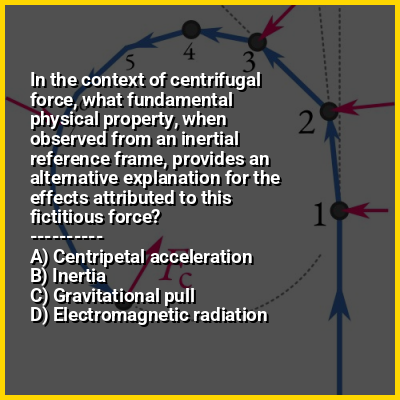
⭐ In the context of centrifugal force, what fundamental physical property, when observed from an inertial reference frame, provides an alternative explanation for the effects attributed to this fictitious force?


⭐ Core Definition: Centripetal force

Centripetal force (from Latin centrum 'center' and petere 'to seek') is the force that makes a body follow a curved path. The direction of the centripetal force is always orthogonal to the motion of the body and towards the fixed point of the instantaneous center of curvature of the path. Isaac Newton coined the term, describing it as "a force by which bodies are drawn or impelled, or in any way tend, towards a point as to a centre". In Newtonian mechanics, gravity provides the centripetal force causing astronomical orbits.

One common example involving centripetal force is the case in which a body moves with uniform speed along a circular path. The centripetal force is directed at right angles to the motion and also along the radius towards the centre of the circular path. The mathematical description was derived in 1659 by the Dutch physicist Christiaan Huygens.
↓ Menu

👉 Centripetal force in the context of Centrifugal force

In Newtonian mechanics, a centrifugal force is a kind of fictitious force (or inertial force) that appears to act on all objects when viewed in a rotating frame of reference. It appears to be directed perpendicularly from the axis of rotation of the frame. The magnitude of the centrifugal force F on an object of mass m at the perpendicular distance ρ from the axis of a rotating frame of reference with angular velocity ω is .

The concept of centrifugal force simplifies the analysis of rotating devices by adopting a co-rotating frame of reference, such as in centrifuges, centrifugal pumps, centrifugal governors, and centrifugal clutches, and in centrifugal railways, planetary orbits and banked curves. The same centrifugal effect observed on rotating devices can be analyzed in an inertial reference frame as a consequence of inertia and the physical forces without invoking a centrifugal force.

↓ Explore More Topics
In this Dossier

Centripetal force in the context of Geocentric orbit

A geocentric orbit, Earth-centered orbit, or Earth orbit involves any object orbiting Earth, such as the Moon or artificial satellites. In 1997, NASA estimated there were approximately 2,465 artificial satellite payloads orbiting Earth and 6,216 pieces of space debris as tracked by the Goddard Space Flight Center. More than 16,291 objects previously launched have undergone orbital decay and entered Earth's atmosphere.

A spacecraft enters orbit when its centripetal acceleration due to gravity is less than or equal to the centrifugal acceleration due to the horizontal component of its velocity. For a low Earth orbit, this velocity is about 7.8 km/s (28,100 km/h; 17,400 mph); by contrast, the fastest crewed airplane speed ever achieved (excluding speeds achieved by deorbiting spacecraft) was 2.2 km/s (7,900 km/h; 4,900 mph) in 1967 by the North American X-15. The energy required to reach Earth orbital velocity at an altitude of 600 km (370 mi) is about 36 MJ/kg, which is six times the energy needed merely to climb to the corresponding altitude.

↑ Return to Menu

Centripetal force in the context of Tidal force

The tidal force or tide-generating force is the difference in gravitational attraction between different points in a gravitational field, causing bodies to be pulled unevenly and as a result are being stretched towards the attraction. It is the differential force of gravity, the net between gravitational forces, the derivative of gravitational potential, the gradient of gravitational fields. Therefore tidal forces are a residual force, a secondary effect of gravity, highlighting its spatial elements, making the closer near-side more attracted than the more distant far-side.

This produces a range of tidal phenomena, such as ocean tides. Earth's tides are mainly produced by the relative close gravitational field of the Moon and to a lesser extent by the stronger, but further away gravitational field of the Sun. The ocean on the side of Earth facing the Moon is being pulled by the gravity of the Moon away from Earth's crust, while on the other side of Earth there the crust is being pulled away from the ocean, resulting in Earth being stretched, bulging on both sides, and having opposite high-tides. Tidal forces viewed from Earth, that is from a rotating reference frame, appear as centripetal and centrifugal forces, but are not caused by the rotation.

↑ Return to Menu

Centripetal force in the context of Circular orbit

A circular orbit is an orbit with a fixed distance around the barycenter; that is, in the shape of a circle.In this case, not only the distance, but also the speed, angular speed, potential and kinetic energy are constant. There is no periapsis or apoapsis. This orbit has no radial version.

Listed below is a circular orbit in astrodynamics or celestial mechanics under standard assumptions. Here the centripetal force is the gravitational force, and the axis mentioned above is the line through the center of the central mass perpendicular to the orbital plane.

↑ Return to Menu

Centripetal force in the context of Women's lacrosse

Women's lacrosse (or girls' lacrosse), sometimes shortened to lax, is a field sport played at the international level with two opposing teams of ten players each (12 players per team at the U.S. domestic level). Originally played by indigenous peoples of the Americas, the modern women's game was introduced in 1890 at the St Leonard's School in St Andrews, Scotland. The rules of women's lacrosse differ significantly from men's field lacrosse. The two are often considered to be different sports with a common root.

The object of the game is to use a long-handled stick (known as a crosse or lacrosse stick) to catch, cradle, and pass a solid rubber lacrosse ball in an effort to score by hurling the ball into an opponent's goal. Cradling is a technique of moving the wrists and arms in a semi-circular motion to keep the ball in the pocket of the stick's head using centripetal force. The head of the lacrosse stick has a mesh or leather net strung into it that allows the player to hold the ball. Defensively, the object is to keep the opposing team from scoring and to dispossess them of the ball through the use of stick checking and body positioning. The rules of women's lacrosse are different from the men's lacrosse game. Equipment required to play is also different from the men's. In the United States, women are only required to wear eyewear or lacrosse goggles and a mouth guard. The stick has restrictions too, as it must be a certain length and the pocket must be shallow enough to show the ball above the side when held at eye level.

↑ Return to Menu