A cave monastery is a monastery built in caves, with possible outside facilities. The 3rd-century monk St. Anthony the Great, known as the founder of Christian monasticism, lived in a cave.
- Albania
- Qafthanë Cave Church, cave church near Urakë
- St. Mary's Church, cave church in Maligrad, an island in the Prespa lake
- Armenia
- Geghard cave monastery/fortress
- Bosnia and Herzegovina
- Bulgaria
- Aladzha Monastery
- Albotin Monastery
- Basarbovo Monastery
- Rock-hewn Churches of Ivanovo
- Cave monasteries of Krepcha
- Monasteries of Provadia
- Cave monasteries on the Plateau of Shumen
- Cave monasteries of Tervel
- Egypt
- St. Simon the Tanner Monastery
- Ethiopia
- France
- Georgia
- David Gareja monastery complex
- Vanis Kvabebi cave monastery/fortress, Javakheti Plateau
- Vardzia cave city and monastery
- Greece
- various cave hermitages at Meteora
- various cave hermitages at Mount Athos
- caves at Karoulia
- Monastery of Saint Mark, Petroussa
- Hungary
- Gellért Hill Cave chapels and monastery, Budapest
- Iraq
- Rabban Hormizd Monastery, Alqosh
- Mar Qayuma Monastery, Dooreh
- Israel
- Qumran Caves, once inhabited by the Essenes
- Montenegro
- North Macedonia
- Romania
- Russia
- Serbia
- Blagoveštenje
- Crna Reka
- Gornjak
- Kađenica
- Churches of Kovilje Monastery
- Church of Sts. Peter and Paul, also known as the Cave Church, 14th-century church in Lukovo
- Church of Sts. Peter and Paul, in Rsovci, where was painted a unique fresco of bald Jesus
- Hermitage of St. Peter Koriški
- Savina
- Thailand
- Wat Tham Khan, Sakon Nakhon province
- Tiger Cave Temple (Wat Tam Sua), Krabi
- Turkey
- Cappadocia cave monasteries
- Cave monastery of İnceğiz
- Church of Saint Peter
- Ukraine
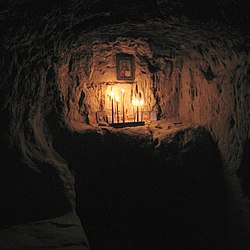
A cell in the caves of the Kytaiv Monastery - Bakhchysarai Cave Monastery in Crimea
- Chelter-Koba in Crimea
- Chylter-Marmara in Crimea
- Inkerman Cave Monastery in Crimea
- Assumption Cave Monastery in Zymne, Volyn Oblast
- Bakota Cave Monastery in Bakota, Khmelnytskyi Oblast
- Kachi-Kalon in Crimea
- Kyiv Pechersk Lavra (Near and Far Caves) in Kyiv
- Kytaiv Monastery in Kyiv
- Shuldan in Crimea
- Sviatohirsk Lavra in Sviatohirsk, Donetsk Oblast
- Yeletskyi Monastery (Saint Anthony's Caves) in Chernihiv
