Causes of climate change in the context of "Logarithmic growth"

Play Trivia Questions online!

or

Skip to study material about Causes of climate change in the context of "Logarithmic growth"

Ad spacer

⭐ Core Definition: Causes of climate change

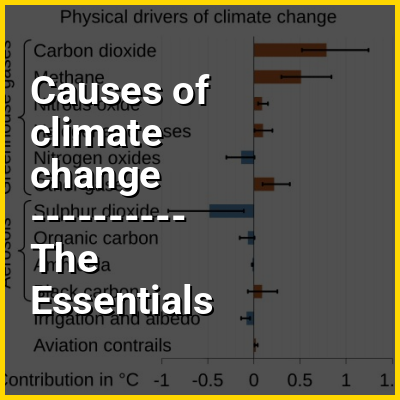
The scientific community has been investigating the causes of current climate change for decades. After thousands of studies, the scientific consensus is that it is "unequivocal that human influence has warmed the atmosphere, ocean and land since pre-industrial times." This consensus is supported by around 200 scientific organizations worldwide. The scientific principle underlying current climate change is the greenhouse effect, which provides that greenhouse gases pass sunlight that heats the earth, but trap some of the resulting heat that radiates from the planet's surface. Large amounts of greenhouse gases such as carbon dioxide and methane have been released into the atmosphere through burning of fossil fuels since the industrial revolution. Indirect emissions from land use change, emissions of other greenhouse gases such as nitrous oxide, and increased concentrations of water vapor in the atmosphere, also contribute to climate change.

The warming from the greenhouse effect has a logarithmic relationship with the concentration of greenhouse gases. This means that every additional fraction of CO2 and the other greenhouse gases in the atmosphere has a slightly smaller warming effect than the fractions before it as the total concentration increases. However, only around half of CO2 emissions continually reside in the atmosphere in the first place, as the other half is quickly absorbed by carbon sinks in the land and oceans. Further, the warming per unit of greenhouse gases is also affected by feedbacks, such as the changes in water vapor concentrations or Earth's albedo (reflectivity).
↓ Menu

>>>PUT SHARE BUTTONS HERE<<<
In this Dossier

Causes of climate change in the context of Carbon dioxide in the atmosphere of Earth

In the atmosphere of Earth, carbon dioxide is a trace gas that plays an integral part in the greenhouse effect, carbon cycle, photosynthesis, and oceanic carbon cycle. It is one of three main greenhouse gases in the atmosphere of Earth. The concentration of carbon dioxide (CO2) in the atmosphere reached 427 ppm (0.0427%) on a molar basis in 2024, representing 3341 gigatonnes of CO2. This is an increase of 50% since the start of the Industrial Revolution, up from 280 ppm during the 10,000 years prior to the mid-18th century. The increase is due to human activity.

The current increase in CO2 concentrations is primarily driven by the burning of fossil fuels. Other significant human activities that emit CO2 include cement production, deforestation, and biomass burning. The increase in atmospheric concentrations of CO2 and other long-lived greenhouse gases such as methane increase the absorption and emission of infrared radiation by the atmosphere. This has led to a rise in average global temperature and ocean acidification. Another direct effect is the CO2 fertilization effect. The increase in atmospheric concentrations of CO2 causes a range of further effects of climate change on the environment and human living conditions.

↑ Return to Menu

Causes of climate change in the context of Climate change denial

Climate change denial (also global warming denial) is a form of science denial characterized by rejecting, refusing to acknowledge, disputing, or fighting the scientific consensus on climate change, which is based on extensive and diverse evidence. Those promoting denial commonly use rhetorical tactics to give the appearance of a scientific controversy where none exists. Climate change denial includes raising unreasonable doubts about the extent to which climate change is caused by humans, its effects on nature and human society, and understating the costs of climate change adaptation while overstating the costs of mitigating it. To a lesser extent, climate change denial can also be implicit when people accept the science but fail to reconcile it with their belief or action. Several studies have analyzed these positions as forms of denialism, pseudoscience, or propaganda.

Many issues that are settled in the scientific community, such as human responsibility for climate change, remain the subject of politically or economically motivated attempts to downplay, dismiss or deny them—an ideological phenomenon academics and scientists call climate change denial. Climate scientists, especially in the United States, have reported government and oil-industry pressure to censor or suppress their work and hide scientific data, with directives not to discuss the subject publicly. The fossil fuels lobby has been identified as overtly or covertly supporting efforts to undermine or discredit the scientific consensus on climate change.

↑ Return to Menu

Causes of climate change in the context of Sustainable food system

A sustainable food system is a type of food system that provides healthy food to people and creates sustainable environmental, economic, and social systems that surround food. Sustainable food systems start with the development of sustainable agricultural practices, development of more sustainable food distribution systems, creation of sustainable diets, and reduction of food waste throughout the system. Sustainable food systems have been argued to be central to many or all 17 Sustainable Development Goals.

Moving to sustainable food systems, including via shifting consumption to sustainable diets, is an important component of addressing the causes of climate change and adapting to it. A 2020 review conducted for the European Union found that up to 37% of global greenhouse gas emissions could be attributed to the food system, including crop and livestock production, transportation, changing land use (including deforestation), and food loss and waste. A different, more recent study in 2023 aimed to estimate the land footprint associated with food loss worldwide concluded an average of 69 million hectares per year.Reduction of meat production, which accounts for ~60% of greenhouse gas emissions and ~75% of agriculturally used land, is one major component of this change.

↑ Return to Menu