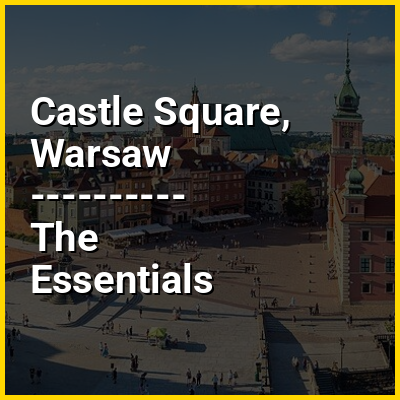
Castle Square (Polish: plac Zamkowy, pronounced [ˈplat͡s zamˈkɔ.vɘ]) is a historic square in front of the Royal Castle – the former official residence of Polish monarchs – located in Warsaw, Poland. It is a popular meeting place for tourists and locals. The square, of somewhat triangular shape, features the landmark Sigismund's Column to the south-west, and is surrounded by historic townhouses. It marks the beginning of the bustling Royal Route extending to the south.
HINT:
In this Dossier
- ⭐ Core Definition: Castle Square, Warsaw
- Castle Square, Warsaw in the context of Royal Castle, Warsaw
- Castle Square, Warsaw in the context of Krakowskie Przedmieście
- Castle Square, Warsaw in the context of Royal Route, Warsaw
- Castle Square, Warsaw in the context of Sigismund's Column
Castle Square, Warsaw in the context of Royal Castle, Warsaw
The Royal Castle in Warsaw (Polish: Zamek Królewski w Warszawie [ˈzamɛk kruˈlɛfskʲi v varˈʂavjɛ]) is a state museum and a national historical monument, which formerly served as the official royal residence of several Polish monarchs. The personal offices of the king and the administrative offices of the royal court were located in the Castle from the 16th century until the final partition of Poland in 1795. Situated in the Castle Square, at the entrance to the Old Town, the Royal Castle holds a significant collection of Polish and European art.
The Royal Castle witnessed many notable events in Poland's history; the Constitution of 3 May 1791, first of its type in Europe and the world's second-oldest codified national constitution, was drafted here by the Four-Year Parliament. The edifice was redesigned into a neoclassical style following the partitions of Poland. Under the Second Polish Republic (1918–1939), it was the seat of the Polish head of state and president. The Second World War brought complete destruction to the building; in September 1939 it was targeted and ignited by Luftwaffe fighter aircraft, and then detonated by the Nazis after the failed Warsaw Uprising in 1944.
View the full Wikipedia page for Royal Castle, WarsawCastle Square, Warsaw in the context of Krakowskie Przedmieście
Krakowskie Przedmieście (Polish) (Polish pronunciation: [kraˈkɔfskʲɛ pʂɛdˈmjɛɕt͡ɕɛ] , lit. 'Kraków Fore-town') is one of the best knownstreets of Poland's capital Warsaw, surrounded by historic palaces, churches and manor-houses. It constitutes the northernmost part of Warsaw's Royal Route, and links the Old Town and Royal Castle (at Castle Square) with some of the most notable institutions in Warsaw, including, proceeding southward, the Presidential Palace, Warsaw University, and the Polish Academy of Sciences headquartered in the Staszic Palace. The immediate southward extension of the street along the Royal Route is New World Street.
Several other Polish cities also have streets named Krakowskie Przedmieście. In Lublin, it is the main and most elegant street. Other cities include Piotrków Trybunalski, Bochnia, Krasnystaw, Olkusz, Sieradz and Wieluń.
View the full Wikipedia page for Krakowskie PrzedmieścieCastle Square, Warsaw in the context of Royal Route, Warsaw
The Royal Route (Polish: Trakt Królewski, IPA: [ˈtrakt kruˈlɛfskʲi]) in Warsaw, Poland, is a former communication route that led southward from the city's Old Town. It now comprises a series of connecting Warsaw streets that feature a number of historic landmarks.
The Royal Route begins at Warsaw's Castle Square and runs south down Krakowskie Przedmieście (Kraków Suburb Street), ulica Nowy Świat (New World Street), Aleje Ujazdowskie (Ujazdów Avenue), ulica Belwederska (Belweder Street) and ulica Sobieskiego (Sobieski Street), finally to arrive at Wilanów Palace, King John III Sobieski's personal residence.
View the full Wikipedia page for Royal Route, WarsawCastle Square, Warsaw in the context of Sigismund's Column
Sigismund's Column (Polish: Kolumna Zygmunta), originally erected in 1644, is located at Castle Square, Warsaw, Poland and is one of Warsaw's most famous landmarks as well as the first secular monument in the form of a column in modern history. The column and statue commemorate King Sigismund III Vasa, who in 1596 had moved Poland's capital from Kraków to Warsaw. It is part of the Historic Centre of Warsaw, which was designated a UNESCO World Heritage Site in 1980.
On the Corinthian column which used to be of red marble and is 8.5 m (28 ft) tall, a sculpture of the king, 2.75 m (9 ft) tall, in archaized armour is placed. Sigismund's Column now stands at 22 m (72 ft) and is adorned by four eagles. The king is dressed in armour, carries a cross in one hand and wields a sword in the other.
View the full Wikipedia page for Sigismund's Column