Caspians in the context of "Onomastics"

Play Trivia Questions online!

or

Skip to study material about Caspians in the context of "Onomastics"

Ad spacer

⭐ Core Definition: Caspians

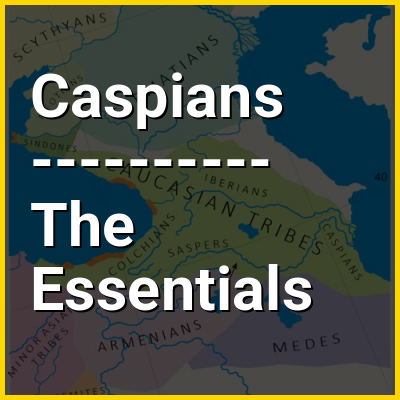
The Caspians (Persian: کاسپی‌ها, Kaspyn; Greek: Κάσπιοι, Káspioi; Aramaic: ܟܣܦܝ, kspy; Old Armenian: Կասպք, Kaspk’; Latin: Caspi, Caspiani) were an people of antiquity who dwelt along the southwestern shores of the Caspian Sea, in the region known as Caspiane. Caspian is the English version of the Greek ethnonym Kaspioi, mentioned twice by Herodotus among the Achaemenid satrapies of Darius the Great and applied by Strabo. The name is not attested in Old Iranian.

The Caspians have generally been regarded as a pre-Indo-European people. They have been identified by Ernst Herzfeld with the Kassites, who spoke a language not identified with any other known language group and whose origins have long been the subject of debate. Onomastic evidence bearing on this point has been discovered in Aramaic papyri from Egypt published by P. Grelot, in which several of the Caspian names that are mentioned—and identified under the gentilic כספי kaspai—are, in part, etymologically Iranian. The Caspians of the Egyptian papyri are therefore generally considered as either an Iranian people or strongly under Iranian cultural influence.
↓ Menu

>>>PUT SHARE BUTTONS HERE<<<
In this Dossier

Caspians in the context of Caspian Sea

The Caspian Sea is the world's largest inland body of water, described as the world's largest lake and usually referred to as a full-fledged sea. An endorheic basin, it is situated in both Europe and Asia: east of the Caucasus, west of the broad steppe of Central Asia, south of the fertile plains of Southern Russia in Eastern Europe, and north of the mountainous Iranian Plateau. It covers a surface area of 371,000 km (143,000 sq mi) (excluding the highly saline lagoon of Garabogazköl to its east), an area approximately equal to that of Japan, with a volume of 78,200 km (19,000 cu mi). It has a salinity of approximately 1.2% (12 g/L), about a third of the salinity of average seawater. It is bounded by Kazakhstan to the northeast, Russia to the northwest, Azerbaijan to the southwest, Iran to the south, and Turkmenistan to the southeast. The name of the Caspian Sea is derived from the ancient Iranic Caspi people.

The lake stretches 1,200 km (750 mi) from north to south, with an average width of 320 km (200 mi). Its gross coverage is 386,400 km (149,200 sq mi) and the surface is about 27 m (89 ft) below sea level. Its main freshwater inflow, Europe's longest river, the Volga, enters at the shallow north end. Two deep basins form its central and southern zones. These lead to horizontal differences in temperature, salinity, and ecology. The seabed in the south reaches 1,023 m (3,356 ft) below sea level, which is the third-lowest natural non-oceanic depression on Earth after Baikal and Tanganyika lakes.

↑ Return to Menu

Caspians in the context of Caspiane

Caspiane or Kaspiane (Greek: Κασπιανή, Armenian: Կասպք Kaspkʿ) was the land populated by the tribe of Caspians, after whom it received its name. Originally a province of the Medes in the 3rd-2nd centuries BC, the land of the Caspians was conquered in the 2nd century BC, then passed to Caucasian Albania under Sassanid Persian suzerainty in the 5th century, and later became an independent state. In the 2nd century AD, it became known as Paytakaran, and after 387 AD became a part of the Caucasian Albanian larger region of Balasakan.It roughly corresponded to the modern Mugan plain and Qaradagh regions.

↑ Return to Menu