Cartesian plane in the context of Coordinate frame


Cartesian plane in the context of Coordinate frame

Cartesian plane Study page number 1 of 1

Play TriviaQuestions Online!

or

Skip to study material about Cartesian plane in the context of "Coordinate frame"


⭐ Core Definition: Cartesian plane

In geometry, a Cartesian coordinate system (UK: /kɑːrˈtzjən/, US: /kɑːrˈtʒən/) in a plane is a coordinate system that specifies each point uniquely by a pair of real numbers called coordinates, which are the signed distances to the point from two fixed perpendicular oriented lines, called coordinate lines, coordinate axes or just axes (plural of axis) of the system. The point where the axes meet is called the origin and has (0, 0) as coordinates. The axes directions represent an orthogonal basis. The combination of origin and basis forms a coordinate frame called the Cartesian frame.

Similarly, the position of any point in three-dimensional space can be specified by three Cartesian coordinates, which are the signed distances from the point to three mutually perpendicular planes. More generally, n Cartesian coordinates specify the point in an n-dimensional Euclidean space for any dimension n. These coordinates are the signed distances from the point to n mutually perpendicular fixed hyperplanes.

↓ Menu
HINT:

In this Dossier

Cartesian plane in the context of Plane (geometry)

In mathematics, a Euclidean plane is a Euclidean space of dimension two, denoted or . It is a geometric space in which two real numbers are required to determine the position of each point. It is an affine space, which includes in particular the concept of parallel lines. It has also metrical properties induced by a distance, which allows to define circles, and angle measurement.

A Euclidean plane with a chosen Cartesian coordinate system is called a Cartesian plane.The set of the ordered pairs of real numbers (the real coordinate plane), equipped with the dot product, is often called the Euclidean plane or standard Euclidean plane, since every Euclidean plane is isomorphic to it.

View the full Wikipedia page for Plane (geometry)
↑ Return to Menu

Cartesian plane in the context of Half-plane

In mathematics, the upper half-plane, is the set of points in the Cartesian plane with The lower half-plane is the set of points with instead. Arbitrarily oriented half-planes can be obtained via a planar rotation. Half-planes are an example of two-dimensional half-space. A half-plane can be split in two quadrants.

View the full Wikipedia page for Half-plane
↑ Return to Menu

Cartesian plane in the context of Hyperbolic angle

In geometry, hyperbolic angle is a real number determined by the area of the corresponding hyperbolic sector of xy = 1 in Quadrant I of the Cartesian plane. Hyperbolic angle is a shuffled form of natural logarithm as they both are defined as an area against hyperbola xy = 1, and they both are preserved by squeeze mappings since those mappings preserve area.

The hyperbola xy = 1 is rectangular with semi-major axis , analogous to the circular angle equaling the area of a circular sector in a circle with radius .

View the full Wikipedia page for Hyperbolic angle
↑ Return to Menu

Cartesian plane in the context of Direct sum

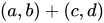
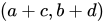
The direct sum is an operation between structures in abstract algebra, a branch of mathematics. It is defined differently but analogously for different kinds of structures. As an example, the direct sum of two abelian groups and is another abelian group consisting of the ordered pairs where and . To add ordered pairs, the sum is defined to be ; in other words, addition is defined coordinate-wise. For example, the direct sum , where is real coordinate space, is the Cartesian plane, . A similar process can be used to form the direct sum of two vector spaces or two modules.

Direct sums can also be formed with any finite number of summands; for example, , provided and are the same kinds of algebraic structures (e.g., all abelian groups, or all vector spaces). That relies on the fact that the direct sum is associative up to isomorphism. That is, for any algebraic structures , , and of the same kind. The direct sum is also commutative up to isomorphism, i.e. for any algebraic structures and of the same kind.

View the full Wikipedia page for Direct sum
↑ Return to Menu

Cartesian plane in the context of 2D geometric model

A 2D geometric model is a geometric model of an object as a two-dimensional figure, usually on the Euclidean or Cartesian plane.

Even though all material objects are three-dimensional, a 2D geometric model is often adequate for certain flat objects, such as paper cut-outs and machine parts made of sheet metal. Other examples include circles used as a model of thunderstorms, which can be considered flat when viewed from above.

View the full Wikipedia page for 2D geometric model
↑ Return to Menu