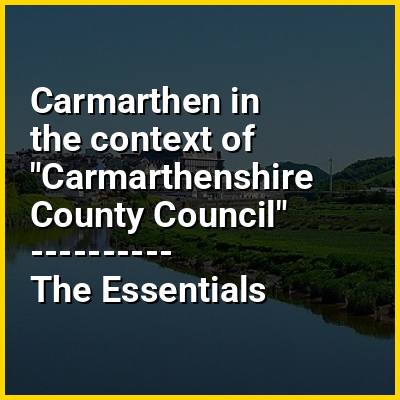
Carmarthen (UK: /kərˈmɑːrðən/ kər-MAR-dhən, locally /kɑːrˈ-/ kar-; Welsh: Caerfyrddin [kaːɨrˈvərðɪn], 'Merlin's fort' or possibly 'Sea-town fort') is the county town of Carmarthenshire and a community in Wales, lying on the River Towy 8 miles (13 km) north of its estuary in Carmarthen Bay. At the 2021 census the community had a population of 14,636, and the built up area had a population of 16,455. It stands on the site of a Roman town, and has a claim to be the oldest town in Wales. In the middle ages it comprised twin settlements: Old Carmarthen around Carmarthen Priory and New Carmarthen around Carmarthen Castle. The two were merged into one borough in 1546. It was the most populous borough in Wales in the 16th–18th centuries, described by William Camden as "chief citie of the country". It was overtaken in size by the mid-19th century, following the growth of settlements in the South Wales Coalfield.
- ⭐ Core Definition: Carmarthen
- Carmarthen in the context of Wales in the Roman era
- Carmarthen in the context of Kingdom of Dyfed
- Carmarthen in the context of Llanelli
- Carmarthen in the context of Carmarthenshire
- Carmarthen in the context of 1966 Carmarthen by-election
- Carmarthen in the context of S4C
- Carmarthen in the context of Dyfed
- Carmarthen in the context of Cantref Gwarthaf (Dyfed)
- Carmarthen in the context of Mark Drakeford
Carmarthen in the context of Wales in the Roman era
The Roman era in the area of modern Wales began in 48 AD, with a military invasion by the imperial governor of Roman Britain. The conquest was completed by 78 AD, and Roman rule endured until the region was abandoned in 383 AD.
The Roman Empire held a military occupation in most of Wales, except for the southern coastal region of South Wales, east of the Gower Peninsula, where there is a legacy of Romanisation in the region, and some southern sites such as Carmarthen, which was the civitas capital of the Demetae tribe. The only town in Wales founded by the Romans, Caerwent, is in South Wales.
View the full Wikipedia page for Wales in the Roman eraCarmarthen in the context of Kingdom of Dyfed
The Kingdom of Dyfed (Welsh pronunciation: ['dəvɛd]), one of several Welsh petty kingdoms that emerged in 5th-century sub-Roman Britain in southwest Wales, was based on the former territory of the Demetae (modern Welsh Dyfed). The royal line was founded by Irish settlers in the 5th century. After the Norman invasion of Wales Dyfed was incorporated into Pembrokeshire. The name was resurrected for the now-defunct administrative area called Dyfed as well as in the names of some regional organisations such as Dyfed–Powys Police.
Dyfed may have originally occupied the area that bordered the rivers Teifi, Gwili and Tywi, and included contemporary Pembrokeshire, the western part of contemporary Carmarthenshire, and with the town of Carmarthen. Dyfed eventually comprised at least seven cantrefi: Cemais, Deugleddyf, Emlyn, Cantref Gwarthaf, Pebidiog, Penfro and Rhos, with an approximate area of about 2,284 square kilometres (882 sq mi).
View the full Wikipedia page for Kingdom of DyfedCarmarthen in the context of Llanelli
Llanelli (Welsh for 'St Elli's Parish'; Welsh: [ɬaˈnɛɬi] ) is a market town and community in Carmarthenshire and the preserved county of Dyfed, Wales. It is on the estuary of the River Loughor and is the largest town in the county of Carmarthenshire.
The town is 11 miles (18 km) north-west of Swansea and 12 miles (19 km) south-east of Carmarthen. At the 2021 census the community had a population of 25,366, and the built up area had a population of 42,155. The local authority was Llanelli Borough Council when the county of Dyfed existed, and it has been under Carmarthenshire County Council since 1996.
View the full Wikipedia page for LlanelliCarmarthen in the context of Carmarthenshire
Carmarthenshire (/kərˈmɑːrðənʃər, -ʃɪər/ kər-MAR-dhən-shər, -sheer; Welsh: Sir Gaerfyrddin [ˈsiːr ɡaːɨrˈvərðɪn] or informally Sir Gâr) is a county in the south-west of Wales. The three largest towns are Llanelli, Carmarthen and Ammanford. Carmarthen is the county town and administrative centre. The county is known as the "Garden of Wales" and is also home to the National Botanic Garden of Wales.
Carmarthenshire has been inhabited since prehistoric times. The county town was founded by the Romans, and the region was part of the Kingdom of Deheubarth in the High Middle Ages. After invasion by the Normans in the 12th and 13th centuries it was subjugated, along with other parts of Wales, by Edward I of England. There was further unrest in the early 15th century, when the Welsh rebelled under Owain Glyndŵr, and during the English Civil War.
View the full Wikipedia page for CarmarthenshireCarmarthen in the context of 1966 Carmarthen by-election
The 1966 Carmarthen by-election, was held in Carmarthen, Wales, on 14 July 1966. The contest was significant in that it resulted in the election of Gwynfor Evans, the first ever Plaid Cymru member of parliament. Plaid Cymru's victory in the Carmarthen constituency, a seminal moment for Welsh nationalism, was part of a wider process toward Welsh devolution which eventually led to the establishment of the Welsh Assembly in 1999.
The election was caused by the death of Labour Party member of parliament Megan Lloyd George.
View the full Wikipedia page for 1966 Carmarthen by-electionCarmarthen in the context of S4C
S4C (Welsh pronunciation: [ˌɛs ˌpɛdwar ˈɛk]; Sianel Pedwar Cymru, lit. 'Channel Four Wales') is a Welsh language free-to-air public broadcast television channel. Launched on 1 November 1982, it was the first television channel to be aimed specifically at a Welsh-speaking audience. S4C's headquarters are based in Carmarthen, at the University of Wales Trinity Saint David's creative and digital centre, Yr Egin. It also has regional offices in Caernarfon and Cardiff. As of 2024, S4C had an average of 118 employees. S4C is the fourth-oldest terrestrial television channel in Wales after BBC One, ITV and BBC Two.
As with Channel 4 (which launched the next day in the rest of the UK), S4C commissions all of its programmes from independent producers. BBC Cymru Wales produces programmes for S4C as part of its public service remit, including the news service Newyddion. From its launch until 2010, S4C also carried English-language programming acquired from Channel 4, which could not be received over-the-air in most of Wales; these programmes aired in non-peak hours and did not always air in pattern with Channel 4's scheduling.
View the full Wikipedia page for S4CCarmarthen in the context of Dyfed
Dyfed (Welsh pronunciation: [ˈdəvɛd]) is a preserved county in southwestern Wales, covering the modern counties Carmarthenshire, Ceredigion and Pembrokeshire. It is mostly rural area with a coastline on the Irish Sea and the Bristol Channel. Between 1974 and 1996, Dyfed was an administrative county of Wales, with its council based at Carmarthen. Dyfed continues to give name to public services including Dyfed-Powys Police and Dyfed Telecom.
View the full Wikipedia page for DyfedCarmarthen in the context of Cantref Gwarthaf (Dyfed)
Cantref Gwarthaf was the largest of the seven cantrefi of Dyfed in southwest Wales. It subsequently became part of Deheubarth in around 950. It consisted of the southeastern part of Dyfed containing most of the basin of the River Tâf, parts of modern-day Pembrokeshire and Carmarthenshire.
The name means "upper-most zone". Its area was about 244 square miles (630 km). Unlike the other Dyfed cantrefi which were divided into two (or fewer) commotes, Cantref Gwarthaf was divided into eight commotes: Amgoed, Derllys, Efelfre, Elfed, Penrhyn, Peuliniog, Talacharn, and Ystlwys. Its civil headquarters were at Carmarthen. Its ecclesiastical centre (and perhaps, in the Age of the Saints, the seat of a bishop) was probably also Carmarthen, although the churches at Llanddowror and Meidrim were also important.
View the full Wikipedia page for Cantref Gwarthaf (Dyfed)Carmarthen in the context of Mark Drakeford
Mark Drakeford (born 19 September 1954) is a Welsh politician who has served as Cabinet Secretary for Finance since September 2024, having previously held the position from 2016 to 2018. He previously served as First Minister of Wales and Leader of Welsh Labour from 2018 to 2024, and as Cabinet Secretary for Health and Social Care from 2013 to 2016, and on an interim basis in 2024. He was first elected as the Member of the Senedd (MS) for Cardiff West in 2011 and is considered to be on the soft left of Labour.
Drakeford was born in Carmarthen in West Wales. He studied Latin at the University of Kent and the University of Exeter. He was a lecturer at the University College of Swansea from 1991 to 1995 and at Cardiff University from 1995 to 1999. He was a Professor of Social Policy and Applied Social Sciences at Cardiff University from 2003 to 2013. Drakeford was elected at the 2011 National Assembly for Wales election for Cardiff West. In 2013, First Minister Carwyn Jones appointed Drakeford to the Welsh Government as Minister for Health and Social Services. He served as Cabinet Secretary for Finance from 2016 to 2018 and as Minister for Brexit from 2017 to 2018. In 2018, he was elected to succeed Jones as Welsh Labour Leader and First Minister.
View the full Wikipedia page for Mark Drakeford