Caribbean region of Colombia in the context of Cartagena de Indias


Caribbean region of Colombia in the context of Cartagena de Indias

⭐ Core Definition: Caribbean region of Colombia

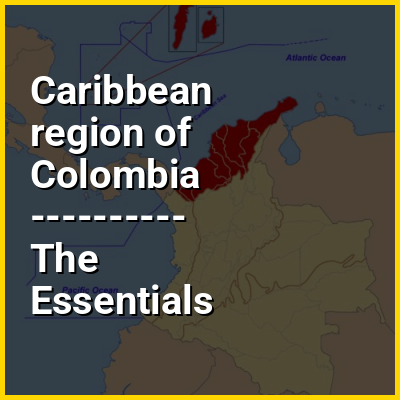
The Caribbean region of Colombia or Colombian Caribbean is the northern, coastal region of Colombia located contiguous to the Caribbean. It is mainly composed of 8 departments. It is the second most populated region in the country after the Andean Region with approximately 11 million residents according to the Colombian Census 2018. The area covers a total land area of 110,000 km (42,000 sq mi), including the Archipelago of San Andrés, Providencia and Santa Catalina in the Caribbean Sea.

The Caribbean region coast extends from the Gulf of Urabá to the Gulf of Venezuela. Straddling the coast are Colombia's two main Atlantic port cities of Barranquilla and Cartagena. The administration of the region is covered by eight department governments: Atlántico, Bolívar, Cesar, Sucre, Córdoba, Magdalena, La Guajira and San Andrés and Providencia. These eight departments also cover approximately 182 municipalities according to the 2018 Census by DANE Colombia. Most of its inhabitants speak a dialect of Caribbean Spanish with variations within its subregions.
↓ Menu
HINT:

In this Dossier

Caribbean region of Colombia in the context of Barranquilla

Barranquilla (/ˌbærəŋˈk(j)ə/; Latin American Spanish: [baraŋˈkiʝa] ) is the capital district of the Atlántico department in Colombia. It is located near the Caribbean Sea and is the largest city and third port in the Caribbean coast region; as of 2018, it had a population of 1,206,319, making it Colombia's fourth-most populous city after Bogotá, Medellín, and Cali.

Barranquilla lies strategically next to the delta of the Magdalena River, 7.5 km (4.7 mi) (originally 25 km (16 mi) before rapid urban growth) from its mouth at the Caribbean Sea, serving as a port for river and maritime transportation within Colombia. It is also the main economic center of the Atlántico department in Colombia. The city is the core of the Barranquilla metropolitan area, with a population of over 2 million, which also includes the municipalities of Soledad, Galapa, Malambo, and Puerto Colombia.

View the full Wikipedia page for Barranquilla
↑ Return to Menu

Caribbean region of Colombia in the context of Cartagena, Colombia

Cartagena (/ˌkɑːrtəˈhɛnə/ KAR-tə-HEN), known since the colonial era as Cartagena de Indias (Spanish: [kaɾtaˈxena ðe ˈindjas] ), is a city and one of the major ports on the northern coast of Colombia in the Caribbean Coast Region, along the Caribbean Sea. Cartagena's past role as a link in the route to the West Indies provides it with important historical value for world exploration and preservation of heritage from the great commercial maritime routes. As a former Spanish colony, it was a key port for the export of Bolivian silver to Spain and for the import of enslaved Africans under the asiento system. It was defensible against pirate attacks in the Caribbean. The city's strategic location between the Magdalena and Sinú rivers also gave it easy access to the interior of New Granada and made it a main port for trade between Spain and its overseas empire, establishing its importance by the early 1540s.

Modern Cartagena is the capital of the Bolívar Department, and had a population of 876,885 according to the 2018 census, making it the second-largest city in the Caribbean region, after Barranquilla, and the fifth-largest city in Colombia. The metropolitan area of Cartagena is the sixth-largest urban area in the country, after metropolitan area of Bucaramanga. Economic activities include the maritime and petrochemical industries, as well as tourism.

View the full Wikipedia page for Cartagena, Colombia
↑ Return to Menu

Caribbean region of Colombia in the context of Caribbean South America

Caribbean South America is a subregion of South America that borders the Caribbean Sea, consisting of the Caribbean region of Colombia and the Venezuelan Caribbean.

Significant cities and metropolitan areas with populations over 250,000 on South America's Caribbean coast include, from west to east: Cartagena (914,552), Barranquilla (2,370,753 metropolitan area), Santa Marta (499,192 district), Maracaibo (5,278,448 metropolitan area), Caracas (8,956,813 metropolitan area), Barcelona (815,141), Puerto La Cruz (454,312), and Cumaná (405,626).

View the full Wikipedia page for Caribbean South America
↑ Return to Menu

Caribbean region of Colombia in the context of Soledad, Atlántico

Soledad (Spanish pronunciation: [soleˈðað]) is a municipality in the Colombian department of Atlántico, part of the Metropolitan area of Barranquilla. It is 6th in population in Colombia and 3rd in the Caribbean region, after Barranquilla and Cartagena. It is also the city with the highest population growth in Colombia and in 2005 was 455,734 and 2019 683,486. On October 29, 2023, Alcira Sandoval Ibañez was elected by popular vote as the new mayor of Soledad.

View the full Wikipedia page for Soledad, Atlántico
↑ Return to Menu

Caribbean region of Colombia in the context of Western Caribbean zone

The western Caribbean zone is a region consisting of the Caribbean coasts of Central America and Colombia, from the Yucatán Peninsula in southern Mexico to the Caribbean region in northern Colombia, and also including the islands west of Jamaica. The zone emerged in the late 16th century as the Spanish failed to completely conquer many sections of the coast, and northern European powers supported opposition to Spain, sometimes through alliances with local powers.

Unsubdued indigenous inhabitants of the region included some Maya polities, and other chiefdoms and egalitarian societies, especially in Belize and along the Mosquitian Shore. In addition, the region was the refuge of several groups of runaway slaves, who formed independent settlements or intermixed with the indigenous societies. The combination of unsubdued indigenous people, outlaws (pirates in this case), and an absence of outside control made it similar in some aspects to the American West or the Wild West, as the western half of North America is often called.

View the full Wikipedia page for Western Caribbean zone
↑ Return to Menu

Caribbean region of Colombia in the context of Natural regions of Colombia

Because of its natural structure, Colombia can be divided into six distinct natural regions. These consist of the Andean Region, covering the three branches of the Andes mountains found in Colombia; the Caribbean Region, covering the area adjacent to the Caribbean Sea; the Pacific Region adjacent to the Pacific Ocean; the Orinoquía Region, part of the Llanos plains mainly in the Orinoco river basin along the border with Venezuela; the Amazon Region, part of the Amazon rainforest; and finally the Insular Region, comprising the islands in both the Atlantic and Pacific Oceans. Colombia is located in South America.

View the full Wikipedia page for Natural regions of Colombia
↑ Return to Menu

Caribbean region of Colombia in the context of Minor C. Keith

Minor Cooper Keith (19 January 1848 – 14 June 1929) was an American businessman whose railroad, commercial agriculture, and cargo liner enterprises had a major impact on the national economies of the Central American countries, as well as on the Caribbean region of Colombia. Keith's work on the Costa Rican railroad to the Caribbean, a project begun by his uncle Henry Meiggs, led him to become involved in the large-scale export of bananas to the United States. In 1899, Keith's banana-trading concerns were absorbed into the powerful United Fruit Company, of which he became vice-president. Keith was also involved in a number of other business ventures, including gold mining in Costa Rica and real estate development in the US.

View the full Wikipedia page for Minor C. Keith
↑ Return to Menu