Canso Causeway in the context of "Trans-Canada Highway"

Play Trivia Questions online!

or

Skip to study material about Canso Causeway in the context of "Trans-Canada Highway"

Ad spacer

⭐ Core Definition: Canso Causeway

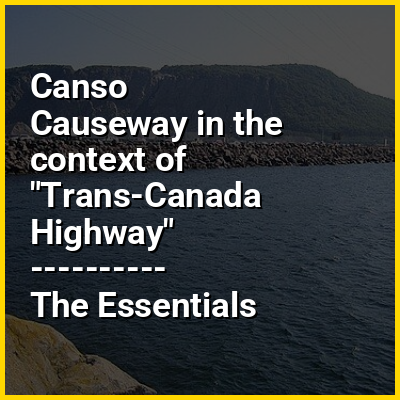
The Canso Causeway (Scottish Gaelic: Cabhsair Chanso)45°38′38″N 61°25′11″W / 45.64389°N 61.41972°W / 45.64389; -61.41972 is a 1,385 m (4,544 ft) rock-fill causeway crossing the Strait of Canso, which provides access by road between Cape Breton Island and the Nova Scotia peninsula.

Its crest thickness is 40 m (130 ft), carrying the two vehicle traffic lanes of the Trans-Canada Highway, Nova Scotia Highway 104 on the mainland side, and Nova Scotia Highway 105 on the Cape Breton side, as well as the single track mainline of the Cape Breton and Central Nova Scotia Railway.
↓ Menu

>>>PUT SHARE BUTTONS HERE<<<
In this Dossier

Canso Causeway in the context of Cape Breton Island

Cape Breton Island (French: île du Cap-Breton, formerly île Royale; Scottish Gaelic: Ceap Breatainn or Eilean Cheap Bhreatainn; Mi'kmaq: Unama'ki) is a rugged and irregularly shaped island on the Atlantic coast of North America and part of the province of Nova Scotia, Canada.

The 10,311 km (3,981 sq mi) island accounts for 18.7% of Nova Scotia's total area. Although the island is physically separated from the Nova Scotia peninsula by the Strait of Canso, the 1,385 m (4,544 ft) long Canso Causeway connects it to mainland Nova Scotia. The island is east-northeast of the mainland with its northern and western coasts fronting on the Gulf of Saint Lawrence with its western coast forming the eastern limits of the Northumberland Strait. The eastern and southern coasts front the Atlantic Ocean with its eastern coast also forming the western limits of the Cabot Strait. Its landmass slopes upward from south to north, culminating in the highlands of its northern cape. A large body of saltwater, the Bras d'Or ("Golden Arm" in French), dominates the island's centre.

↑ Return to Menu