Calorimeter in the context of "Titration"

Play Trivia Questions online!

or

Skip to study material about Calorimeter in the context of "Titration"

Ad spacer

⭐ Core Definition: Calorimeter

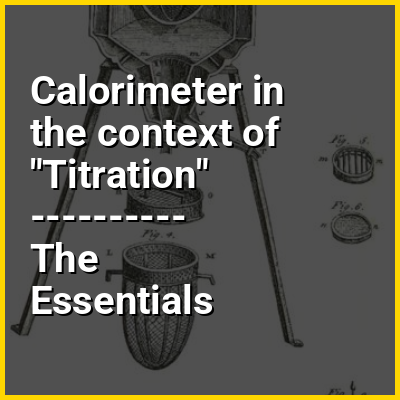
A calorimeter is a device used for calorimetry, or the process of measuring the heat of chemical reactions or physical changes as well as heat capacity. Differential scanning calorimeters, isothermal micro calorimeters, titration calorimeters and accelerated rate calorimeters are among the most common types. A simple calorimeter just consists of a thermometer attached to a metal container full of water suspended above a combustion chamber. It is one of the measurement devices used in the study of thermodynamics, chemistry, and biochemistry.

To find the enthalpy change per mole of a substance A in a reaction between two substances A and B, the substances are separately added to a calorimeter and the initial and final temperatures (before the reaction has started and after it has finished) are noted. Multiplying the temperature change by the mass and specific heat capacities of the substances gives a value for the energy given off or absorbed during the reaction. Dividing the energy change by how many moles of A were present gives its enthalpy change of reaction. where q is the amount of heat according to the change in temperature measured in joules and Cv is the heat capacity of the calorimeter which is a value associated with each individual apparatus in units of energy per temperature (joules/kelvin).

↓ Menu

>>>PUT SHARE BUTTONS HERE<<<
In this Dossier

Calorimeter in the context of Chemical energy

Chemical energy is the energy of chemical substances that is released when the substances undergo a chemical reaction and transform into other substances. Some examples of storage media of chemical energy include batteries, food, and gasoline (as well as oxygen gas, which is of high chemical energy due to its relatively weak double bond and indispensable for chemical-energy release in gasoline combustion). Breaking and re-making chemical bonds involves energy, which may be either absorbed by or evolved from a chemical system. If reactants with relatively weak electron-pair bonds convert to more strongly bonded products, energy is released. Therefore, relatively weakly bonded and unstable molecules store chemical energy.

Energy that can be released or absorbed because of a reaction between chemical substances is equal to the difference between the energy content of the products and the reactants, if the initial and final temperature is the same. This change in energy can be estimated from the bond energies of the reactants and products. It can also be calculated from , the internal energy of formation of the reactant molecules, and , the internal energy of formation of the product molecules. The internal energy change of a chemical process is equal to the heat exchanged if it is measured under conditions of constant volume and equal initial and final temperature, as in a closed container such as a bomb calorimeter. However, under conditions of constant pressure, as in reactions in vessels open to the atmosphere, the measured heat change is not always equal to the internal energy change, because pressure-volume work also releases or absorbs energy. (The heat change at constant pressure is equal to the enthalpy change, in this case the enthalpy of reaction, if initial and final temperatures are equal).

↑ Return to Menu

Calorimeter in the context of Calorimetry

In chemistry and thermodynamics, calorimetry (from Latin calor 'heat' and Greek μέτρον (metron) 'measure') is the science or act of measuring changes in state variables of a body for the purpose of deriving the heat transfer associated with changes of its state due, for example, to chemical reactions, physical changes, or phase transitions under specified constraints. Calorimetry is performed with a calorimeter. Scottish physician and scientist Joseph Black, who was the first to recognize the distinction between heat and temperature, is said to be the founder of the science of calorimetry.

Indirect calorimetry calculates heat that living organisms produce by measuring either their production of carbon dioxide and nitrogen waste (frequently ammonia in aquatic organisms, or urea in terrestrial ones), or from their consumption of oxygen. Lavoisier noted in 1780 that heat production can be predicted from oxygen consumption this way, using multiple regression. The dynamic energy budget theory explains why this procedure is correct. Heat generated by living organisms may also be measured by direct calorimetry, in which the entire organism is placed inside the calorimeter for the measurement.

↑ Return to Menu

Calorimeter in the context of Energetic Gamma Ray Experiment Telescope

The Energetic Gamma Ray Experiment Telescope (EGRET) was one of four instruments outfitted on NASA's Compton Gamma Ray Observatory satellite. Since lower energy gamma rays cannot be accurately detected on Earth's surface, EGRET was built to detect gamma rays while in space. EGRET was created for the purpose of detecting and collecting data on gamma rays ranging in energy level from 30 MeV to 30 GeV.

To accomplish its task, EGRET was equipped with a spark chamber, calorimeter, and plastic scintillator anti-coincidence dome. The spark chamber was used to induce a process called electron-positron pair production as a gamma ray entered the telescope. The calorimeter on the telescope was then used to record the data from the electron or positron. To reject other energy rays that would skew the data, scientists covered the telescope with a plastic scintillator anti-coincidence dome. The dome acted as a shield for the telescope and blocked out any unwanted energy rays.

↑ Return to Menu