Cabinet of curiosities in the context of Science


Cabinet of curiosities in the context of Science

⭐ Core Definition: Cabinet of curiosities

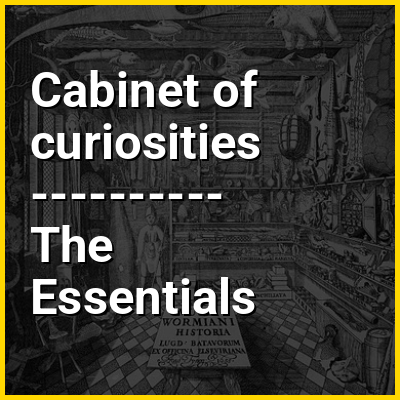
Cabinets of curiosities (German: Kunstkammer [ˈkʊnstˌkamɐ] and Kunstkabinett [ˈkʊnstkabiˌnɛt]), also known as wonder-rooms (German: Wunderkammer [ˈvʊndɐˌkamɐ] ), were encyclopedic collections of objects whose categorical boundaries were, in Renaissance Europe, yet to be defined. Although more rudimentary collections had preceded them, the classic cabinets of curiosities emerged in the sixteenth century. The term cabinet originally described a room rather than a piece of furniture. Modern terminology would categorize the objects included as belonging to natural history (sometimes faked), geology, ethnography, archaeology, religious or historical relics, works of art (including cabinet paintings), and antiquities. In addition to the most famous and best documented cabinets of rulers and aristocrats, members of the merchant class and early practitioners of science in Europe formed collections that were precursors to museums.

Cabinets of curiosities served not only as collections to reflect the particular interests of their curators but also as social devices to establish and uphold rank in society. There are said to be two main types of cabinets. As R. J. W. Evans notes, there could be "the princely cabinet, serving a largely representational function, and dominated by aesthetic concerns and a marked predilection for the exotic," or the less grandiose, "the more modest collection of the humanist scholar or virtuoso, which served more practical and scientific purposes." Evans goes on to explain that "no clear distinction existed between the two categories: all collecting was marked by curiosity, shading into credulity, and by some sort of universal underlying design".
↓ Menu
HINT:

In this Dossier

Cabinet of curiosities in the context of Museum

A museum is an institution dedicated to displaying and preserving culturally or scientifically significant objects. Many museums have exhibitions of these objects on public display, and some have non-exhibited collections that are used by researchers and specialists. Museums host a much wider range of objects than a library, and they usually focus on a specific theme, such as the arts, science, natural history or local history. Museums that host exhibitions and interactive demonstrations are often tourist attractions, and many draw large numbers of visitors from outside of their host country, with the most visited museums in the world attracting millions of visitors annually.

Since the establishment of the earliest known museum in ancient times, museums have been associated with academia and the preservation of rare items. Museums originated as private collections of interesting items, and not until much later did the emphasis on educating the public take root.

View the full Wikipedia page for Museum
↑ Return to Menu

Cabinet of curiosities in the context of Antiquarian

An antiquarian or antiquary (from Latin antiquarius 'pertaining to ancient times') is an aficionado or student of antiquities or things of the past. More specifically, the term is used for those who study history with particular attention to ancient artefacts, archaeological and historic sites, or historic archives and manuscripts. The essence of antiquarianism is a focus on the empirical evidence of the past, and is perhaps best encapsulated in the motto adopted by the 18th-century antiquary Sir Richard Colt Hoare, "We speak from facts, not theory."

The Oxford English Dictionary first cites "archaeologist" from 1824; this soon took over as the usual term for one major branch of antiquarian activity. "Archaeology", from 1607 onwards, initially meant what is now seen as "ancient history" generally, with the narrower modern sense first seen in 1837.

View the full Wikipedia page for Antiquarian
↑ Return to Menu

Cabinet of curiosities in the context of Ashmolean Museum

The Ashmolean Museum of Art and Archaeology (/æʃˈmliən, ˌæʃməˈlən/) on Beaumont Street in Oxford, England, is Britain's first public museum. Its first building was erected in 1678–1683 to house the cabinet of curiosities that Elias Ashmole gave to the University of Oxford in 1677. It is also the world's second university museum, after the establishment of the Kunstmuseum Basel in 1661 by the University of Basel.

The present building was built between 1841 and 1845. The museum reopened in 2009 after a major redevelopment, and in November 2011, new galleries focusing on Egypt and Nubia were unveiled. In May 2016, the museum redisplayed galleries of 19th-century art.

View the full Wikipedia page for Ashmolean Museum
↑ Return to Menu

Cabinet of curiosities in the context of Cabinet painting

A cabinet painting (or cabinet picture) is a small painting, typically no larger than two feet (0.61 meters) in either dimension, but often much smaller. The term is especially used for paintings that show full-length figures or landscapes at a small scale, rather than a head or other object painted nearly life-size. Such paintings are done very precisely, with a great degree of "finish".

From the fifteenth century onward, wealthy collectors of art would keep these paintings in a cabinet, which was a relatively small and private room (often very small even in large houses) to which only those with whom they were on especially intimate terms would be admitted. A cabinet, also known as a closet, study (from the Italian studiolo), office, or by other names, might be used as an office or just a sitting room. Heating the main rooms in large palaces or mansions in the winter was difficult, so small rooms such as cabinets were more comfortable. They offered more privacy from servants or other household members and visitors. Typically, a cabinet would be for the use of a single individual; a large house might have at least two (his and hers) and often more.

View the full Wikipedia page for Cabinet painting
↑ Return to Menu

Cabinet of curiosities in the context of Frans II Francken

Frans Francken the Younger (1581, Antwerp – 6 May 1642, Antwerp) was a Flemish painter and the best-known and most prolific member of the large Francken family of artists. He painted large altarpieces for churches as well as smaller historical, mythological and allegorical scenes. His depictions of collectors' cabinets established a popular new genre of art in the era. Francken often collaborated with other artists, adding figures and narrative elements to scenes created by specialists in landscape, architectural and floral still life paintings.

View the full Wikipedia page for Frans II Francken
↑ Return to Menu